Founders planning MVP costs with charts, code, and development workspace

MVP Development Cost in 2026: A Founder's Guide to Budgeting, Pricing Models, and Hidden Expenses

This article breaks down what it actually costs to build a Minimum Viable Product in today's market, from team rates and tech stack choices to pricing models and hidden line items. You'll get realistic numbers for different MVP types and a practical way to budget without burning your runway.

Content authorNikita SivtsovPublished onReading time12 min read

What an MVP actually is

An MVP is a learning tool; Eric Ries, who popularized the term in The Lean Startup, defined it as "that version of a new product which allows a team to collect the maximum amount of validated learning about customers with the least effort." The point is learning.

Dropbox is the textbook case. Drew Houston didn't build a full sync engine before testing demand. He recorded a three-minute explainer video showing how the product would work and posted it to Hacker News in 2007. The waiting list jumped from 5,000 to 75,000 overnight, which told him the hypothesis was right before he wrote a single line of production code.

Airbnb went a different route. Brian Chesky and Joe Gebbia rented three air mattresses in their San Francisco living room during a sold-out design conference and charged $80 a night. The "product" was a single-page site and a PayPal button. Three guests booked. That was enough signal to keep going. Both stories matter for the MVP development cost discussion because they show the cheapest MVP is the one that proves or kills your assumption fastest.

What drives MVP development cost

The MVP development cost for the same idea can swing from $15,000 to well over $150,000 based on a handful of choices you make before anyone writes code. SoftTeco's 2025 analysis puts the typical range at $15,000 to $150,000+, and the variance is almost entirely driven by scope, team, stack, and design. Founders who understand these levers stop asking "how much does it cost to build an MVP" as a single question and start asking it per decision.

The sections below walk through each driver. Treat them as dials you can turn, because every one of them shifts the final number in a real way.

Scope and feature set

Feature scope is the single biggest cost lever. A tightly scoped MVP with three core features, such as sign-up and one main workflow supported by a basic dashboard, costs a fraction of one with ten. Each added feature compounds because it needs design, backend, frontend, QA, and edge-case handling. Triple the features and the MVP development cost doesn't triple. You roughly quadruple it once integration complexity is factored in.

This is where prioritization frameworks pay off. The MoSCoW method, created by Dai Clegg at Oracle in the 1990s, forces you to sort features into Must-have, Should-have, Could-have, and Won't-have. RICE (Reach, Impact, Confidence, Effort) does similar work with numerical scoring. Use either one honestly and you'll cut your initial feature list in half.

A simple rule of thumb for MVP pricing decisions:

  • If a feature doesn't test your core hypothesis, it doesn't belong in v1

  • If users can work around its absence for two months, defer it

  • If removing it makes the product pointless, it's a Must-have

Team size and location

Where your team sits changes everything. According to Remote Crew's 2025 data, senior developer rates in North America run $90–$150+ per hour, while Eastern Europe sits at $40–$60 and Latin America at $45–$75. South and Southeast Asia range from $25 to $70 based on seniority and specialization, per Uvik's 2026 salary report.

A standard MVP team has a product manager, a designer, two developers, and a QA engineer. Drop the PM and you save money but pay for it in scope drift. Drop QA and you'll pay for it in post-launch bug fixes. The cheaper-region math also has a catch. Communication overhead with a team eight time zones away adds real friction, which is why Accelerance reported Latin American outsourcing rates fell about 7.1% in 2025 as US companies shifted there for time-zone overlap.

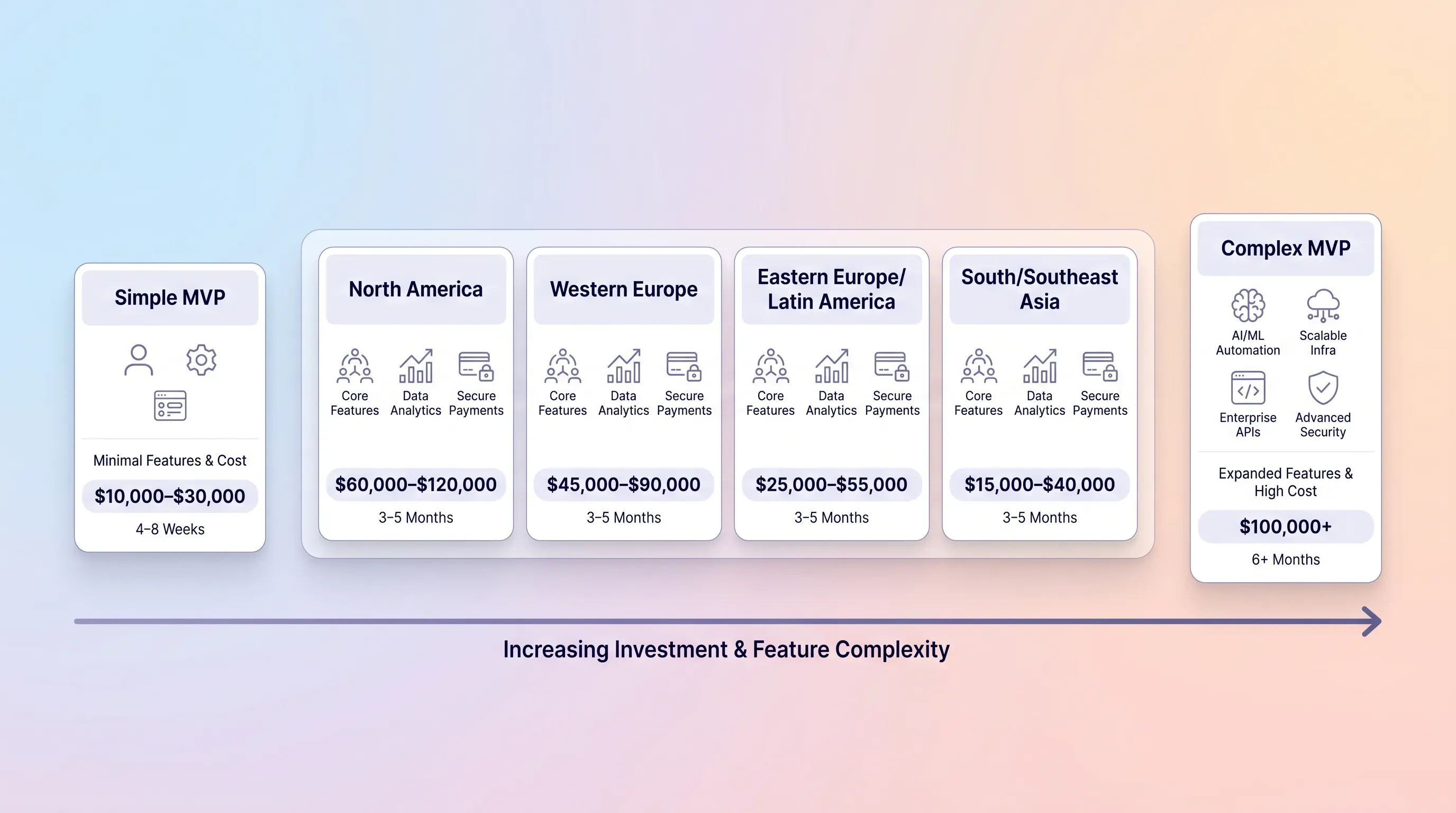
For founders asking how much does it cost to build an MVP, here's how the same mid-complexity MVP roughly priced out in 2026 by region:

  • North America: $60,000–$120,000

  • Western Europe: $45,000–$90,000

  • Eastern Europe / Latin America: $25,000–$55,000

  • South / Southeast Asia: $15,000–$40,000

MVP development prices by region dashboard

Tech stack choices

Tech stack choices shapes both upfront spend and what you'll pay to maintain the thing for years. A web app on a standard stack (React and Node with Postgres) is the cheapest path because the talent pool is huge and tooling is mature. Going native on iOS and Android doubles your MVP development cost because you're building two codebases. Cross-platform frameworks like Flutter or React Native compress that, though they trade off some performance for cost.

No-code and low-code tools have changed the math for certain MVP types. Bubble, Webflow, Glide, and Softr can ship a working marketplace or internal tool for under $10,000 if your logic isn't exotic. The catch is scale. Once you hit thousands of users or need custom integrations, you'll likely rebuild. That's fine if the no-code MVP earned its keep by validating demand first.

Over-engineering at the MVP stage is the most common waste I see. Microservices and Kubernetes. None of these solve problems a 500-user product has. Pick boring, proven tools.

Design and UX requirements

Design costs scale with custom work. A templated UI kit like Tailwind UI or a Figma community file gets you a clean interface for a few thousand dollars. A full custom design system with brand work and custom illustrations can easily run $15,000–$40,000 before a single screen ships to engineering.

The tempting move is to skip design to save money. Don't. Don Norman, who coined the term "user experience" while at Apple, has said poor usability is the single biggest reason products fail to retain users. A clean, simple interface built on existing components beats a custom-designed one that nobody understands. If your MVP pricing is tight, spend on a competent UX designer for two weeks and use a template kit for the visual layer.

Common MVP pricing models

How you pay for the work matters as much as who does it. The dominant arrangements carry different risks; fixed price differs from time and materials, and in-house teams bring their own constraints. Picking the wrong one is how founders end up paying twice for the same MVP.

Fixed price contracts

Fixed-bid works when your scope is locked down and unlikely to change. You sign for a defined feature list at an agreed price, and the agency delivers it regardless of hours. The appeal is obvious. You know your MVP development cost on day one.

The problem is that MVPs almost never have locked scopes. The moment you learn something from a user test and want to adjust, you're filing a change request, which agencies charge for at a premium. Worse, fixed-bid creates an incentive for the vendor to interpret requirements narrowly and rush to delivery. You get what's in the contract. Fixed price genuinely protects founders only when the product is well-understood (a clone of something existing, a tightly defined internal tool) and the spec is bulletproof.

Time and materials

Time and materials bills by the hour or sprint and fits how MVPs actually get built. You pay for the work done, and scope evolves with learning. It's the model most experienced founders prefer once they've been burned by a fixed-bid mess.

The risk is open-ended MVP development cost. Without governance, hours pile up and your MVP pricing creeps from $40,000 to $80,000 without a clear reason. The fix is structural: weekly sprint goals, transparent time reporting, a hard budget cap per phase, and a product owner on your side who can say no to gold-plating. Done well, time and materials stays predictable. Done badly, it's a leak.

In-house team

Hiring full-time engineers and designers sounds like the disciplined choice, but the math rarely works for a pre-product startup. The Bureau of Labor Statistics put the median software developer salary at $130,160 in 2024, and Glassdoor data shows mid-level engineers averaging $170,365 in total comp. Add a designer at $110,000 and a PM at $130,000. A QA engineer at $90,000 then pushes your fully loaded annual payroll north of $700,000 before recruiter fees or equipment and benefits.

For a six-month MVP, you're looking at roughly $350,000 in salary alone, plus 25–30% in benefits and overhead. An equivalent agency engagement runs $50,000–$120,000. In-house only makes sense once you've validated the product and need long-term ownership of the codebase. Building the MVP itself with full-time hires is almost always overspending.

How much does it cost to build an MVP in 2026

Readers skim straight to this section, so here are the numbers without padding. The MVP development cost in 2026 falls into three rough tiers based on complexity, and the figures below assume an offshore or nearshore team at mid-range rates.

Simple MVP ($8,000–$25,000, 4–8 weeks): a landing page with email capture or a single-platform web app with two or three features. Think early-stage validation tools or basic SaaS dashboards. UX Continuum's analysis of 50+ MVP projects puts simple builds at $8,000–$18,000 when handled by mid-level offshore developers.

Mid-complexity MVP ($25,000–$70,000, 8–14 weeks): a web app with user accounts, payments, a few integrations, and an admin panel. Most B2B SaaS MVPs land here. The same range covers a single-platform mobile app with backend and push notifications.

Complex MVP ($70,000–$150,000+, 14–24 weeks): multi-sided marketplaces or fintech products with compliance requirements. American Chase reports the average cost to build an MVP at this tier runs $60,000 to $150,000 for mobile apps in 2026.

Timelines pull the MVP development cost totals up or down. A two-month sprint with a small team is cheaper than a six-month build with the same headcount because you're paying less in calendar overhead. AgileSoftLabs gives a 2–6 month window in its MVPs typically run 2–6 months guide, and squeezing into the shorter end requires ruthless scope discipline.
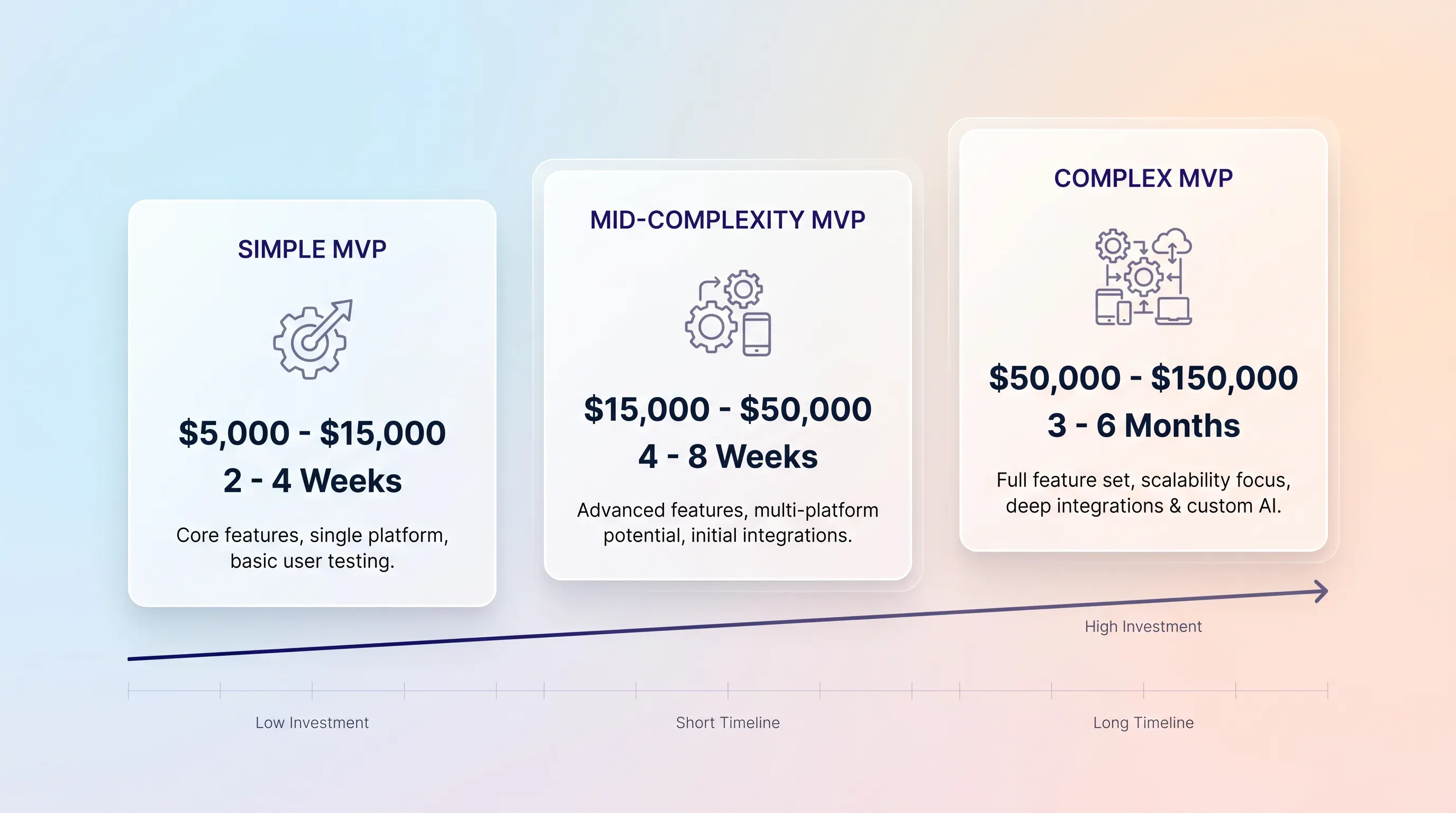
MVP development cost dashboard

Hidden costs founders miss

The quote you get from an agency covers design and development. It rarely covers the dozen other line items that show up between kickoff and launch. First-time founders underestimate MVP development cost line items by 20–30%.

Here's what to budget for beyond the headline number:

  • Cloud hosting (AWS or GCP): $50–$2,000/month depending on traffic

  • Third-party APIs: Stripe takes 2.9% + $0.30 per transaction, and Twilio charges per SMS

  • Analytics and monitoring: Mixpanel, Amplitude, Sentry, LogRocket can run $200–$1,500/month combined

  • Apple Developer Program ($99/year) and Google Play ($25 one-time) for mobile

  • Legal: Terms of Service and Privacy Policy, with GDPR compliance review at $1,500–$5,000

  • Post-launch bug fixes and small iterations: 15–25% of original build cost in the first three months

  • Domain and SSL setup

A 20% contingency on top of the development quote is the minimum. For regulated spaces like fintech or healthtech, push it to 30%. The question of how much does it cost to build an MVP only has an honest answer when these line items are in the spreadsheet too.

How to lower your MVP budget

The biggest savings come from scoping. A founder who cuts four features from the spec saves more than one who shaves $20/hour off the rate. Start there.

A few tactics that genuinely work:

  1. Run a discovery phase first. Two weeks of structured workshops to nail down scope costs $5,000–$10,000 and saves multiples of that in rework. Skipping it is the most expensive shortcut in software.

  2. Use off-the-shelf components for anything non-core. Auth0 for login, Stripe for payments, Intercom for support, Algolia for search. Building these yourself is a tax on your runway.

  3. Pick one platform for v1. Mobile-first products can launch on iOS only and add Android later. Web-first can defer mobile entirely. You'll cut roughly 40% off the MVP development cost.

  4. Choose your region deliberately. Eastern Europe and Latin America offer senior talent at half the US rate, and the time-zone overlap with either US or EU clients makes daily collaboration workable.

  5. Use a real MVP framework. The Dropbox video approach (sell before you build) still works in 2026 for many product categories.

The answer to how much does it cost to build an MVP drops by 30–50% once a founder applies these honestly. The discipline is harder than the rate negotiation, which is why most skip it.

Next steps for your MVP

Smart scoping beats cheap hourly rates every time. A $40/hour developer building the wrong feature wastes more money than a $120/hour senior shipping the right one in half the time. Founders who internalize this build MVPs that get to market and earn their next round. Those who chase the lowest quote rebuild within a year.

Before you talk to a single agency, write a one-page product brief covering the problem, the user, the core hypothesis, and the two or three features that test it. Get two or three estimates so you can compare scopes and MVP pricing. Validate your assumption with real conversations before any code is written.

If you'd like a tailored breakdown of your MVP development cost based on your specific scope and timeline, our team can put together a realistic estimate and a discovery plan that protects your budget from the surprises covered above. Reach out for a consultation and we'll help you pressure-test the spec before a single sprint begins.

Choose the smallest feature set that proves the riskiest assumption. If the main risk is demand, a landing page or concierge test can be enough. If the risk is usability, build a clickable prototype first. Write one success metric before development starts, then cut features that don’t affect it.

Yes, you can test an MVP idea without code when the goal is to validate demand or pricing. Use a landing page, waitlist, demo video, clickable prototype, or manual service behind a simple form. Code becomes necessary once you need repeatable workflows or real user behavior data.

Rebuild a no-code MVP when the tool blocks core product work or creates high operating costs. Common triggers include slow performance, limited integrations, poor data control, or workflows that need custom logic. Don’t rebuild just because the product gained users. Rebuild when the platform limits learning or revenue.

Yes, maintenance belongs in the MVP development cost from day one. Budget for bug fixes, small product changes, hosting updates, and monitoring after launch. A practical starting point is 15% to 25% of the original build cost for the first three months, especially if users will test live workflows.

Compare estimates by scope, assumptions, team roles, and what’s excluded. A lower quote often leaves out discovery, QA, or post-launch support. The client should ask each agency to break the estimate into phases and name the deliverables for each phase. That makes price differences easier to judge.

Book a call

Book a time that works best for you

You Might Also Like

Discover more insights and articles

MVP vs MLP product launch comparison

MVP vs MLP: Which Launch Strategy Fits Your Product

This article compares MVP vs MLP by looking at two ways to ship a first version of a product: the Minimum Viable Product and the Minimum Lovable Product. We'll look at where each idea came from, how they shape early decisions, and how to pick the right one for your stage and market.

Startup idea testing with experiments and demand validation

How to Test Your Startup Idea Before the Market Tests You

This article is a working guide for first-time founders who want to know what real validation looks like before a single dollar goes to development. We walk through cheaper, faster pre-build experiments you can run this week, and we show you how to tell real buying signals apart from the polite noise founders mistake for proof.

No-code to custom SaaS MVP growth journey split comparison

No-Code vs Custom Development: Best Approach for MVPs in 2026

This article helps early-stage founders decide on no-code vs custom development for an MVP in 2026. It walks through the decision by business stage and the real cost crossover.

Staff Augmentation Services team planning

How To Choose Staff Augmentation Services For Hybrid IT Teams In 2026

In this article, we explore the shift from traditional outsourcing to capability-driven partnerships in modern software development. We explain how to evaluate geographic models and successfully integrate specialized external talent into hybrid teams.