Why this debate keeps confusing founders
Most articles on no-code vs custom development line the two approaches up like rivals and ask you to pick a winner. That framing is wrong. The founders who get this right use both, just at different points in the life of the company. Charles Thomas built the freelancer marketplace Comet on Bubble and grew it to roughly $800,000 in monthly revenue before the team moved parts of the stack to custom code.
The right answer depends on where your business is today. A pre-revenue founder and a Series A founder are solving completely different problems, so they shouldn't be using the same tools. What follows is a stage-by-stage framework and a short checklist you can use after the real cost comparison moves from 100 users to 1,000 and then 10,000 users.
What each approach actually means in 2026
No-code in 2026 is not what it was five years ago. Platforms like Bubble, Webflow, Softr, and Glide now handle real production workloads, payments, role-based access, and API integrations. Bubble alone runs apps that have raised serious money; the solar lender Dividend Finance facilitated more than $1 billion in loans on its Bubble-built platform before Fifth Third Bank acquired it in 2022. The misconception that no-code platforms are toy tools for landing pages is outdated.
Custom development has also changed. AI-assisted coding tools have made small teams faster, although the productivity story is messier than the marketing suggests. GitHub's own controlled experiment found developers using Copilot completed a coding task 55% faster than those without it. A 2024 study by Uplevel Data Labs reached a different conclusion and found 41% more bugs in code from teams with Copilot access. The honest read is that AI helps a lean engineering team move faster on well-scoped work, but it doesn't turn a two-person team into a ten-person one.
Custom development also doesn't have to mean a six-figure spend on day one. Modall, a development studio that tracks MVP pricing, puts a medium custom MVP at $30,000 to $60,000 over two to four months. A simple no-code MVP runs $5,000 to $15,000 over four to six weeks. Both ranges are real. Neither side of the no-code vs custom development debate tells you which one fits your situation.
No-code vs custom development by business stage
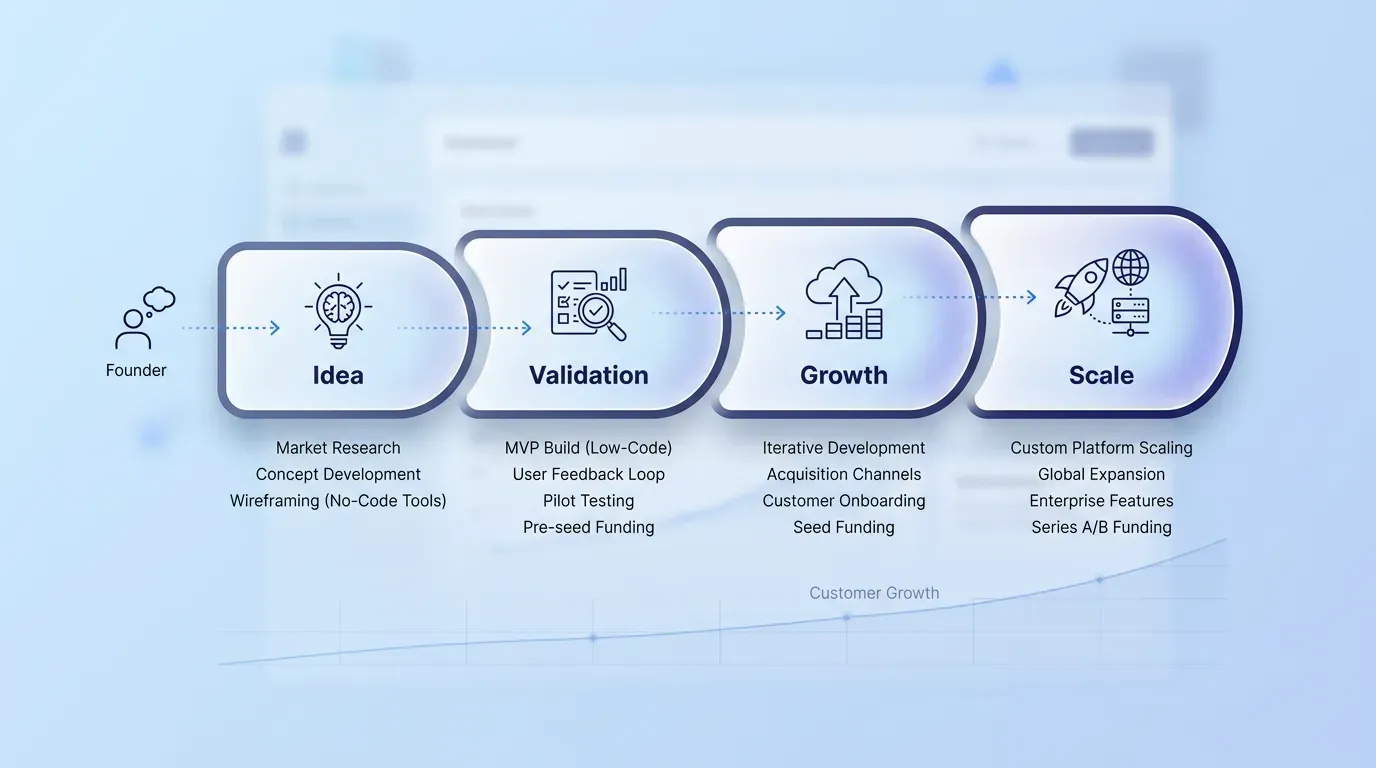
The central idea of this article is simple. Stage drives the no-code vs custom development decision. Here's the rough map most founders travel through:
-
Idea stage. You have a hypothesis and zero paying customers.
-
Pre-validation. You're talking to potential users and trying to get the first few to pay.
-
Early traction. You have customers, with some retention and a feature backlog.
-
Scaling. You have a growth engine that works and you're pouring fuel on it.

At the idea and pre-validation stages, the only question that matters is whether anyone cares. CB Insights' 2024 update of its startup post-mortem study analyzed 431 failed VC-backed companies and found 43% failed due to poor product-market fit. Spending four months on a custom build before you know whether the market wants the thing is the most expensive mistake an early founder can make.
At early traction and scaling, the question flips. Now you know people want it. The risk shifts from "will anyone buy" to "can we deliver this reliably as we grow." That's when custom SaaS development starts to earn its keep. Switching tools as the business evolves is normal. Treating it as a failure of planning is what gets founders stuck on the wrong stack for two years too long.
When no-code platforms are the smarter bet
No-code is the right answer when speed of learning matters more than anything else. If you're pre-validation, you don't need a scalable backend. You need to know whether five strangers will pay you for the thing you described.
Qoins, a debt-repayment app built on Bubble, used the platform to test its core idea of rounding up everyday purchases to pay off debt. The team later told idealink.tech that Bubble scaled better than they originally expected, and major parts of the business still run on it today. They've helped users pay off over $30 million in debt. That's a real business.
No-code platforms also win when runway is tight. If you have six months of cash and need to be charging customers in eight weeks, a custom SaaS development project that takes four months is a runway killer. The Bloom Institute of Technology raised $122 million after building its early platform on Webflow, Typeform, Airtable, and Zapier. The team launched something functional and got students paying before it expanded the engineering footprint.
The third clear case for no-code is fast market testing where you need to iterate in days. When the question you're answering is still "what do users actually want," any minute spent on infrastructure is a minute not spent on the actual question.
Signals it is time for custom SaaS development
The moment to move in the no-code vs custom development process arrives when specific things start breaking. Watch for these signals:
-
Platform fees climb past 8 to 10% of monthly revenue. On Bubble's Growth plan, you get 250,000 workload units for $119 per month billed annually, and overages cost $0.30 per 1,000 extra units. Heavy apps blow through that fast.
-
Customers ask for features the platform can't deliver. Real-time collaboration, complex permissioning, custom AI pipelines, and offline-first mobile experiences are the usual suspects.
-
Performance issues hit your conversion or retention numbers. Slow page loads on a marketing site are annoying. Slow workflows in a SaaS product are a churn engine.
-
Your unit economics stop working because platform pricing scales with usage in a way your revenue model doesn't.
DBB Software, an agency that handles Bubble-to-custom migrations, documented Wallfly's transition from Bubble to a FastAPI backend with a TypeScript frontend and PostgreSQL on AWS. The trigger wasn't ambition. The team had hit the ceiling of what Bubble could do for their scraping and search workload, and the migration was the unblock.
These are triggers. If none of them apply yet, stay where you are.
The gray zone in the middle
Most founders reading this aren't cleanly in one stage. You have traction and revenue, yet your no-code stack can't quite do everything on the list. The no-code vs custom development mistake is to treat the move as a single hard cutover.
A hybrid approach works better. Keep the no-code front end where it does its job well, and move the backend logic that's hitting limits to custom code. Connect them through APIs. Many SaaS teams now run a Bubble or Webflow front end against a custom backend for payments and complex business logic. The 2026 Bubble vs custom guide from Suffescom calls this the dominant pattern for scaling startups in 2026.
Running both stacks in parallel during migration is also fine. Pick the part of the product causing the most pain, rebuild it, route traffic to the new version, and keep going. The transition does not have to be one big bang.
The real cost comparison at scale
This is where the no-code vs custom development question gets concrete. Take a hypothetical B2B SaaS at three growth stages and compare what each path actually costs over twelve months.
At 100 users on Bubble's Growth plan, you're paying around $119 per month for the platform plus $50 to $100 in plugins and hosting extras. Call it $2,500 for the year. A custom build at this stage, even a lean one, runs $30,000 to $60,000 according to Modall's 2026 pricing data, plus ongoing maintenance. No-code wins by a wide margin.
At 1,000 active users, workload consumption climbs. You're likely on the Team plan at $349 per month, with overages pushing real spend to $500 to $800 per month. That's $6,000 to $10,000 per year. A custom build still costs more in absolute terms once you factor in a part-time engineer at roughly $133,080 median salary per year according to the May 2024 Bureau of Labor Statistics data, or around $90 to $150 per hour for a senior contractor. No-code still wins on cash, although the gap narrows.
At 10,000 users, the math flips. Workload-heavy apps on Bubble can exceed $1,500 per month once you account for overages and the operational support needed to keep things running. That's $18,000 to $30,000 per year in platform fees alone, with no equity in the code and no control over the roadmap. A custom SaaS development build at this stage, amortized over its useful life with a small engineering team to maintain it, comes in cheaper per year and gives you an asset you own.
The no-code vs custom development tipping point is the moment your platform fees, as a share of revenue, cross the cost of running your own engineering. For most SaaS businesses with average revenue per user between $30 and $100 per month, that crossover happens somewhere between 2,000 and 8,000 active users. Your trajectory matters more than your current spend. If you're doubling every quarter, plan the migration before the bill forces you to.
How to plan the migration without breaking your product
The migration is its own project. Treat it like one. The most common mistake, according to DBB Software's migration guide, is trying to rebuild everything at once. Six-month rewrites become eighteen-month rewrites, and your competitors don't pause while you're heads-down.
Start with the part of the product that's causing the most pain. If your search is slow, rebuild search first and route only that workflow to the new system. If billing logic is breaking, move billing. Each migrated piece should ship independently and prove itself in production before you touch the next one.
Data migration deserves its own plan. Export your schema from the no-code platform, then design the custom database around how the product actually works now (not how it was first built) while both systems run in parallel long enough to catch edge cases. A common pattern is to write to both databases for a few weeks and compare outputs before you cut reads over.
Communication is the part founders forget. Tell paying customers what's changing and when. If a feature will look or behave differently after migration, give them notice. If there will be a maintenance window, give them more notice. The Wallfly migration handled by DBB Software succeeded partly because the team treated the rebuild as a scoped project with its own timeline.
Underestimating timeline is the other classic no-code vs custom development mistake. A custom SaaS development rebuild that the team thinks will take three months almost always takes five. Plan for that, and make sure your no-code platform contract covers the realistic migration window.
Self-assessment checklist for founders
Run through these questions honestly. They take about ten minutes and will tell you which stage you're in.
-
Have at least ten people paid for your product without you personally convincing them? If no, you're pre-validation. Stay on no-code platforms.
-
Do you have positive monthly retention on a cohort of more than 100 users? If no, custom development is premature.
-
Are platform fees more than 8% of monthly revenue? If yes, the cost case for custom SaaS development is starting to make sense.
-
In the last quarter, did you lose a deal or a customer because your no-code stack couldn't deliver a specific feature? If yes, that's a migration signal.
-
Is your monthly user growth above 15%? If yes, model your platform costs out twelve months and see where the line crosses your engineering budget.
-
Do you have at least six months of runway beyond the projected migration cost? If no, a hybrid approach is safer than a full rewrite.
If you answered no to questions 1 and 2, your job right now is validation. If you answered yes to questions 3 through 5, start scoping the migration. If you're somewhere in the middle, the no-code vs custom development hybrid path covered earlier is where to focus.
Revisit this checklist every quarter. The answers will change as the business grows, and the right tool for January isn't the right tool for October.
The bottom line on no-code vs custom development
The no-code vs custom development decision is a sequence of stage-appropriate choices. No-code platforms are the right first chapter when you're proving the market wants what you're building. Custom SaaS development is the right next chapter once you have something worth scaling and the unit economics to justify owning the code.
At Aalpha, we build both. If you're at the validation stage, we'll tell you to stay on Bubble or Webflow and save your cash. If you're hitting the limits we covered above and need a partner for the migration to custom SaaS development, that's where our team comes in. Reach out for a scoping call and we'll help you figure out which chapter you're actually in.