MVP vs MLP product launch comparison

MVP vs MLP: Which Launch Strategy Fits Your Product

This article compares MVP vs MLP by looking at two ways to ship a first version of a product: the Minimum Viable Product and the Minimum Lovable Product. We'll look at where each idea came from, how they shape early decisions, and how to pick the right one for your stage and market.

Content authorNikita SivtsovPublished onReading time11 min read

Where MVP and MLP came from

The MVP vs MLP debate starts with one question every founder faces: how much should we build before we let anyone in? The term Minimum Viable Product was coined in 2001 by Frank Robinson, CEO of SyncDev, who described it as the product that "maximizes return on risk for both the vendor and the customer." Eric Ries then popularized it through the Lean Startup movement and defined the MVP as the version of a product that lets a team collect the maximum amount of validated learning with the least effort.

For a decade, that became the default playbook for early-stage teams. Ship rough, learn fast, iterate. But somewhere along the way, founders started using "MVP" as cover for shipping broken things. Users got tired of being beta testers for products that barely worked.

That reaction is where the Minimum Lovable Product came in. Brian de Haaff, co-founder and CEO of Aha!, introduced the MLP in 2013 and expanded on it in his 2017 book Lovability. His argument was simple. A product people tolerate is not the same as a product they reach for. Both MVP and MLP answer the same launch question, but they point at different priorities.

What an MVP actually is

An MVP is a stripped-down version of a product built to test a single hypothesis with real users. The goal is to learn whether anyone wants what you're making before you spend a year building it.

Drew Houston's first version of Dropbox is the clearest example. In 2008, instead of building cloud sync infrastructure, he recorded a four-minute demo video showing how the product would work. The waitlist jumped from a few thousand to 75,000 signups almost overnight. No working product. Just a test of demand. Houston later said, "I was part of that audience, so I made the video that would get me excited about Dropbox. The production value wasn't great. It was just me sitting in my bedroom at 3 a.m."

Airbnb's start was even rougher. Brian Chesky and Joe Gebbia rented out three air mattresses for $80 each during a 2007 design conference in San Francisco. That was the MVP. A site, a few mattresses, breakfast included. The point wasn't to build a hospitality platform. It was to see if strangers would pay to sleep on a stranger's floor.

What counts as "viable" in MVP product development is the smallest thing that produces a real signal. If the signal is yes, you build. If it's no, you pivot or kill it before the costs pile up. The Agile Alliance warns that teams miss this point when they stress the "minimum" at the expense of "viable," and ship something so thin that no honest feedback is possible.

What an MLP brings to the table

A Minimum Lovable Product is a small first version that people genuinely enjoy using. Lovability comes from a focused experience and careful design, with a clear identity from the first interaction.

De Haaff has a sharp way of explaining the gap. As he put it, "you could eat a can of cat food if you really had to, it is unlikely you would be clamoring for a second serving." Many MVPs are the cat food version of a product. They work. Nobody wants seconds.

An MLP trims scope just as ruthlessly as an MVP, but the savings get reinvested into the few things that ship. Copy is production-ready. Animations are tuned. Onboarding feels considered. Sagentia Innovation's design team frames it as a way to cross the chasm between early adopters and the early majority, because mainstream users want convenience and quality alongside any novelty. That's why MLPs win in crowded markets where users already have a working alternative.

Key differences between MVP vs MLP

Both approaches are "minimum," but they're minimum in different directions. The MVP vs MLP comparison shows up across four practical dimensions that shape every early decision: what you're measuring, what you ship, how it feels, and how long it takes to get there.

Goal and mindset

MVP product development is built around hypothesis testing. The team is asking, "Will anyone use this?" Success at launch is a clean read on demand, even if the read says no. MVP teams chase data.

MLP product development flips the question. The team asks, "Will the people who try this come back, tell friends, and stay?" Success at launch is the first batch of users who feel something. MLP teams chase delight, and they measure it. Rahul Vohra at Superhuman built his roadmap around a single number: the share of users who'd be "very disappointed" if the product disappeared. The mindset shift changes what "done" means at launch.

Scope and features

An MVP ships with the bare minimum needed to test a use case. Polish is skipped on purpose. If a hardcoded admin panel and a Stripe link will validate the idea, that's the build.

An MLP cuts scope just as hard, but every surviving feature gets the full treatment. The MVP vs MLP examples below illustrate how the same starting point produces two different builds:

  • An MVP for a note-taking app ships with three fonts and no search, while the export stays clunky. It exists to confirm people want yet another note tool.

  • An MLP for the same product gets the font and search experience right, and its export respects formatting because the bet is that craft is the wedge.

Both teams cut features. One cuts to learn faster. The other cuts to make the survivors shine.

User experience and design

MVPs have rough user interface (UI) and almost no brand work. Speed beats aesthetics when you don't yet know if the idea has legs. A landing page built in a weekend is fine. A logo can wait.

MLPs treat design and micro-interactions as core to the product, with copy held to the same standard. Linear is a good reference point. Karri Saarinen and fellow founders Jori Lallo and Tuomas Artman spent a month building a prototype before showing it to anyone, then ran a private invite-only beta so they could control who experienced the product first. Saarinen has said the team wanted Linear to feel beautiful because "if you have a project management tool that is beautiful, then anything can be beautiful." That obsession with first impressions is what separates the MVP vs MLP approach in practice.

Time and cost to build

MVPs are faster and cheaper. The Dropbox demo video was made in a weekend. The Airbnb "platform" was a single page on airbedandbreakfast.com. You can run an MVP test for a few thousand dollars and a few weeks of work.

MLPs cost more upfront. Superhuman spent three years and 14 people coding before launching publicly, with Rahul Vohra personally onboarding early users in two-hour sessions. That trade-off is one of the biggest factors in the MVP vs MLP decision. If your runway is short and your hypothesis is unproven, paying for craft you don't yet know users want is hard to justify.

When MVP product development makes sense

MVP product development is the smarter bet when your biggest unknown is demand. If you don't yet know whether anyone wants the thing, the fastest way to find out is to put a rough version in front of real people and watch what happens. Polish slows down the answer here.

The situations where MVP product development wins:

  • Untested markets where you can't yet name a competitor

  • B2B tools and internal pilots, where buyers tolerate rough edges if the workflow saves time

  • Tight runway, where shipping in six weeks vs six months is the difference between learning and dying

  • Concierge or "Wizard of Oz" services, where the back end is humans doing the work manually

The warning attached to MVP product development is straightforward. Don't ship rough into a market where users already expect polish. A consumer photo app launched in 2025 against established players cannot get away with a half-finished onboarding. The expectations bar has been set by someone else, and an MVP that ignores it reads as broken.

When MLP product development wins

MLP product development wins when demand has already been validated. You already know people want a better email client or a better issue tracker. The question is whether they'll love yours enough to switch and stay.

Superhuman is the textbook case. Rahul Vohra spent the first year on user interviews and no product, then three more years building before launch. When the product market fit score sat at 22% in April 2017, the team didn't ship harder. They went back to the survey data and doubled down on speed and keyboard shortcuts, which pushed the score to 58% within a year. Email already existed. The bet was that craft would pull the right users across.

Linear tells a similar story. By 2025 the company had reached 15,000 paying customers and a $1.25B valuation on minimal marketing spend, mostly through word of mouth from people who found the product unusually well-built. Sequoia's Stephanie Zhan noted that when management at some firms tried to consolidate onto incumbent tools, the teams using Linear "revolt!" That kind of loyalty comes from MLP product development discipline applied from day one.

MLP product development works best when demand signals exist, whether from your own use of the category or from competitors with millions of users; a survey base willing to tell you what they hate about the current options gives you the same kind of signal. Without that signal, you're polishing a guess.
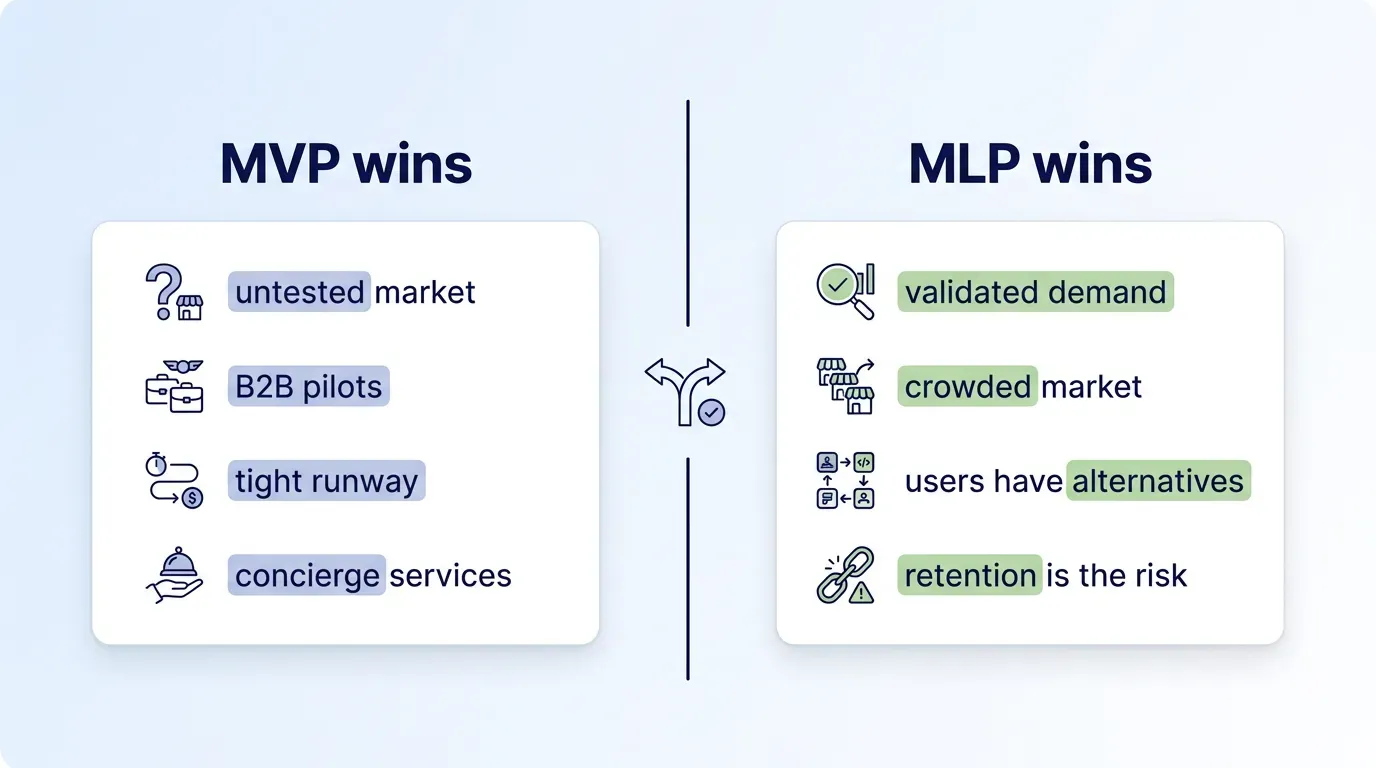
MVP vs MLP decision comparison chart

How to choose between the two

The MVP vs MLP choice is less about taste and more about naming your biggest unknown. If you're not sure whether anyone will want this, MVP. If you're sure people want this category but not sure they'll stay with yours, MLP. The framework below keeps that honest.

Ask yourself a short set of questions before committing:

  1. What's the bigger risk: demand or retention? Demand risk points to MVP product development. Retention risk points to MLP product development.

  2. Has a competitor already set a high quality bar? If yes, shipping rough will read as broken, and an MLP is safer.

  3. How much runway do you have? Under six months of cash forces an MVP whether you like it or not.

  4. Can you name your earliest user and what they currently use? If no, you're not ready for either approach. Go talk to people first.

Hybrid thinking helps too. A team can run MVP product development on a new feature inside an MLP-grade product, or wrap a rough back end in a polished front end while the technical bet gets validated. The MVP vs MLP label matters less than the discipline behind it. What you call the release doesn't change the trade-offs you're making.

One more honest check. Teams sometimes pick MLP because they're afraid of negative feedback on a rough product, and sometimes pick MVP because they don't want to invest in design. Both are bad reasons. Pick the approach that matches what you're actually testing, even when it requires the hard work.

Final thoughts

MVP and MLP are practical tools for launch strategy. The MVP vs MLP question has several right answers because it depends on what you're testing and who you're testing it on; your room for error determines how aggressive the choice can be. Be honest about which risk you're facing before you commit to a path.

If you're a founder or product manager mapping your next launch, take the framework in this article and run your release against it. Name your biggest unknown. Pick the approach that gives you the cleanest read on it. Then ship. Our team at [Company Name] works with early-stage teams on exactly this decision, from scoping the first release to designing the test that proves whether it worked. If you'd like a second pair of eyes on your MVP vs MLP call, reach out and we'll walk through it with you.
Yes, you can test an MVP without code if the core question is demand. Use a landing page or clickable prototype to see whether users sign up or pay. Treat clicks alone as weak evidence unless they lead to a concrete commitment.

Measure lovability through repeat use and willingness to recommend. Track cohort retention after the first week or month, then ask users what they’d miss if the product disappeared. Strong answers point to specific moments in the product rather than general praise about the idea.

Choose the approach after you define the legal and safety floor. In health or finance, a rough test still needs consent flows and secure data handling. If that baseline makes a quick build unsafe, test demand with interviews or prototypes before involving live user data.

MVP vs MLP decisions fail when teams hide from the real risk. A team picks MVP to avoid design work, or picks MLP to delay market feedback. Write the test question first. Then define the pass signal and cut anything that doesn’t help answer it.

Involve a product partner when the team disagrees about scope or can’t name the riskiest assumption. Company Name, or a product partner in that role, should help turn the launch into a test for a named user and a measurable pass signal before development starts.

Book a call

Book a time that works best for you

You Might Also Like

Discover more insights and articles

Startup idea testing with experiments and demand validation

How to Test Your Startup Idea Before the Market Tests You

This article is a working guide for first-time founders who want to know what real validation looks like before a single dollar goes to development. We walk through cheaper, faster pre-build experiments you can run this week, and we show you how to tell real buying signals apart from the polite noise founders mistake for proof.

No-code to custom SaaS MVP growth journey split comparison

No-Code vs Custom Development: Best Approach for MVPs in 2026

This article helps early-stage founders decide on no-code vs custom development for an MVP in 2026. It walks through the decision by business stage and the real cost crossover.

Staff Augmentation Services team planning

How To Choose Staff Augmentation Services For Hybrid IT Teams In 2026

In this article, we explore the shift from traditional outsourcing to capability-driven partnerships in modern software development. We explain how to evaluate geographic models and successfully integrate specialized external talent into hybrid teams.

Node.js development cost discussion

Node.js Development Services Cost 2026 | Complete Price Guide

In this article, we examine the true expenses of Node.js applications, break down initial development costs, and uncover hidden maintenance obligations. This guide provides information to help organizations budget accurately and avoid unexpected financial pitfalls throughout the software lifecycle.