Software outsourcing project budget with hidden costs icons

How Much Do Software Development Outsourcing Services Cost: 2026 Breakdown

In this article, we break down the true total cost of ownership for outsourced development projects. This guide explores the modern talent market, assesses hidden management expenses, and identifies cost-effective engagement models.

Content authorNikita SivtsovPublished onReading time10 min read

Introduction

Software development projects demand careful financial planning and precise execution. Today, many companies struggle to accurately forecast their budgets because they focus exclusively on hourly vendor rates. This guide explains the true financial investment required for building digital products in 2026 and exposes the hidden expenses often omitted from initial vendor quotes. For example, over 60% of companies underestimate hidden costs of outsourcing by at least 25%. This guide sets a realistic baseline for calculating total cost of ownership and highlights how the rising demand for senior architectural talent impacts overall budget planning. Accurately estimating these expenses requires companies to examine management overhead, time zone coordination, and onboarding delays. Understanding these financial components helps organizations confidently evaluate software development outsourcing services and select vendor partnerships that align with their long-term technical objectives.

2026 Talent Market Reality

Organizations establish these vendor partnerships in the modern talent market, and this market creates a new challenge for software development projects. Artificial intelligence tools make basic coding tasks faster and increase junior-level output. A 2025 Stack Overflow survey shows that 84% of developers use artificial intelligence tools during the development process. This widespread adoption makes coding faster. However, fast coding does not automatically build a stable system. Artificial intelligence coding assistants produce raw code that requires strict architectural oversight, similar to how a content generator produces text that needs editorial review.

The demand for architectural oversight makes senior engineering talent expensive but necessary for project success. Software systems quickly accumulate technical debt when experienced engineers do not guide the architecture. Project evaluations require looking past cheap hourly rates to focus on the technical leadership that external teams provide. Senior engineers understand system design, security protocols, and scalability requirements. These professionals prevent costly mistakes that inexperienced developers make when they rely on automated tools. This senior expertise protects the project budget and prevents extensive post-launch rework.

Hidden Outsourcing Costs

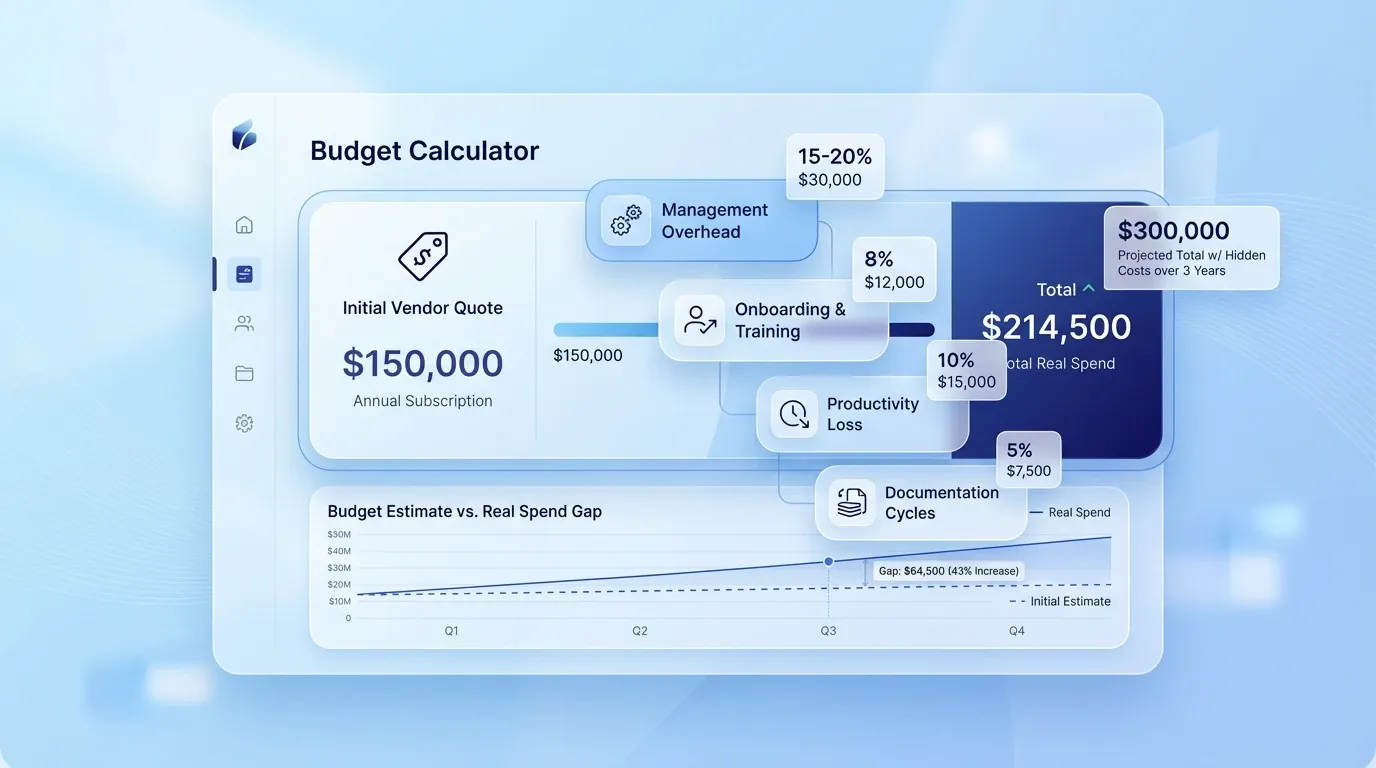
Companies protect the project budget when they use financial discipline to establish the true cost for external development projects. Initial vendor quotes rarely show the complete financial picture because unquoted expenses quickly inflate the final bill. Many project estimates focus exclusively on the developer's hourly rate and miss the operational overhead entirely during the evaluation of software development outsourcing services. Proper budget calculation requires the measurement of several hidden expenses that occur behind the scenes.

Financial audits consistently reveal specific operational costs that vendors exclude from their initial estimates:

  • Management overhead averages $300,000 per year and consumes approximately eight percent of the yearly contract amount.

  • Teams with minimal time zone overlap experience a 15-20% productivity loss from constant communication delays.

  • Extensive onboarding periods require payment for weeks of transition time before external developers write any usable code.

  • Asynchronous communication requires extra documentation cycles that slow down the entire development pipeline.

These hidden costs accumulate rapidly. Detailed financial tracking reveals how administrative drag drains the development budget, similar to how AI search engine visibility reports track unobserved algorithmic changes. A realistic financial baseline requires the inclusion of these hidden layers. Projects inevitably exceed their original budgets when financial calculations ignore the cost of time zone coordination and communication overhead.

Software outsourcing hidden costs budget calculator

Engagement Models for ROI

Organizations prevent these budget overruns when they choose the right engagement model, and this model determines the financial success of a project. Vendor agreements require careful structuring because different projects require different levels of external control and internal technical leadership. No single model fits every scenario for software development outsourcing services. Internal engineering capacity and scope clarity dictate the correct choice.

Projects without internal technical leaders require external managers to direct the development team. This decision carries significant financial weight because project management overhead typically adds 20-30% to base costs. Financial foresight helps avoid models that conflict with internal workflows. An engagement model provides the highest Return on Investment when it matches specific managerial constraints. Project-based contracts, dedicated nearshore teams, and team augmentation setups offer different frameworks for different needs. Each framework shifts the management burden differently between internal staff and external vendors. The chosen model protects the project budget when it aligns with the actual capacity to govern external engineers.

Project-Based Contracts

Project-based contracts provide a strong return on investment for projects with a highly defined scope. This model transfers the delivery risk entirely to the vendor. The vendor agrees to deliver a specific product for a fixed price within a set timeframe. This predictability locks in the budget early. However, requirement changes after work begins cause problems. Any deviation from the original scope results in costly change orders and delayed timelines. This model supports the development of standalone applications or predictable system migrations. The framework fails when projects require constant iteration, discovery phases, or frequent user feedback cycles.

Dedicated Nearshore Teams

Dedicated nearshore teams offer a framework for continuous development cycles. This structure provides a stable group of external developers who work exclusively on a single product. Similar time zones allow these engineers to participate in daily standups and collaborate in real time. Careful calculation of internal management capacity ensures proper support for this external group. Internal technical leaders retain full control over the product roadmap and priority shifts. Dedicated teams integrate with internal workflows and adopt specific engineering standards. This model supports complex platforms that require long development periods. A predictable monthly rate provides the flexibility to pivot technical directions.

Team Augmentation

Team augmentation provides a different type of flexibility and serves as a solution to cover immediate skill gaps. This model inserts specialized external engineers directly into existing internal teams. This approach bypasses the long recruitment cycles that typically accompany specialized tech talent recruitment. However, this structure requires strong internal engineering leadership to manage the augmented staff. The addition of external contributors requires clear awareness of internal management bandwidth. Internal technical leaders assign tasks, review code, and ensure the augmented developers meet engineering standards. Team augmentation increases development capacity quickly during critical release cycles. Augmented engineers quickly become misaligned with the core product vision when capable internal managers do not guide the daily work.

Speed Versus Stability Paradox

These capable internal managers also face a dangerous paradox between development speed and system stability that AI coding assistants create. Because these tools write functions in seconds, inexperienced developers often accept the output without understanding the underlying logic. This fast-paced generation builds severe technical debt if technical leaders do not govern the process, and AI-assisted development introduces its own class of architectural risks that compound over time when left unaddressed. For example, recent studies show that AI-generated pull requests averaged 10.83 issues versus 6.45 for human-generated code.

Security risks multiply when teams prioritize speed over architectural soundness. Researchers found that teams using AI produced 10x more security vulnerabilities than control groups. Much like how unedited AI content creation requires human review before publication, raw automated code requires strict architectural evaluation before deployment. Organizations establish strict engineering standards to protect their projects.

If companies implement a strict definition of done, they force external teams to test and document every feature. This mandatory review process slows down the initial coding phase but prevents failures later. Companies demand strong platform engineering standards from their vendors to maintain quality. These standards ensure that fast AI-assisted coding does not compromise the final product's security and maintainability. The benefits of enforcing these strict quality gates easily offset the costs of slower initial development. Companies protect their digital assets from collapsing under the weight of automated mistakes when they demand verifiable stability over raw speed.

Software Development Outsourcing Services Evaluation

Companies demand this verifiable stability and look beyond the initial build phase when they evaluate software development outsourcing services. Cheap hourly rates from junior developers often mask significant backend expenses that appear after the product launches. A low initial quote seems attractive, but poor code architecture leads to expensive system overhauls. Industry data reveals that software maintenance accounts for 60-80% of total lifecycle costs. If vendors write messy code today, buyers will pay a premium to fix it tomorrow.

Organizations protect the core budget when they calculate exact long-term financial commitments. When agencies lack senior architectural guidance, their developers make structural errors that force the team to rewrite entire modules. Analysts note that rework consumes 40-70% of a project's budget. Buyers carefully evaluate vendors to prevent these financial drains. Organizations take specific chronological steps to assess a vendor's long-term value:

  1. They review past client case studies to understand how the vendor handles technical debt.

  2. They examine the agency's quality assurance processes to verify that developers catch bugs early.

  3. They request detailed maintenance models that project costs for three years after launch.

  4. They require senior engineers to lead the initial system architecture design.

These practices help organizations understand the true price tag of their digital products. An agency that charges higher hourly rates for senior talent often delivers a much lower total cost of ownership over the software's lifespan.

Specialized Vendor Selection

Companies also consider how the right agency size influences the final project cost. Many companies default to hiring large generalist enterprise firms because these recognizable names feel safe. However, this cautious approach often backfires financially. Research indicates that large Information Technology projects run 45% over budget and 7% over time on average. These large agencies carry heavy administrative overhead and frequently assign their most junior developers to new accounts.

In contrast, midsize specialized agencies deliver precise capabilities that yield better financial outcomes. These smaller firms focus on specific technologies or industries. Just as SEO for nonprofits requires specific strategies that differ from corporate marketing, custom software requires specific architectural knowledge that generalist firms lack. Specialized agencies bring senior talent who already understand the nuances of the client's industry.

Financial foresight helps companies recognize the danger of mismatched vendor capabilities. Industry reports show that more than one-third of delayed software projects originate from poor vendor selection. Buyers evaluate an agency's actual technical depth carefully. If a company hires a specialized midsize firm, they avoid paying the expensive learning curve that large generalist vendors charge to their clients.

Conclusion

Companies avoid these expensive learning curves when they thoroughly evaluate long-term financial commitments for modern technology projects. These projects often accumulate expensive technical debt and require extensive post-launch rework when organizations choose software development outsourcing services that rely solely on the lowest hourly rate. Successful projects need a hybrid engagement model that balances budget predictability with the flexibility to manage modern architectural complexities. In the future, the technology sector will prioritize vendor partnerships that offer transparent pricing and strong technical leadership. A careful evaluation of transparent vendor partnerships ensures that projects launch successfully and grow efficiently, and this evaluation prevents the depletion of internal resources. Project teams secure the development pipeline when they request comprehensive cost breakdowns before they sign contracts.

You prepare your staff when you define clear communication channels and assign specific review responsibilities. Your internal managers must know who approves daily pull requests and who answers technical questions. This preparation prevents workflow bottlenecks and helps external developers start writing code faster.

You should track cycle time and the ratio of bugs found during the testing phase. These measurements tell you how quickly the team delivers features and whether those features work properly. You can also monitor sprint completion rates to ensure the agency maintains a predictable delivery schedule.

You protect your intellectual property when you sign a non-disclosure agreement before sharing any project details. You should also verify that the final contract includes a clause that transfers all code ownership to your company. You maintain control of your digital assets when you host repositories on your servers.

You don't need a technical background if you hire a vendor that provides architectural leadership. Companies like Pollume help businesses turn ideas into scalable digital products through expert engineering. A capable partner handles the complex system design while you focus on the business requirements and user experience.

The selection process for software development outsourcing services typically takes four to eight weeks. You need this time to review case studies, conduct technical interviews, and negotiate contract terms. If you rush this evaluation phase, you risk hiring an agency that lacks the specific skills your project requires.

Book a call

Book a time that works best for you

You Might Also Like

Discover more insights and articles