Startup idea testing with experiments and demand validation

How to Test Your Startup Idea Before the Market Tests You

This article is a working guide for first-time founders who want to know what real validation looks like before a single dollar goes to development. We walk through cheaper, faster pre-build experiments you can run this week, and we show you how to tell real buying signals apart from the polite noise founders mistake for proof.

Content authorNikita SivtsovPublished onReading time15 min read

Why most founders validate wrong

Every founder hears the same advice: validate your product idea. Talk to users. Validate before you build. Don't waste a year on something nobody wants. And then most founders ignore it and start building anyway. The gap between the advice and the behavior is enormous, and it shows up in the data. CB Insights, after reviewing 431 shutdowns of VC-backed companies, found poor product-market fit was a root cause in 43% of failures. The capital ran out because nobody wanted the thing.

Part of the problem is that "validation" has turned into a vibe. Founders say they validated their idea because a friend liked it or a Twitter post got 80 likes. None of that is evidence. As Rob Fitzpatrick puts it in The Mom Test, people give you "polite noise" instead of facts, and we accept it because we want to. So when you set out to test your startup idea, you have to decide upfront what counts as proof and what doesn't. The rest of this piece gives you a concrete way to do that, without writing code.

The MVP myth

Somewhere along the way, "build an MVP" became the default first step. It shouldn't be. An MVP is one of the most expensive ways to test your startup idea and find out whether it is real. By the time you've shipped one, you've spent weeks or months on design, engineering, hosting, and bug fixes. You've also spent something harder to recover, which is your own conviction. Once a founder has built the thing, admitting nobody wants it feels almost impossible.

The original idea of a Minimum Viable Product, the one Drew Houston used at Dropbox, was much smaller than what founders treat it as today. His first MVP was a four-minute screencast that showed what Dropbox would do before any working product existed. The waitlist jumped from 5,000 to 75,000 overnight. The MVP served as the test.

MVPs are for learning how to deliver value once you already know someone wants it. They answer questions like what the onboarding should look like and how to price tiers. They are bad at answering the question that matters most at the start, which is whether anyone cares enough to pay. Treating an MVP as your first step to test your startup idea skips the cheaper experiments that actually answer that question and locks you into a build before the market has spoken.

What real validation actually means

Validation is structured evidence gathering. That's it. You decide what you need to see, then look for it and accept what the world tells you. Validation requires evidence rather than a round of LinkedIn applause. The reason founders get this wrong is that weak signals feel almost identical to strong ones in the moment, and you have to train yourself to tell them apart.

A strong signal helps validate your product idea because it costs the person on the other side something. Money is the obvious one. A paid pre-order, a deposit, an annual contract, even $5 on a Stripe page counts more than 500 "this is amazing" replies. Time is another. Someone giving you a 45-minute interview about a workaround they built in a spreadsheet is a stronger signal than a friend forwarding your link. Repeated unsolicited demand, the same problem coming up across separate conversations without you steering toward it, is gold. Weak signals are compliments, likes, vague verbal interest, and "I would totally use this."

When you compare pre-build methods to test your startup idea, judge each one by how much it costs you to run and how strong the signal is at the end. Cheap and fast with weak signal is fine for early stages. Slow and expensive with strong signal is fine when you're close to committing capital. The wrong combination is slow and weak, which is exactly what building an MVP too early looks like.

Pre-build methods to test your startup idea

Think of the methods below as a ladder to test your startup idea. The bottom rungs are cheap and fast but give you softer evidence. The top rungs are more involved but tell you whether you have a business. You don't have to do all of them. You climb until you've gathered enough proof that writing the first line of code feels like the obvious next step instead of a leap of faith.

Problem interviews

The goal of a problem interview is to find out what the person already does when they hit the problem you think you're solving. You're hunting for evidence of a painful workaround, because that's the only proof the problem is real enough to act on. Rob Fitzpatrick's rule of thumb is to ask about specifics in the past instead of opinions about the future. "Would you use a tool for this?" tells you nothing. "Walk me through the last time this happened" tells you everything.

A useful interview to test your startup idea sounds boring. You ask a marketing manager how she handled the last campaign report. She says she copied data from four tools into a spreadsheet on a Sunday night and emailed it to her boss at 11 p.m. after she swore at her laptop. That's a workaround. That's pain. A misleading interview sounds exciting. You describe your product, the person says "Oh wow, I'd definitely use that," you both leave happy, and nothing real has been learned.

A few signals worth looking for during these calls:

  • The person has already tried to fix the problem themselves, with a script or a paid tool.

  • They can describe a specific recent instance without you prompting them.

  • They've spent money or time on a workaround, even if it didn't fully work.

If nobody you talk to can point to a real, recent instance, you don't have a problem worth building for yet. Run more interviews or move on. The cost is your time. The speed is days. The signal is moderate, which is why this is the bottom rung.

Landing page smoke tests

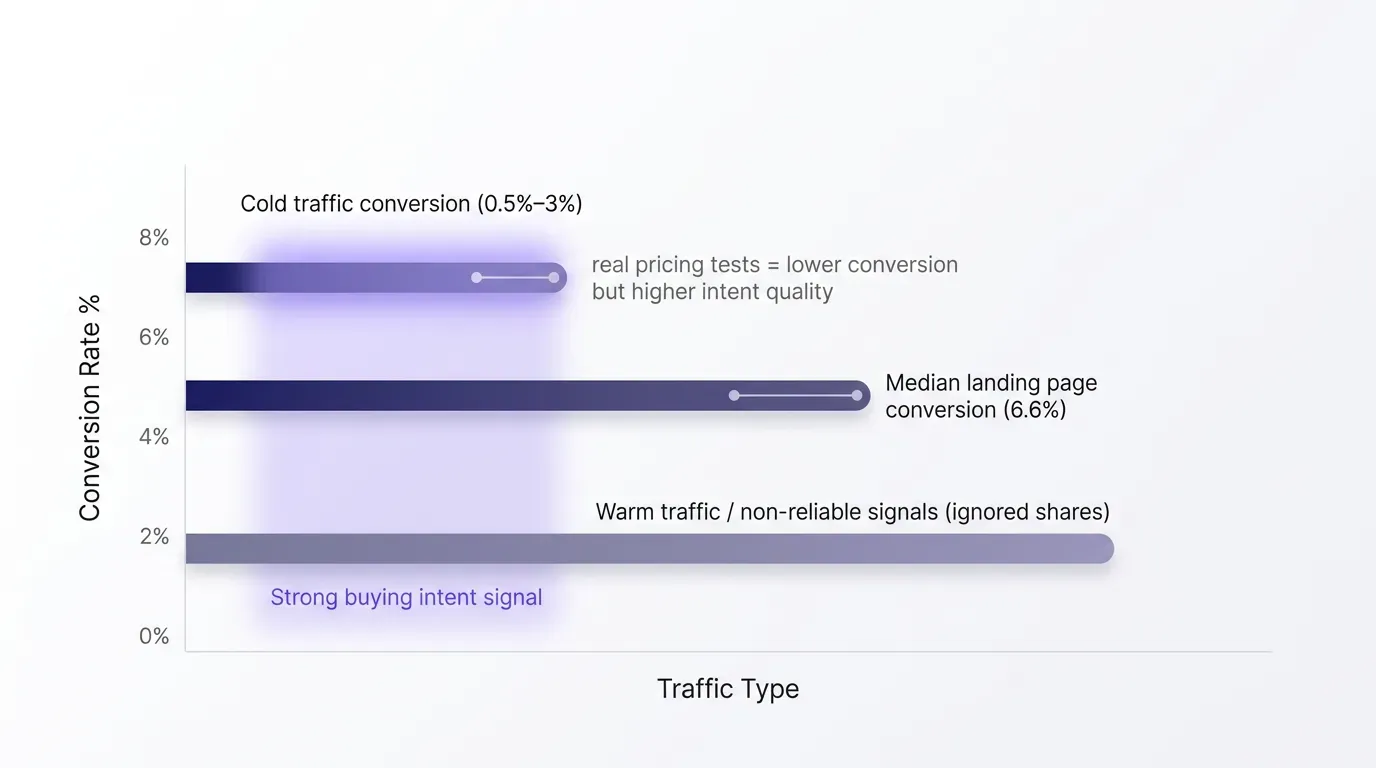
A landing page smoke test is the next step up to test your startup idea. You build one simple page that describes the offer as if it exists and send cold traffic to it from ads or a relevant community after you put a clear price on it. To validate your product idea, you measure how many strangers click the call to action. The keyword is strangers. Your network will click anything you send them, and that data is worthless.

This is how Buffer started. Joel Gascoigne put up a two-page site explaining what Buffer would do, with a "Plans and Pricing" button. When users clicked through, they saw three pricing tiers and a note that the product wasn't ready. He used those clicks to decide whether to build, and he had his first paying customer within four days of launch. The whole experiment took less time than a single sprint.

What does a positive result look like? According to Unbounce data on 41,000 pages, the median landing page conversion rate is 6.6%, but smoke tests with real pricing convert far lower because they're testing buying intent. Anywhere from 0.5% to 3% on cold traffic with a real price attached is a serious signal. Below that, you're looking at interest without intent. What you cannot count is friends sharing the link. Run paid traffic, ideally to a specific audience, and treat warm shares as a separate, weaker data set. MVP testing through landing pages works when the traffic is honest and the offer is specific.

Landing page smoke tests results diagram

Fake door experiments

A fake door is a landing page's sharper cousin. You advertise a feature or product as if it already exists inside a real flow, then measure who tries to use it. When they click, you tell them the truth: it's not built yet, and here's how to stay in the loop while you gauge interest. The ethics live in that follow-up message. As long as you don't take money under false pretenses and you're transparent about the state of the thing, it's a fair test.

Fake doors work best inside something with existing traffic when you test your startup idea. If you run a small newsletter, you can add a "new product" button to your footer. If you have an existing app, you can add a tile for a feature that doesn't exist yet and count taps. Larger companies do this constantly. The pattern surfaces real demand because clicking takes effort, and effort beats opinion. A click-through rate roughly two or three times what your normal in-product CTAs get is a meaningful signal. A spike in clicks combined with people emailing you to ask when it's coming is even stronger.

Where founders go wrong in MVP testing is treating curiosity clicks as buying intent. A click on a button labeled "Free" tells you almost nothing. A click on a button labeled "$29/month" tells you a lot. Always price the door. If you want to validate your product idea, the price has to be on the sign before you count the people walking up to it.

Concierge MVP testing

A concierge MVP delivers the promised outcome by hand to a small number of paying customers before any software exists. You are the product. If your idea is an app that automates expense categorization for freelancers, you sit down with three freelancers and categorize their expenses from their bank exports in a spreadsheet you email back each Friday. They pay you. You learn what the product actually has to do.

This is the strongest method to test your startup idea short of building, because it answers two questions at once. Will people pay for the outcome? And what does the outcome actually need to include? You'll discover edge cases no interview surfaces. You'll find out that the freelancers don't care about pretty charts but desperately want a quarterly summary for their accountant. You'll see which customers churn after one month and which ask for more. The classic example is Zappos. Nick Swinmurn photographed shoes at local stores before he posted them online. When an order came in, he drove to the store, bought the shoes at retail, and shipped them himself. No warehouse, no inventory deal. He tested one thing: whether people would buy shoes online without trying them on. They would. Amazon later acquired the company for $1.2 billion.

Concierge MVP testing is uncomfortable for a reason. It's slow, and it makes you do work the software was supposed to do for you. That's the point. The discomfort is the data. If you can't get three people to pay for a manual version of your idea, automating it won't fix the demand problem. MVP testing at this level produces evidence so concrete that the rest of the build decision becomes obvious.

Manual service delivery to validate your product idea

Manual service delivery is the concierge approach extended. Instead of three customers for a few weeks, you run the offer as a small service business for a couple of months. You set real prices and handle real complaints for a couple of months. You'll find out whether customers stay after the second invoice and whether the unit economics make sense before you spend a cent on engineering.

This approach to MVP testing surfaces problems that interviews and landing pages cannot. Pricing is one. You'll discover the gap between what people say they'll pay and what they actually pay when the invoice lands. Delivery is another. The thing that sounded simple in your pitch deck turns out to involve six steps, two of which the customer hates. Churn is the third, and it's the most important. A product nobody returns to is a product nobody needed. To validate your product idea at this level is to run a real, tiny business with the lights on.

The upside is that by the end of a manual service phase, you know exactly what the software has to do, who the customer is, what they'll pay, and where the operational pain sits. That makes scoping a lean MVP cheaper, faster, and less risky. You also find, as some founders do, that the service business itself is the business and you don't need to build software at all. Either outcome is a win compared to shipping code into silence.

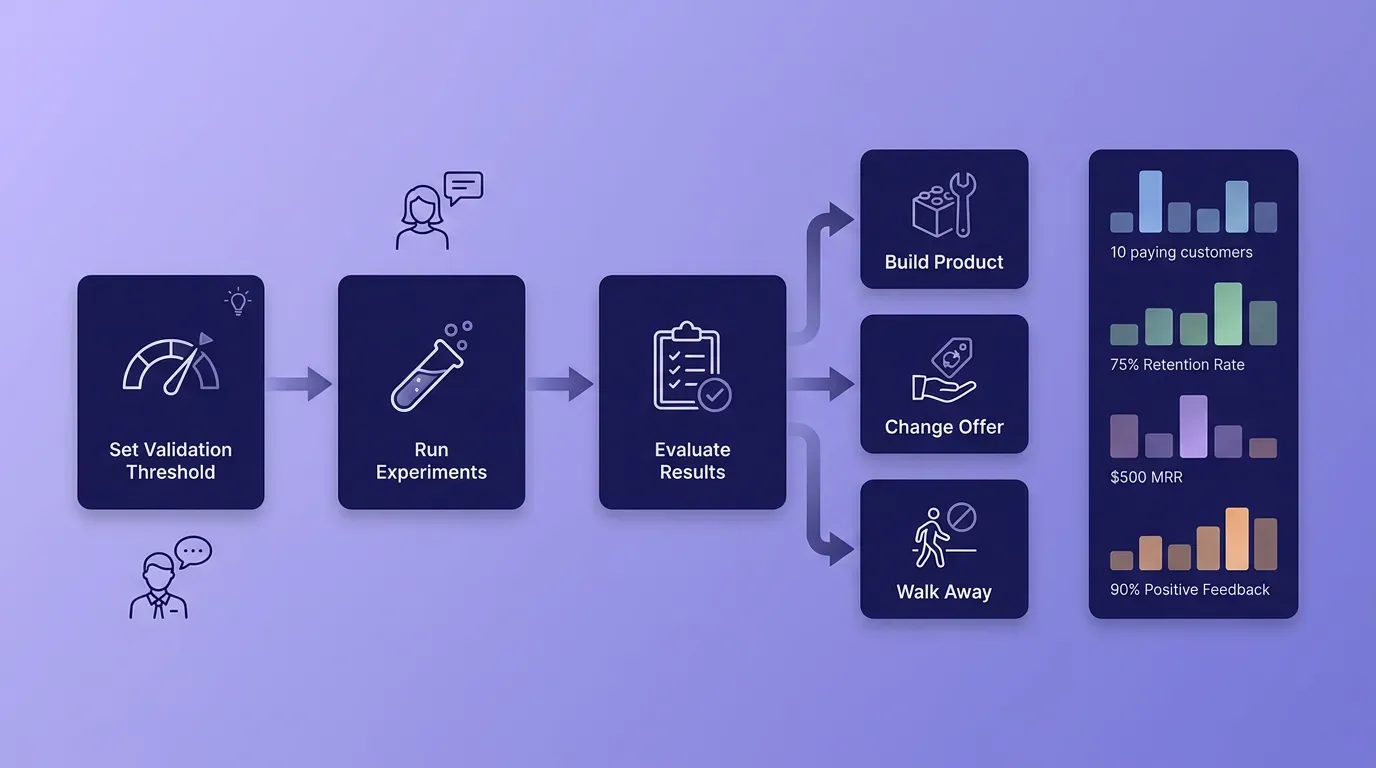
The validation threshold

The validation threshold is the rule you set before you start to test your startup idea, and it defines exactly what evidence you need to see before you write the first line of code. It converts validation from a feeling into a decision. The whole point is that you commit to the threshold in advance, when you're still cold-headed about the idea. Once you're three months in and emotionally attached, you'll rationalize anything as proof.

A threshold is specific and measurable. Here are examples of items a founder might write down before running experiments:

  1. Ten paying customers at the target price from outside your friends and founders' market.

  2. A cold-traffic conversion rate above 1% on a smoke test landing page with real pricing.

  3. At least 60% of concierge customers asking for a second cycle without being prompted.

  4. Three unsolicited referrals, where a current customer brings you a new one without you asking.

The numbers themselves don't matter as much as the discipline. You decide them and keep them fixed once the experiments are running. If you hit the threshold, you build. If you don't, you either change the offer and run another round, or you walk away. Both are valid outcomes. Shrugging off the data because you want to build the thing is invalid.
Validation threshold dashboard

Signals founders confuse with validation

The reason the threshold matters so much is that humans are wired to mistake encouragement for evidence. Friends and family will tell you the idea is great. Advisors will say it has legs. Twitter will give you a dopamine hit. None of it predicts whether a stranger will hand you money.

The most common false positives are worth naming directly, because they show up in almost every early-stage pitch deck I've ever read.

  • Compliments from friends and family. They love you. They are not your market.

  • Social media likes and shares. Liking a tweet costs nothing. Buying costs money. The two correlate badly.

  • Vague verbal interest. "I'd totally use that" is the most dangerous sentence in startup conversations because it feels like a yes and isn't.

  • Advisor enthusiasm. Advisors get paid in equity or coffee. They optimize for being supportive, not accurate.

  • Waitlist signups with no follow-up behavior. A signup is a curiosity click unless it's followed by replies, deposits, or repeat engagement.

The pattern across all of these is that they cost the other person nothing. Real signals cost something on the other side, whether that's cash, time, or a referral they have to make to their boss. When you find yourself collecting evidence that cost the other person zero, you're collecting reassurance. To test your startup idea honestly is to actively prefer the kinds of feedback that sting a little.

From validation to a lean MVP

The payoff of pre-build work is that by the time you're ready to write code, you have evidence to validate your product idea. You know who the customer is, because ten of them have paid you. You know what they'll pay, because you ran a smoke test with real pricing. You know what the product has to do, because you delivered it manually for two months and watched what mattered. Scoping a lean MVP becomes a matter of automating known work.

The founders who skip this work build features nobody asked for, then use customer research after launch to test your startup idea and figure out why nobody signed up. The founders who do this work build smaller MVPs and waste less capital. The development phase is where startups burn money. Crossing the validation threshold first is what makes that burn worth it.

If you take one thing from this piece, take this: pick one pre-build method this week and run it before touching any code. Interview five people. Put up a smoke test. Sell the manual version to a stranger. Whatever it is, do it before you build. At PaceAI, we work with first-time founders to test your startup idea through structured pre-build experiments and to scope a lean MVP only once the evidence is in. If you want a second pair of eyes on your validation plan before you commit to development, get in touch and we'll help you test your startup idea the right way.

Track the audience, traffic source, offer, price, visits, clicks, replies, payments, and follow-up behavior. A simple spreadsheet works well because it keeps the evidence visible. Add notes on objections and exact customer wording, since repeated phrases often point to the problem your MVP needs to solve.

Run a smoke test until you have enough cold traffic to read the pattern, usually at least 500 qualified visitors or 7 to 14 days. Don’t stop after one strong day. Keep the offer, price, and audience fixed during the test so the result reflects demand rather than constant changes.

Yes, but payment is the strongest signal. If you can’t charge yet, ask for a signed letter of intent with a named price, a deposit, a booked onboarding call, or access to real workflow data. These actions cost the buyer time or commitment, which makes them more useful than compliments.

Treat a failed test as a decision point, not a personal verdict. Review whether the audience, problem, offer, or price caused the weak result, then change one variable and run another test. If paid demand still doesn’t appear after a focused second round, move to a different problem.

Wait until your evidence reaches the threshold you set before you test your startup idea. Hiring developers too early turns uncertainty into code costs. PaceAI helps founders review validation evidence and scope a lean MVP after manual delivery, smoke tests, or customer commitments show what needs to be built.

Book a call

Book a time that works best for you

You Might Also Like

Discover more insights and articles

No-code to custom SaaS MVP growth journey split comparison

No-Code vs Custom Development: Best Approach for MVPs in 2026

This article helps early-stage founders decide on no-code vs custom development for an MVP in 2026. It walks through the decision by business stage and the real cost crossover.

Staff Augmentation Services team planning

How To Choose Staff Augmentation Services For Hybrid IT Teams In 2026

In this article, we explore the shift from traditional outsourcing to capability-driven partnerships in modern software development. We explain how to evaluate geographic models and successfully integrate specialized external talent into hybrid teams.

Node.js development cost discussion

Node.js Development Services Cost 2026 | Complete Price Guide

In this article, we examine the true expenses of Node.js applications, break down initial development costs, and uncover hidden maintenance obligations. This guide provides information to help organizations budget accurately and avoid unexpected financial pitfalls throughout the software lifecycle.

AI cost dashboard for MVP

7 Critical Steps to Control Artificial Intelligence Cost During MVP Development

In this article, we examine the financial realities of integrating machine learning features into minimum viable products. We explain how to identify hidden infrastructure expenses and implement structural safeguards that prevent massive budget overruns during early development.