UX design process in an MVP

How to Build an MVP: Extensive Architecture Guide for 2026

In this article, we explain the paradox of rapid software development in today's landscape and discuss why foundational architecture matters early on. We explore practical strategies to strip non-essential features and preserve structural integrity.

Content authorNikita SivtsovPublished onReading time11 min read

Introduction

The pressure to launch software quickly in a highly competitive market often forces teams to accumulate early technical debt. Software engineers establish basic functionality to test ideas with users and secure initial funding. In previous decades, teams created simple prototypes with basic tools and straightforward codebases. Today, people integrate complex artificial intelligence features and process large amounts of data from the very beginning. However, many developers struggle during their first major growth phase because they make poor structural choices that halt their progress entirely.

When engineers build an MVP, ignoring long-term architectural stability creates severe operational bottlenecks. The financial consequences of these early shortcuts affect the entire software industry. According to Paradigm Solutions, poor software quality cost the U.S. $2.41 trillion in 2022, and technical debt accounted for a massive portion of that expense. This guide outlines how to select a scalable database structure and make the right architectural tradeoffs that ensure long-term viability. A careful approach to early engineering prevents expensive system rewrites later.

2026 Development Paradox

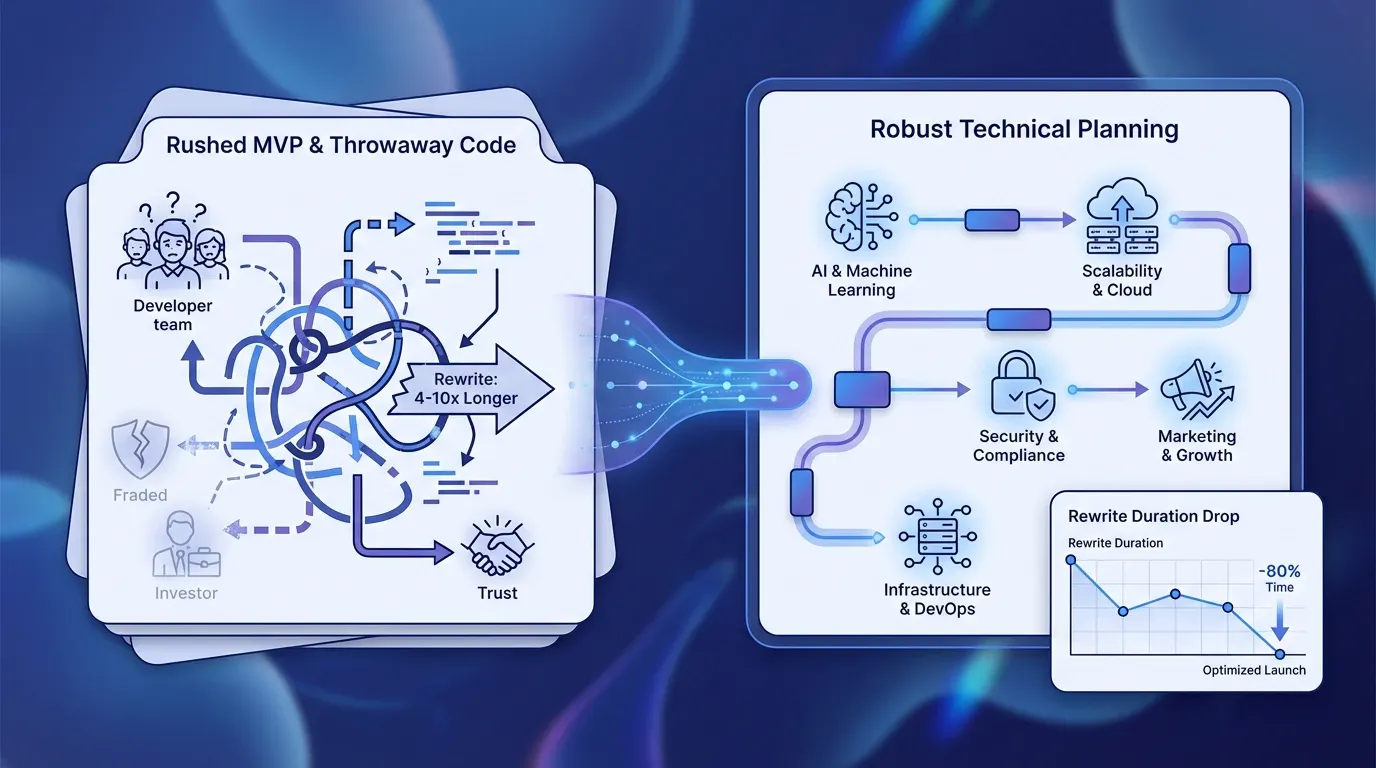
Engineers prevent these expensive rewrites when they understand why throwaway code fails in the modern software landscape. In the past, engineers built a minimum viable product quickly to secure initial funding. Today, developers face rising demands from artificial intelligence applications that require strong data pipelines from day one. If teams rush the development process, they sacrifice the precision needed to handle complex datasets later. Often, demo-able MVPs consist of throwaway code that requires a complete rebuild once funding arrives. This rebuild process delays future releases. According to 8th Light, software rewrites run four to ten times longer than engineers initially estimate. Investors lose trust when startups rewrite basic infrastructure for months and delay new features.

Technical planning requires engineers to treat their MVP requirements template as a blueprint for scale rather than a sketch for a prototype. This structural blueprint prevents short-sighted decisions during early development. Early infrastructure requires specific elements to support initial growth phases:

  • Well-defined data models that support complex queries and maintain performance.

  • Isolated core services that prevent single points of failure.

  • Standardized security protocols that protect user information from the start.

Organizations apply lessons from a modern digital marketing strategy to align their technical capabilities with market expectations. Proper planning ensures the initial code serves as a foundation rather than a disposable draft.

MVP development paradox

Engine Wheels Philosophy

Developer community discussions emphasize that teams build this stable foundation when they strip non-essential features and maintain structural integrity. Engineers refer to this approach as the engine and wheels philosophy. A car only needs an engine and wheels to move forward. Similarly, developers focus entirely on the core mechanisms that deliver value to the user when they build an MVP. Messy coding practices create technical debt that slows future development. Successful teams prioritize the quality of their foundational architecture over rapid feature launches.

System design requires a methodical approach. A structured MVP requirements template helps engineers identify which modules they can delay and which modules they build correctly from the start. Recent architectural shifts favor this disciplined approach. For example, modular monoliths allow teams to reshape modules and avoid the friction of multiple independent service configurations. This soundness in design ensures the system remains flexible as user needs change.

Developers write modular code to avoid the trap of complex dependency resolution later. They isolate business logic into distinct domains. These professionals plug new features into the existing structure safely when integrations occur. They use this modular foundation to handle sudden spikes in traffic efficiently. Startups that use AI-powered content creation often experience these sudden traffic spikes, and their engineering teams rely on early architectural choices to scale the system.

High-Stakes Architecture Decisions

These early architectural choices require specific technical decisions that dictate how an application performs under pressure. Engineers face immense pressure to launch a minimum viable product fast. This urgency often leads to shortcuts in database design and server architecture. These shortcuts create operational bottlenecks later. Founders who ignore structural planning encounter system instability when user traction arrives.

Bad architecture decisions cause product failures and require expensive emergency fixes, often compounded by AI-generated code introduced early without proper oversight. Engineers lose the certainty of a stable deployment pipeline when they build on top of fragile foundations. These professionals introduce unpredictable bugs with every new feature. They notice performance degradation as the user base expands. The engineering team frequently resolves critical errors and rarely develops new capabilities.

Developers establish strict boundaries around their core infrastructure to maintain stability during rapid growth. They evaluate database schemas, deployment models, and communication protocols carefully. The following sections examine these critical technical choices and explain how to prevent expensive technical debt.

Database Requirements Template

Engineers make their first critical technical choice when they select the correct database schema because this structure determines how the application handles data at scale. Engineers often pick a database based on familiarity rather than structural requirements. This approach causes significant downtimes during rapid user growth. Data imbalances occur when tables grow large and queries become inefficient.

If a database lacks proper indexing and logical partitioning, the system fails under heavy load. A known example illustrates this issue. In 2010, Foursquare suffered a 17-hour downtime because data became unbalanced across shards as the platform grew rapidly. A rigid data model offers no protection against unexpected traffic spikes. Developers map out data relationships carefully before they write initial code. Relational boundaries match the actual business logic to prevent database locks and application freezes.

Monolithic Systems Over Microservices

While relational boundaries prevent application freezes, many engineering teams mistakenly believe they need to build microservices to achieve enterprise scale. This assumption complicates early development and delays the product launch. A distributed architecture introduces network latency, complex deployment pipelines, and difficult debugging processes. Simple monolithic systems handle massive scale better during the early stages of a company.

A monolith provides comfort to small engineering teams because it keeps all business logic in one manageable codebase. Developers deploy a single application and avoid release coordination across dozens of separate services. When traffic increases, teams scale the monolith vertically through additional server resources. Shopify demonstrates the power of this approach. During Black Friday weekend in 2024, Shopify's Rails monolith handled 173 billion requests without failure. Monoliths offer the most reliable path to market validation.

Reliable APIs for Future Growth

While these monoliths offer the most reliable path to market validation, early shortcuts in Application Programming Interface (API) design reduce development velocity. Poorly designed endpoints force client applications to make multiple round trips to the server to fetch basic information. This endpoint inefficiency increases server load and drains mobile battery life. If developers change an endpoint without version control, they break the application for existing users.

Strict API contracts create a stable foundation for future integrations. Engineers define exactly what data each endpoint expects and returns. Standardized response formats reduce parsing errors on the client side. When teams separate their internal database schemas from their external API responses, they refactor the backend and avoid frontend disruptions. Clean API design prevents technical debt across the entire technology stack.

Software Development Trap

Even when clean API design prevents technical debt, many software teams fall into a predictable trap when they start their companies. These teams write code with high confidence and spend months on complex features, but they do not test their core business thesis. They believe that superior technology automatically translates into market success. This mindset creates a severe disconnect between engineering efforts and actual user needs.

When engineers build an MVP, they align their architectural choices with strict business metrics. They write excessive code before they achieve product-market fit, and this wastes capital and developer time. According to Startup Genome research, premature scaling causes 74% of startup failures, and these failed companies write over three times more code than successful ones. These companies overproduce software because they focus on theoretical scaling problems rather than immediate customer pain points.

Organizations that integrate automated content generators often experience this trap when they over-engineer their initial platforms before they validate demand. Organizations prevent this mistake and adopt a structured approach to early product development. First, they define specific user acquisition goals before they design the initial system infrastructure. Second, they measure user engagement on core features rather than track total lines of code written. Third, they remove any proposed module that does not directly support the primary business objective.

These steps ensure engineering teams avoid complex systems that nobody actually wants to buy or use.

Feedback Velocity

Engineering teams avoid complex systems when they gather early community feedback, and this feedback often forces teams to delay their initial product launch. This strategic pause creates tension between the desire to launch fast and the need to validate the software structure. When development teams rush to release a minimum viable product, they often ship software that fails to solve the user's actual problem. Teams take the time to collect and analyze early user insights and prevent this outcome.

However, a delayed development timeline introduces financial risks. Startups operate with limited financial runways, and every delayed week burns capital. An analysis of venture-backed companies shows that the median time is 22 months from a final fundraise to company shutdown, and a quarter of these companies operate as walking dead businesses for over three years. Companies that partner with a specialized online advertising firm understand that a late launch harms a company just as much as a broken product.

Software teams find the right balance and implement user feedback loops that do not halt engineering progress. When they build an MVP, teams release private beta versions to highly engaged community members. This approach provides certainty about the product's direction without a large public launch. Developers gain confidence because they solve real problems, and companies protect their financial resources when they keep the iteration cycles tight and focused.

Scalable Software Foundations

To keep these iteration cycles tight and focused, engineering teams plan code health systematically from the very beginning of a project. Many teams view technical debt as a problem they will solve only after they secure their next funding round. These teams allow messy code to infect the entire architecture, and this eventually halts all new feature development. Successful engineering organizations reduce debt continuously and do not treat it as an occasional cleanup task.

Teams use an effective MVP requirements template that includes specific guidelines to manage early architectural compromises. When engineers take a shortcut to test a new feature, they need a formal process to revisit and refactor that code before it becomes a permanent dependency. Without this structured process, engineers turn temporary system hacks into permanent structural flaws. Software teams value product quality over sheer speed and adopt strict policies to manage debt during their development sprints.

For example, enterprise engineering teams manage system health and allocate resources strictly. Shopify maintains its large platform because it dedicates 10% of sprint capacity to daily technical debt and another 10% to weekly debt reduction efforts. This systematic approach prevents complex software systems from failing. Companies apply this same precision to early stage projects and guarantee their software handles sudden traffic spikes. These companies maintain code regularly and ensure the initial product remains flexible enough to support continuous long-term business growth.

Conclusion

This continuous long-term business growth shows that a successful product launch requires teams to balance rapid market validation with sound structural engineering. Establishing a strong foundation early prevents future system collapses and expensive rewrites that drain resources. As the software industry evolves toward more complex applications, companies that prioritize clean code and modular design outpace competitors who rely on fragile prototypes. These companies adapt to market changes faster and scale easily. To build an MVP that handles growth efficiently from day one, contact Pollume's development team for an architectural consultation. Teams that want to accelerate the early design and prototyping phase can also explore how AI design tools fit into the MVP workflow before engineering begins.

You need a product manager, a software engineer, and a user interface designer to build an mvp. These three roles cover business strategy, technical work, and user experience. Small teams communicate well and work fast when they don't manage large groups.

You should budget between fifty thousand and one hundred thousand dollars for a standard software product. This amount pays for design, engineering, and hosting for three to four months. You'll spend more money if you add machine learning features.

Developers usually take three to four months to launch a product from the idea stage. You spend the first month designing the interface and the remaining months writing code. You shouldn't stretch this timeline because you need user feedback quickly.

Engineers often choose Ruby, Python, or JavaScript frameworks to create early software. Programmers use libraries of code in these languages to speed up development. You don't have to write everything from scratch when you use these established tools.

You should hire an external agency if you want to skip the recruiting process. Companies like Pollume provide teams that handle full-stack engineering and cloud hosting. You can transition to internal employees later, but it's easier when your product generates steady revenue.

Book a call

Book a time that works best for you

You Might Also Like

Discover more insights and articles

MVP development with UX steps

6 Steps to Integrate User Experience Design Principles into Minimum Viable Products

In this article, we outline a structured approach to embed design foundations into early-stage software releases. The discussion highlights practical methods to validate market hypotheses and protect development budgets from unnecessary features.

Claude design result

Claude Design Tool by Anthropic: AI Website Redesign

In this article, we walk through our hands-on experience using the Claude Design tool to redesign a real site from scratch. This is a practical first-person account of the full process, from writing the initial prompt to comparing the final result with the original.

Software architecture review meeting

How to Facilitate Software Architecture Reviews: Step-by-Step Guide

In this article, we explain how to facilitate productive technical evaluations that align stakeholders on critical trade-offs. This guide provides practical steps to prevent development bottlenecks and establish clear decisions for modern digital products.

Nearshore vs offshore teams comparison

Nearshore vs Offshore Outsourcing: Strategic Comparison For 2026

In this article, we examine the strategic shift in software development outsourcing methodologies for 2026. We evaluate the operational and architectural impacts of different team structures to help organizations build resilient engineering teams.