Nearshore vs offshore teams comparison

Nearshore vs Offshore Outsourcing: Strategic Comparison For 2026

In this article, we examine the strategic shift in software development outsourcing methodologies for 2026. We evaluate the operational and architectural impacts of different team structures to help organizations build resilient engineering teams.

Content authorNikita SivtsovPublished onReading time11 min read

Introduction

Software development outsourcing provides organizations with external engineering talent to build and maintain technical products. For decades, companies have relied on these external teams to speed up project delivery and reduce operational costs. Traditionally, organizations viewed this strategy as a straightforward method to secure inexpensive labor. However, organizations shifted their outsourcing motivations from cost savings to talent access over the past few years. Today, these organizations face a complex environment where cloud-native architectures and artificial intelligence integrations require deep technical expertise rather than basic coding capabilities.

This evolution changes the decision between nearshore vs offshore outsourcing into an important architectural choice rather than a simple financial calculation. Nearshore models function as high-collaboration extensions of internal teams, while offshore models operate as scalable execution engines for structured tasks. The appropriate model determines project velocity, security compliance, and overall software quality. A misaligned team structure often results in significant technical debt and delayed product launches. Organizations carefully evaluate how these operational models align with their specific technical requirements to build secure and high-performing engineering teams.

2026 Strategic Reset

Organizations look beyond historical cost-cutting measures to build these high-performing engineering teams. For decades, companies used offshore outsourcing primarily to cut expenses. However, data shows that cost reduction as the primary outsourcing driver dropped to 34% from 70% in 2020. The software industry requires advanced architectural skills that cheap labor markets cannot provide. Today, organizations face a talent paradox where senior software engineers face scarcity, and junior developer oversupply remains high. Because of this scarcity, organizations evaluate nearshore vs offshore outsourcing models with certainty about their project requirements. Companies need precision when they select external teams.

If companies hire junior developers just to save money, they risk project failure because they lack architectural alignment. Complex products require experienced architects who understand system dependencies. External engineers must integrate with internal developers to build these complex systems. Just as non-profits improve their outreach through charity search engine marketing, companies refine their talent acquisition strategies to target specific technical capabilities. The focus shifted from finding the cheapest coders to finding the most capable technical partners. This shift forces organizations to rethink how they structure their global workforce. A resilient software product demands high-level analytical skills. When organizations review their budgets, they recognize that cheap hourly rates often result in expensive technical debt. We break down exactly where these costs accumulate in our 2026 outsourcing cost guide. Therefore, the strategic reset centers entirely on acquiring senior engineering talent.

Core Structural Differences in nearshore vs offshore outsourcing

Organizations must integrate this senior engineering talent effectively, and they build trust with external teams through continuous communication. Nearshore outsourсing models operate in similar time zones, and this proximity allows internal and external developers to solve problems together during regular business hours. Eastern Europe remains one of the strongest regions for this model, and nearshore teams there operate within one to two time zones of most Western European clients. Even minor geographic gaps disrupt workflows, because a time zone difference of just one hour can cause an 11% communication decrease. Conversely, offshore models rely on asynchronous workflows to manage scale across global time zones. This structural difference impacts project stability and delivery speed. Research indicates that nearshore real-time collaboration saves 30-40% project time compared to offshore asynchronous models. If companies want to maintain workflow momentum, they evaluate the following structural differences between the two models:

  • Communication cycles: Nearshore teams provide immediate feedback during daily meetings, while offshore teams require overnight waits for responses.

  • Task execution: Offshore partners execute structured tasks at a massive scale, while nearshore partners adapt quickly to changing project requirements.

  • Strategic alignment: Close cultural proximity helps nearshore teams understand business objectives faster than distant offshore teams.

Organizations evaluate these factors carefully, much like how marketing teams implement SEO for nonprofits to align their message with audience behavior. Companies choose the model that fits their specific operational rhythm.

Architectural Security Implications

This operational rhythm dictates system safety, and complex software architectures require constant collaboration and strict security protocols. Organizations need assurance that their external partners can protect sensitive data and integrate smoothly with internal systems. When companies manage mission-critical initiatives, they rely on tight feedback loops to prevent catastrophic system failures. Offshore models work well for legacy system maintenance, but they struggle to support dynamic enterprise architectures that demand immediate problem resolution. The technical soundness of a software product depends on the team's ability to identify and fix vulnerabilities instantly.

This requirement becomes critical as the U.S. cybersecurity field faces a 700,000 professional shortage, and the global gap reaches four million. Because companies lack internal security experts, they partner with external engineers who understand modern threat landscapes. If a security breach occurs, teams in the same time zone coordinate a rapid response. Distributed teams that work across oceans often delay this response, and this delay exposes the business to massive financial and reputational damage. Organizations prioritize architecture and security when they build distributed teams. They know that a fragmented team produces fragmented code. Therefore, the right outsourcing model directly dictates the structural integrity of the final product.

Cloud-Native Complexity

This structural integrity faces constant tests because cloud-native environments change rapidly and require continuous integration. Engineers communicate constantly to manage microservices and containerized applications. Nearshore outsourсing supports this environment because developers troubleshoot infrastructure issues together on the same video call. When teams use asynchronous models, miscommunications about cloud configurations happen frequently. These errors force developers to rewrite code and rebuild infrastructure. Consequently, offshore development typically requires 30-50% more development time because of these rework cycles. Companies approach cloud migrations with conviction when their external teams align closely with internal architects. This alignment eliminates deployment bottlenecks and keeps the development pipeline moving forward. Teams deploy code faster when they collaborate in real time. Cloud architecture forgives few mistakes, so immediate communication prevents minor configuration errors from becoming major system outages. Teams that use a managed cloud hosting setup reduce these configuration risks and keep the deployment pipeline stable.

AI Integration Workflows

Immediate communication also drives successful artificial intelligence development, and artificial intelligence changes how products function and how users interact with software. The integration of Artificial Intelligence (AI) models into existing applications demands deep architectural alignment and immediate technical feedback. The market reflects this urgency, because AI-related job postings grew despite tech layoffs due to massive production demand. Companies need engineers who understand complex algorithms and data pipelines. When data scientists and software engineers work in the same time zone, they test and refine machine learning models faster. This real-time testing ensures the reliability of the AI features before they reach the end user. The separation of AI development across distant time zones breaks the feedback loop. This separation produces disconnected systems that fail to deliver meaningful insights. Real-time iteration remains mandatory for successful AI deployment. We explore this risk in detail in our article on AI in software development and technical debt.

Zero-Trust Security in offshore outsourсing

Successful deployment also depends on strict access controls, and modern software requires zero-trust security frameworks that verify every user and device constantly. The implementation of these strict compliance measures across distributed global teams creates operational friction. When organizations rely heavily on external teams in distant time zones, they increase their exposure to delayed incident responses. Data shows that 38% of distributed teams experience timezone emergencies quarterly, and unresolved critical issues last eight or more hours. Eight hours of system vulnerability compromises the safety of customer data and violates strict regulatory compliance laws. If a critical security patch needs immediate deployment, companies cannot afford to wait for external developers to wake up. Continuous security monitoring demands synchronized engineering efforts that asynchronous workflows simply cannot provide. Security protocols require immediate action and unified team responses.

Multi-Shore Hybrid Architecture

Companies need these unified team responses, and they adopt a hybrid architecture to balance strategic alignment and global scale. This model pairs local architects with global execution teams. An industry analysis shows that hybrid outsourcing combines nearshore core product development with offshore quality assurance and infrastructure maintenance work. This approach gives companies confidence to tackle complex software projects. Organizations build cohesion across these distributed units when they assign specific roles based on geographic advantages. A misaligned structure creates bottlenecks, and companies must coordinate their talent distribution carefully. Companies review a case study on team transformation and establish a hybrid framework through specific operational phases. They implement this framework to maximize efficiency across time zones:

  1. Senior nearshore engineers design system architecture and oversee product development.

  2. Offshore execution units handle routine testing procedures and legacy code maintenance.

  3. Both regions synchronize deployment schedules to maintain continuous integration.

  4. Overlapping communication windows allow teams to transfer daily progress reports.

This structural division resolves the core debate surrounding nearshore vs offshore outsourcing. Nearshore outsourcing handles high-collaboration tasks that require immediate feedback. Meanwhile, offshore teams manage high-volume tasks that benefit from continuous overnight cycles. The hybrid approach allows companies to secure senior talent nearby and manage budgets effectively.
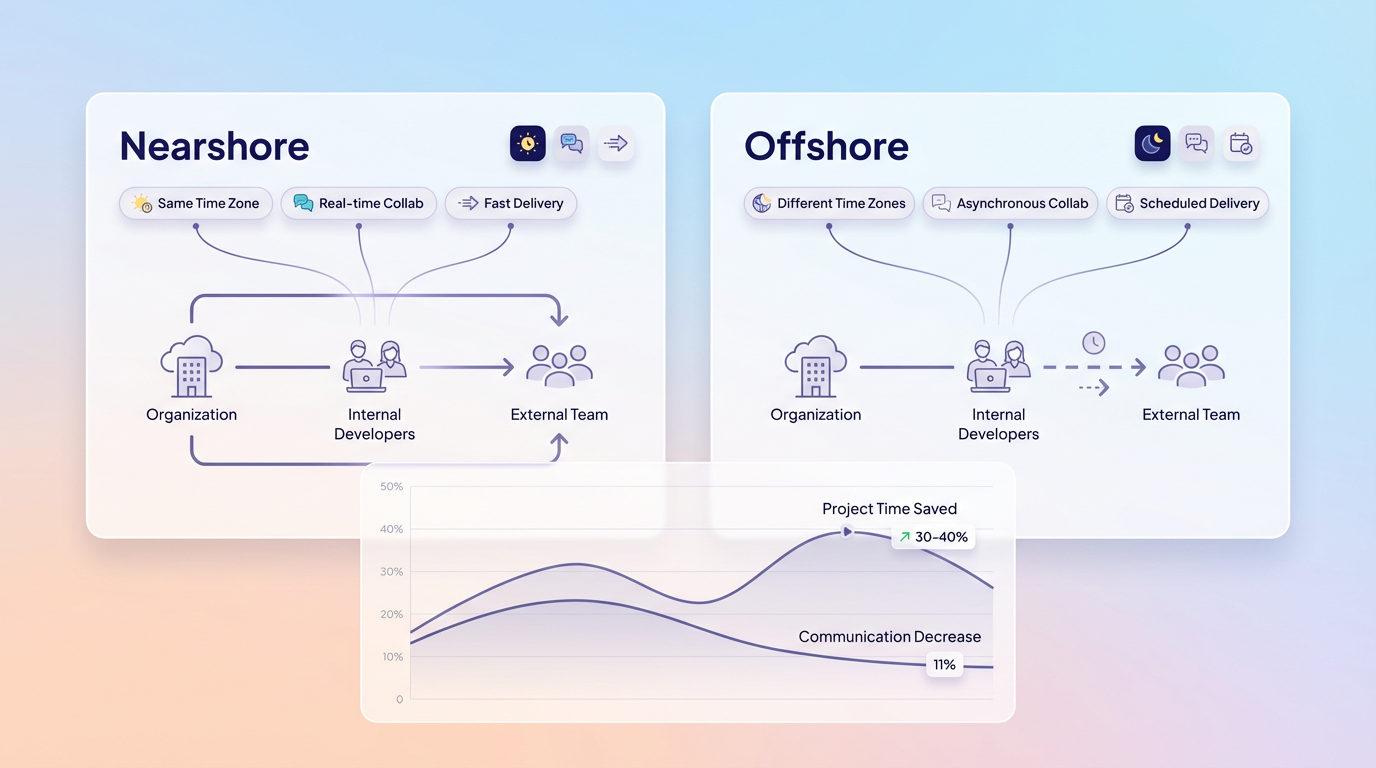
A clean SaaS dashboard illustration with two rounded cards labeled 'Nearshore' and 'Offshore', showcasing workflow diagrams in muted purple.

Outcome-Based Engagement

Companies want to manage these budgets effectively, and they transition from hourly billing rates to outcome-based pricing models to ensure software quality. Hourly contracts prioritize mere presence over actual productivity. In these traditional setups, vendors bill for hours worked regardless of the final product's functionality. This financial misalignment often hides inefficiencies within offshore outsourcing operations. When companies pay for hours, they absorb the financial risk of slow onboarding and training delays. Data reveals that new hires typically operate at 25% productivity during their first four weeks, and they require eight to twenty-six weeks to reach full capacity.

Outcome-based engagements shift this financial risk back to the vendor. Companies define specific deliverables, and the external partner receives payment only upon successful deployment. This model works particularly well for early-stage products, MVP development especially benefits when a fixed scope and fast delivery directly affect market validation. Vendors must deploy senior engineers who understand complex architectures and do not pad accounts with junior developers. Outcome-based pricing requires strict definitions to function properly. Companies implement automated tools and a content generator to document project requirements and acceptance criteria accurately. When expectations remain clear, external partners align their development cycles with the business objectives. Outcome-based contracts guarantee that organizations pay for completed features and do not fund the vendor's learning curve. This pricing shift changes the vendor relationship from a transactional resource exchange into a strategic technical partnership.

ROI and Success Measurement

Organizations evaluate this strategic technical partnership carefully, and companies measure the success of their external partnerships through time-to-market acceleration and technical debt reduction. Traditional ROI calculations often rely on flawed hourly rate comparisons. Instead, organizations evaluate deployment frequency and code accuracy. High-performing teams release software updates faster and require fewer rollback procedures. When external developers write clean code the first time, internal teams spend less time to fix architectural mistakes. This technical validation proves the true value of the outsourcing partnership.

The evaluation of nearshore vs offshore outsourcing models requires tracking long-term team stability. High developer turnover disrupts project momentum because new engineers must learn the existing codebase from scratch. When a departed engineer needs replacement, feature development halts and technical debt increases. Industry records show that nearshore development partners maintain 93-98% client retention compared to 60-75% offshore average rates. This stability allows nearshore outsourcing partners to build deep institutional knowledge over time. Senior developers who understand the product history write better code and anticipate integration issues before they occur. Organizations calculate their final ROI when they measure how much management overhead the external team requires. Successful partnerships operate autonomously and deliver features without constant internal supervision. Companies build resilient engineering organizations that sustain long-term growth when they focus on deployment quality instead of hourly costs.

Conclusion

Companies focus on this deployment quality to build resilient engineering organizations. To summarize our major points, companies align their outsourcing strategies with specific technical and security requirements. The decision between nearshore vs offshore outsourcing shapes the operational resilience and deployment velocity of engineering initiatives. While offshore teams provide large scale for structured execution, nearshore partners deliver the real-time collaboration necessary for complex innovation. Organizations will increasingly adopt hybrid structures that combine the advantages of both models. These organizations take the next step when they evaluate project complexity and team communication needs before they restructure their teams. They also explore strategies for AI content creation to maintain stakeholder engagement during these operational transitions.


You should sign an initial contract for six to twelve months. This timeframe gives developers time to understand your business goals and deliver working software. Short agreements force teams to rush their work, and they can't write good code under pressure.

You can ask candidates to take standardized language tests or conduct video interviews. Many organizations require a B2 level or higher on the Common European Framework of Reference for Languages. Video calls help you evaluate how well programmers discuss technical concepts.

You must register your intellectual property rights in your home country and outline ownership in the vendor agreement. You don't want foreign laws governing your code ownership. A local legal team can draft contracts that assign all copyright and patent rights directly to your company.

You need a team of three to five engineers to build an initial product. A company like Pollume assigns frontend and backend developers to create your application. Small groups communicate better and spend less money while they test core features with early users.

You can transition your team, but you need to plan the knowledge transfer over several months. You'll evaluate nearshore vs offshore outsourcing options to decide which structure fits your new budget. The old team must document their code before the new engineers take over the project.

Book a call

Book a time that works best for you

You Might Also Like

Discover more insights and articles