Node.js development cost discussion

Node.js Development Services Cost 2026 | Complete Price Guide

In this article, we examine the true expenses of Node.js applications, break down initial development costs, and uncover hidden maintenance obligations. This guide provides information to help organizations budget accurately and avoid unexpected financial pitfalls throughout the software lifecycle.

Content authorNikita SivtsovPublished onReading time9 min read

Introduction

Modern Node.js application development requires an initial investment that can range anywhere from $25,000 to well over $250,000 in 2026. Funding the initial codebase is a significant step, but the complete total cost of ownership presents a true financial challenge. The development phase represents only a fraction of what an organization will ultimately spend. The bulk of the expense resides in hidden post-launch obligations, such as dependency management, infrastructure scaling, and continuous security updates. For instance, annual software maintenance costs typically consume 15 to 25 percent of the original development budget. When organizations fail to account for these recurring obligations, they often encounter technical debt that slows down innovation and increases their budgets. A thorough strategy for nodejs development services forecasts these long-term expenses alongside upfront coding costs to ensure the application remains secure, performant, and financially sustainable.

Baseline Investment Parameters

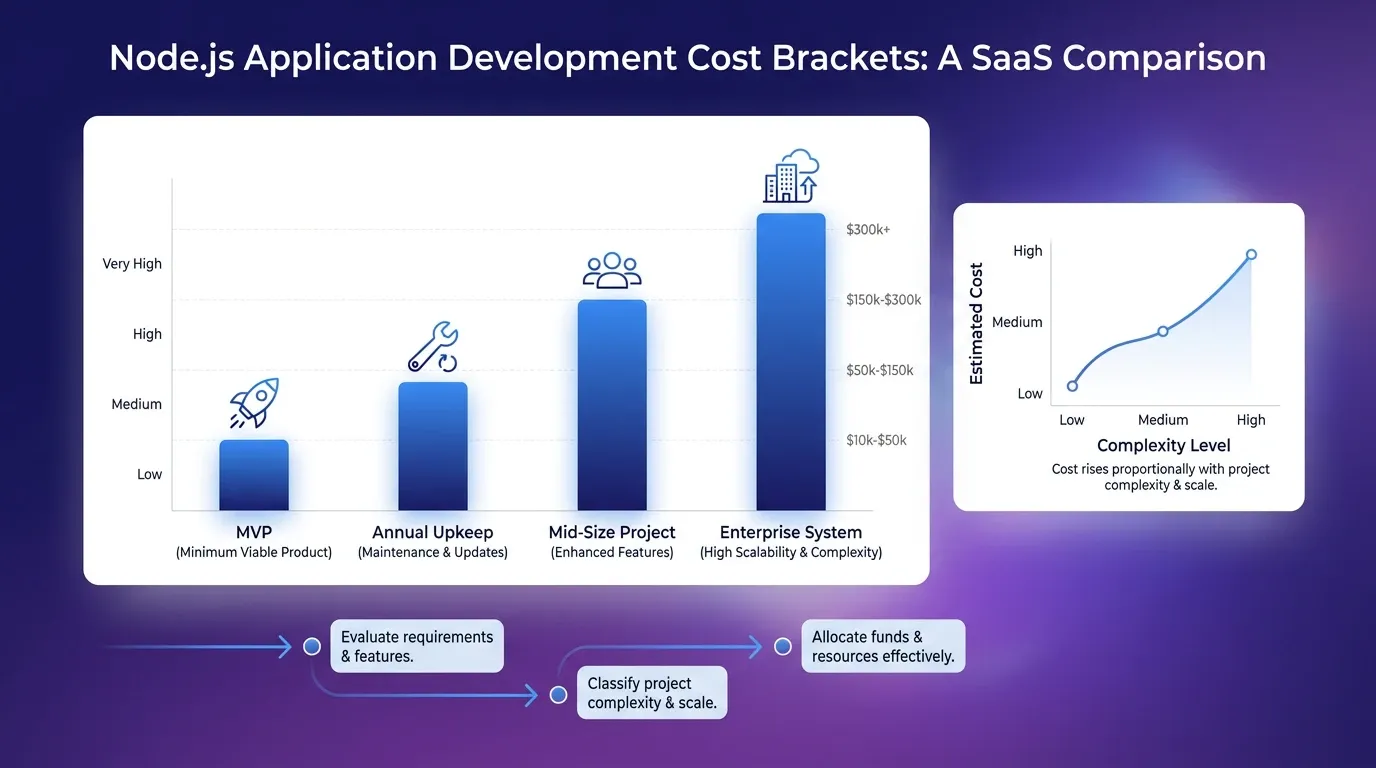
These upfront coding costs dictate the initial financial commitment required to launch a functional Node.js application. These projects require a clear evaluation of core requirements before funds flow to a specific development tier. Organizations that apply a strong brand-building framework usually start with a basic project to test market viability. According to Abbacus Technologies, developers build small Minimum Viable Products for $7,000 to $25,000, and these basic applications require an additional $1,000 to $5,000 annually for upkeep. Complex projects require steeper upfront costs as features multiply and data structures expand. Development teams classify these broader financial commitments for nodejs development services into distinct pricing brackets based on technical demands:

  • Mid-size projects cost $25,000 to $100,000 and incorporate custom third-party integrations.

  • Enterprise systems require an investment between $100,000 and $500,000 to handle complex microservices architecture.

This pricing precision helps organizations secure adequate funding for the coding phase. Companies plan accurately when they understand exact market rates. However, this initial budget allocation only covers the surface layer of the software's true lifetime expense.
Node.js application development comparison

Npm Ecosystem Expenses

Open-source modules act as the foundation for modern JavaScript development, and they carry substantial hidden financial burdens that add to this lifetime expense. These packages reside in the Node Package Manager ecosystem and help programmers speed up product delivery. This ecosystem saves initial coding time, but it shifts the financial burden toward continuous maintenance. Outdated packages require regular audits to guarantee the protection of digital assets. Unchecked packages compound technical debt rapidly and choke the application's performance, which is why backend architecture decisions made early in the project have such long-term consequences.

Vulnerable modules add to this maintenance burden. Black Duck reported that 81% of applications contained high or critical-risk open-source vulnerabilities in 2025. These flaws consume countless engineering hours during the remediation process. Analysts from Quandary Peak estimate the five-year Total Cost of Ownership for a single major open-source component reaches $135,498. This massive expense stems from integration testing, version bumps, and continuous security patching.

Software budgets must reflect these ongoing realities to achieve financial certainty. These financial plans need to account for software maintainers who constantly monitor repositories for deprecation warnings and breaking changes. Appropriate funding ensures that applications remain stable. These budgets also support structured data management, which depends heavily on healthy underlying libraries. Engineers look closely at how code libraries intertwine beneath the surface to uncover these specific ecosystem expenses.


Dependency Vulnerabilities

Deeply nested code libraries introduce complex security risks that demand constant monitoring. Standalone packages rarely exist in isolation, because they usually rely on other packages to function. These indirect inclusions form a massive dependency tree. According to DEV Community metrics, an average npm project pulls 79 transitive dependencies into its core architecture. Each hidden library within this tree represents a potential entry point for malicious actors. Organizations that value data safety typically address this layer of risk immediately. Organizations often use a nodejs development services calculator to project the costs of this active management. The management process requires engineers to regularly scan the entire tree and manually resolve conflicts when automated patches fail. This constant vigilance naturally extends to the broader risks of external code injection.

Supply Chain Threats

External code injection often leads to software supply chain attacks that force organizations to spend heavily on emergency remediation protocols. These attacks occur when hackers target popular open-source repositories to distribute malicious updates to thousands of applications simultaneously. The structural soundness of every dependent project collapses instantly if a core library falls under attacker control. The SANS Institute detailed how the widely used Axios npm package suffered a compromise on March 31, 2026, and this breach affected over 100 million weekly downloads. Such massive threats require immediate action to prevent further damage. Delayed remediation multiplies the financial damage for the affected organizations. These emergencies require engineering teams to halt feature development, isolate the affected components, and rewrite integration layers. A Node JS development company usually anticipates these crisis scenarios and budgets for rapid incident response. This response proves that securing third-party code represents an inescapable cost of modern software ownership.

Impact of Talent Shortages

The cost of modern software ownership also increases because the shrinking pool of senior technology professionals drives development rates upward and forces organizations to rethink their hiring strategies. According to forecasts from the International Data Corporation, the IT skills shortage will cost organizations $5.5 trillion by 2026. This scarcity severely limits how companies source talent to build reliable systems. To offset rising upfront expenses, companies sometimes hire inexperienced programmers who offer low hourly rates. However, this approach compromises application quality and generates expensive technical debt.

When organizations prioritize cheap labor over deep expertise, they often pay more later. Inexperienced coders write poorly optimized architecture that lacks scalability and requires constant fixing. A Stripe Developer Coefficient Report indicates that engineers spend approximately 17 hours per week to deal with maintenance issues and debug bad code. To prevent these recurring expenses, companies engage professional nodejs development services that supply seasoned architects. Expert engineers write clean code that reduces long-term maintenance. Similar to how AI visibility marketing requires precise data to function correctly, application development requires deep technical knowledge to establish a solid foundation.

Organizations often perform specific actions to prevent financial losses that inexperienced teams cause:

  1. Audit complex systems frequently because junior developers build inefficient database queries that slow down server response times.

  2. Hire senior architects at premium rates to rewrite tangled logic and resolve deep-rooted structural flaws.

  3. Allocate additional capital to patch security vulnerabilities that inexperienced coders missed during the initial build.

Organizations build trust with stakeholders when they invest in experienced professionals, and they structure their teams carefully to maximize budget efficiency.

Right Engagement Models

Organizations evaluate different hiring frameworks to overcome the talent shortage and control software budgets effectively. An in-house engineering department requires overhead expenses, such as employee benefits, equipment, and office space. To bypass these fixed costs, organizations frequently partner with an external full stack development team rather than building an in-house department from scratch. Outsourcing provides financial flexibility, but the geographic location heavily influences the final invoice.

Offshoring to distant countries offers the lowest hourly rates, but extreme time zone differences disrupt communication, and teams cannot collaborate effectively. Industry data indicates that Eastern European senior developers charge between $30 and $59 per hour, while Latin American engineers bill $32 to $65 per hour in 2026. Because of this pricing parity, nearshoring to Latin America has emerged as a cost-effective alternative for North American businesses. This model maintains working hour alignment and fosters real-time collaboration.

Fast Dolphin reports that Latin American senior developers bill 40 to 60 percent lower than their United States equivalents for the exact same roles. This geographic strategy eliminates the need to schedule midnight meetings to monitor daily progress. Similar to how search engine optimization demands consistent regional targeting, software engineering requires strong regional alignment to ensure clear communication and predictable project expenses. Overlapping time zones provide better communication that distant offshore models cannot match, and this geographic stability prepares organizations to tackle long-term operational costs.

Post-Launch Infrastructure Budgets

These long-term operational costs transform into continuous operational expenses after organizations launch an application, and they affect the financial stability of the software. Many organizations incorrectly assume that spending stops once the codebase reaches production. In reality, modern applications require strong cloud infrastructure, continuous security testing, and active performance monitoring. Research from Gartner shows that 70 percent of enterprise IT budgets go toward maintenance rather than innovation. Organizations typically allocate at least twenty percent of their initial development budget for annual post-launch operations to keep the software functional.

Poorly planned infrastructure leads to technical debt that compounds over time. A 2026 Global Technology Leadership Study from Deloitte reveals that technical debt accounts for 21 to 40 percent of an organization's IT spending. To minimize these losses, engineering teams implement Development and Operations tools that automate routine server scaling and code deployments. This automation reduces manual labor hours and prevents costly system downtimes. Financial planners often rely on a nodejs development services calculator to forecast these precise operational requirements months in advance.

Companies maintain better budget control when they accurately map out their long-term infrastructure needs before they write the first line of code. Adequate funding for continuous security testing allows the engineering team to identify vulnerabilities early so they do not crash the system. This proactive financial strategy builds confidence among stakeholders and ensures the application functions well over its entire lifecycle.

Conclusion

Stakeholders build this confidence when they understand the complete cost of ownership for Node.js applications. Organizations need more than just funds for the initial codebase to build these applications. Proper budgets for ongoing dependency management and continuous security updates dictate the long-term success of the software. Teams that scope their Node.js projects properly from the start prevent the infrastructure gaps that most early budgets fail to account for. Organizations use nodejs development services to prevent costly flaws and ensure a return on investment. They secure future software projects against technical debt when they address maintenance requirements proactively. An immediate review of all project budgets helps organizations account for these post-launch realities.

Developers usually complete a basic application in two to three months. This timeline changes based on the features you want to include. The schedule extends to four months if you don't keep your data processing simple.

You should choose hourly billing when you purchase nodejs development services because software requirements change often. Fixed prices force engineers to rush their work so they don't lose money. Hourly contracts give you flexibility to adjust features.

You can hire an outsourcing firm like Pollume to build your digital product. The company specializes in full-stack development and helps clients refine concepts before coding begins. Their engineers focus on iterative delivery so you don't waste money on unnecessary features.

You should host your application on platforms like Heroku or DigitalOcean during the first year. These providers offer cheap introductory tiers that won't strain your budget. You can move your database to Amazon Web Services when your user base grows.

Developers prefer to use MongoDB because it handles information the same way the application does. This shared format helps engineers write code faster so they don't make mistakes. You can also use PostgreSQL if your product requires strict financial transaction records.

Book a call

Book a time that works best for you

You Might Also Like

Discover more insights and articles

AI cost dashboard for MVP

7 Critical Steps to Control Artificial Intelligence Cost During MVP Development

In this article, we examine the financial realities of integrating machine learning features into minimum viable products. We explain how to identify hidden infrastructure expenses and implement structural safeguards that prevent massive budget overruns during early development.

AI development workflow diagram

Guide to AI in Application Development: Complete 2026 Workflow

In this article, we demonstrate how software teams restructure development lifecycles to integrate artificial intelligence. We explain how to transition from experimental pilot phases to production-grade workflows.

UX design process in an MVP

How to Build an MVP: Extensive Architecture Guide for 2026

In this article, we explain the paradox of rapid software development in today's landscape and discuss why foundational architecture matters early on. We explore practical strategies to strip non-essential features and preserve structural integrity.

MVP development with UX steps

6 Steps to Integrate User Experience Design Principles into Minimum Viable Products

In this article, we outline a structured approach to embed design foundations into early-stage software releases. The discussion highlights practical methods to validate market hypotheses and protect development budgets from unnecessary features.