The outsourcing debate is framed wrong
Most founders I talk to treat the outsource software development question as a coin flip. Build in-house, or outsource software development abroad. Hire a team in Austin, or hire a team in Krakow. That framing is comforting because it's binary, and binary feels decisive. It's also the root of about 80% of the bad outcomes I've watched up close.
The yes-or-no debate hides when to outsource software development because the real questions are what to hand off and how much of the thinking has to stay on your side of the table. Those details are the whole game. A founder who outsources the wrong slice of work to the world's best agency will still ship the wrong product on time.
The global outsourcing market is now worth roughly $591 billion and growing every year, which means the supply side has never been more capable or more competitive. Failures keep stacking up because founders walk in with a switch in their hand when they should be walking in with a dial. This article is about how to turn the dial.
Three ways founders outsource software development wrong
After watching enough early-stage teams burn cash, the failures start to rhyme. They're rarely about bad engineers. They're almost always about the founder handing off the wrong thing, at the wrong time, with no agreement on how to talk about it. Here are the three patterns that keep showing up.
Outsourcing too early
The most expensive code in the world is code that builds a feature nobody asked for. And yet founders sign six-figure outsource software development contracts before a single customer has confirmed the problem is real. The logic feels right in the moment. You have an idea and some savings, so why wait? Because 43% of failed startups die from poor product-market fit, according to CB Insights' 2024 analysis of 431 shutdowns, and most of them had a working product when they died.
Founders mistake motion for progress. Watching a Jira board fill up feels like building a company. It isn't. Marc Andreessen put it bluntly in his 2007 essay on product-market fit: "You can always feel when product/market fit is not happening. The customers aren't quite getting value out of the product, word of mouth isn't spreading." If you can't feel it yet, a vendor cannot manufacture it for you.
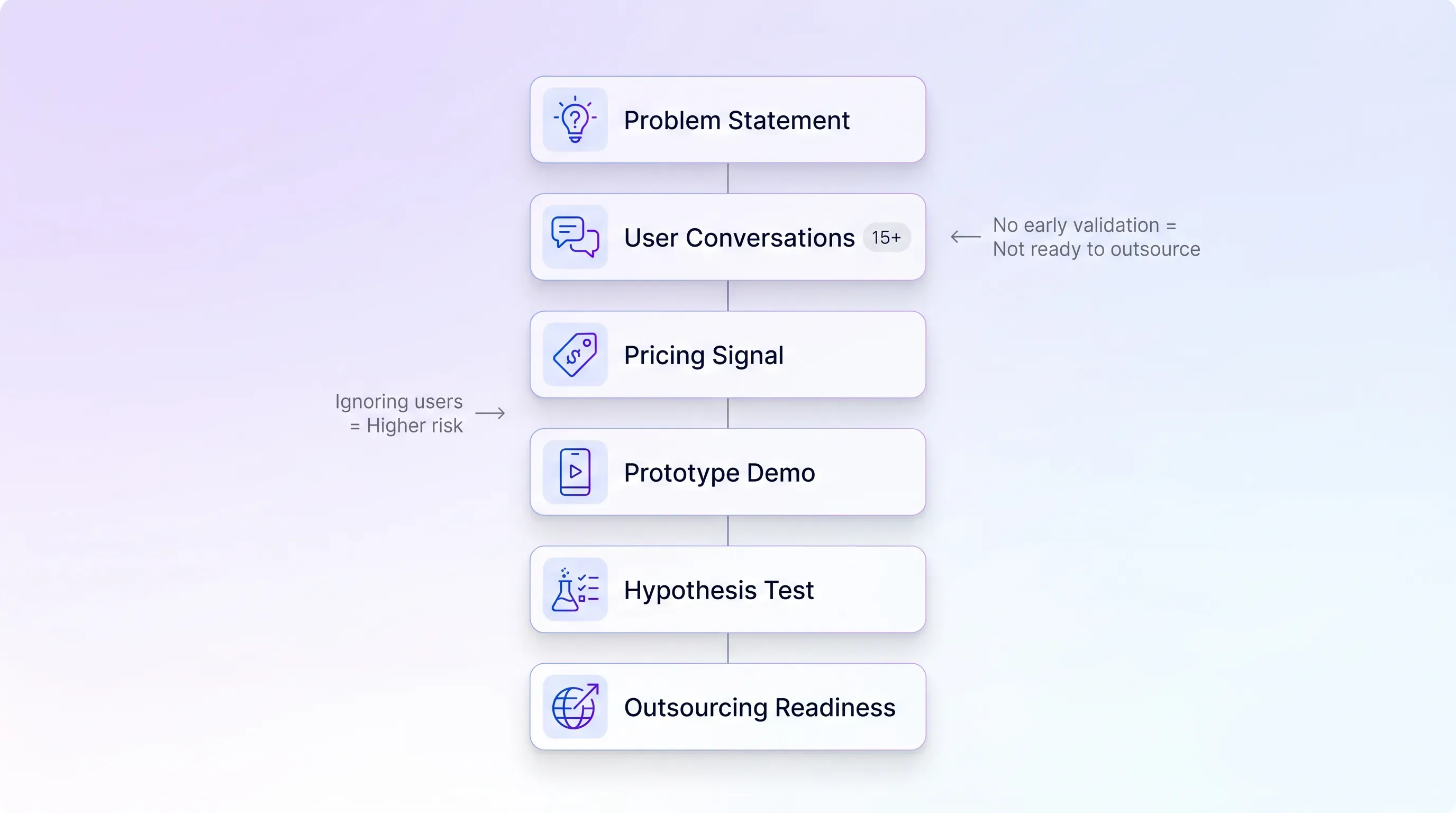
What early validation should look like before any decision about when to outsource software development is made:
-
A documented problem statement based on at least 15 conversations with potential users
-
A pricing signal, meaning someone has said "I'd pay for that" or actually pre-paid
-
A no-code or Figma prototype that you've put in front of those users
-
A written hypothesis about what you're testing in the first build
If you can't write those four things on one page, you're not ready to outsource software development. You're ready to talk to more customers. Paul Graham's "make something people want" line is famous because it keeps being ignored, especially by founders with money to spend.

Outsourcing the wrong layer
This one is sneakier. The founder has a real problem with real users behind it, and real money is on the table. They sit down to write the spec and run out of patience halfway through, then ship a half-formed Notion doc to a vendor labeled "build this." Product thinking got outsourced under the cover of engineering tickets.
Architecture choices, user flows, prioritization, what to cut, what to fake, what to defer, these are product decisions. They belong to the founding team because they encode your bet on the market. When you ship them to a vendor, the vendor will make those calls based on what's easiest to build instead of what's right for your customer. That's not their fault. They don't know your customer.
A few examples of work that looks technical but is actually strategy in disguise:
-
"Build a notifications system." Translation: decide which events matter enough to interrupt a user, and that's a retention call.
-
"Add a billing flow." Translation: pick a pricing model and decide how to handle failed payments. All revenue decisions.
-
"Set up the onboarding." Translation: decide what the first three minutes of your product feel like, which is the single highest-leverage UX surface you own.
When founders outsource these as tickets, they get back working code that solves the wrong problem. The fix is to keep the thinking close and outsource software development execution. Write the spec until it bores you, then hand it over.
Outsourcing without a communication contract
The third pattern is the quietest killer. Founder and vendor sign the SOW and exchange Slack handles, with "sync as needed" as the operating plan. Two weeks later, the founder asks for an update and gets a wall of screenshots from a feature nobody scoped. Six weeks later, the deadline slips and nobody saw it coming.
Deloitte's 2020 Global Outsourcing Survey found that supplier management is "underpowered" in most client organizations, with some providers describing client-side vendor management as "chaotic" and "purely cost-focused." The fix requires a one-page communication contract before work starts.
A basic communication contract should cover:
-
A weekly status format with three sections: shipped, in progress, blocked
-
A standing 30-minute call, same day same time, with a named owner on both sides
-
A written escalation path for when a blocker isn't resolved in 48 hours
-
A demo cadence, even if the demo is one screen of one flow
-
An agreement on what "done" means before a ticket is started, not after
Silence between updates compounds. Day one of misalignment is a five-minute conversation. Day thirty is a rebuild. The contract is the thing that lets you sleep.
Development outsourcing as a spectrum, not a switch
Once you accept that the three mistakes above are about what and how, not whether, the model shifts. Development outsourcing is a gradient, and you choose where on the gradient your team sits for each piece of work.
On one end, there's staff augmentation. You rent engineers who plug into your team and follow your direction. You own the roadmap and delivery risk, including the architecture. Innowise's breakdown of the two models puts it well: with augmentation, "the responsibility still sits with you."
In the middle, there's project-based delivery. When you outsource software development this way, you hand a vendor a defined scope with a fixed outcome, like "migrate our backend from Heroku to AWS by Q2." The vendor owns delivery against that scope. You own everything outside it. This is where most well-run development outsourcing engagements live.
On the far end, there's fully managed product teams. The vendor owns design, engineering, QA, and sometimes product management, against business outcomes defined in an SLA. You set the destination. They drive. This works for non-core work, like an internal admin tool, and is almost always a disaster for the product your company is named after.
A founder's actual decision is "which point on this spectrum, for which slice of work, right now." Different slices of your roadmap belong at different points. Treating that as one decision is what creates the binary trap.
A 2x2 matrix for when to outsource software development
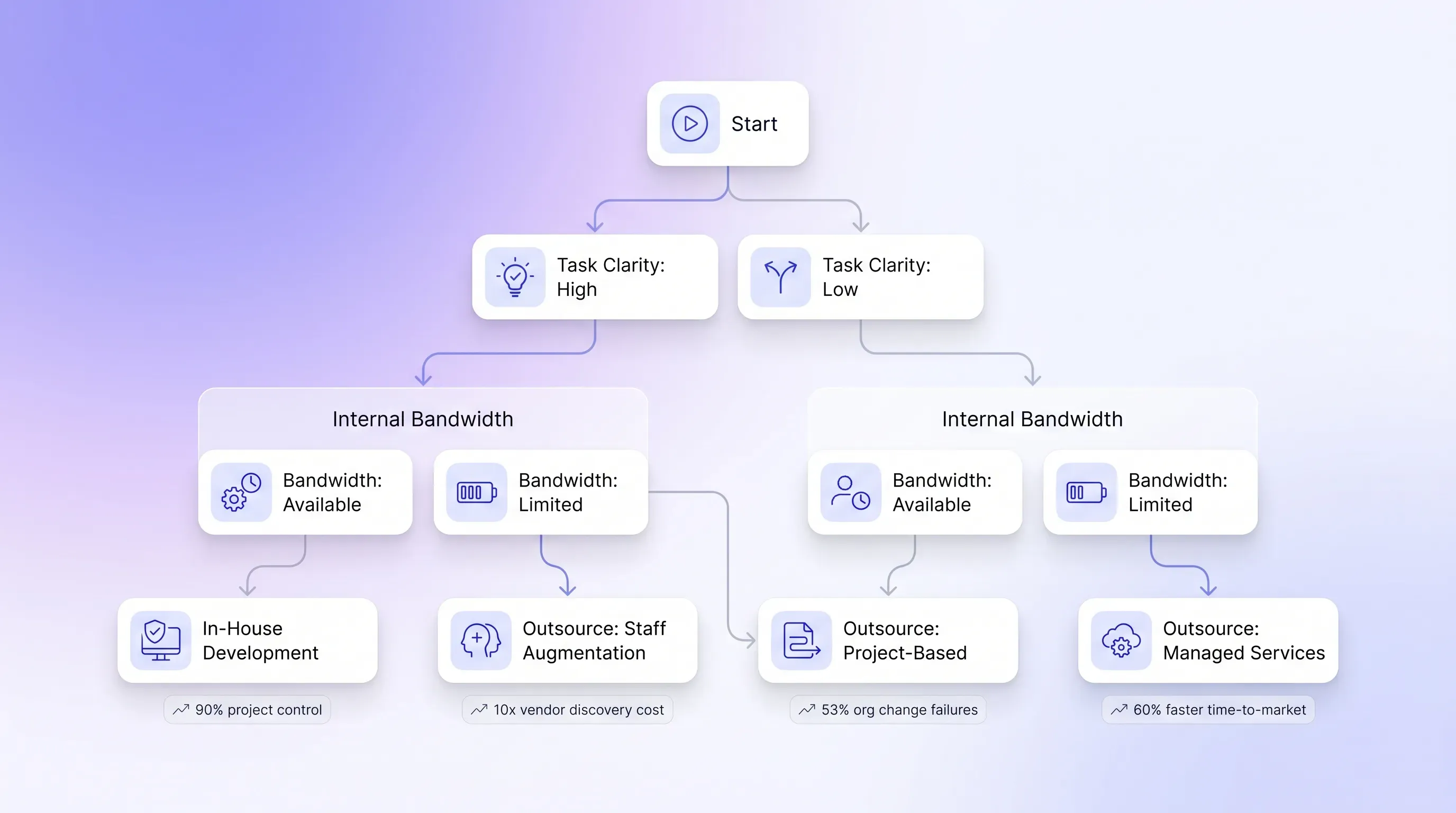
Here's the framework I use when founders ask me when to outsource software development. Two axes. Task clarity on the horizontal, internal bandwidth on the vertical. Four quadrants. You can draw it on a napkin in 30 seconds, and it will save you months.
Task clarity means: do you have a written spec a stranger could build from without asking you 50 questions? Internal bandwidth means: does your team have the hours and the focus to do this work in the next 90 days without dropping something else? Both are honest yes-or-no questions. Lie to yourself on either axis and the matrix breaks.

High clarity, low bandwidth
This is the strongest case for outsourcing, and it's where most successful engagements live. The work has a tight spec, and your team is buried. Hand it off.
Typical work in this quadrant: a Stripe integration with a documented pricing model, a SOC 2 readiness sprint, a database migration with a known schema, or a platform port from React Native to native iOS. The vendor relationship that fits best here is project-based delivery with a fixed scope and a fixed price. Staff augmentation also works if you have a strong technical lead internally to review the code.
The risk in this quadrant is small but real: assuming the spec is clearer than it is. Run the spec by one engineer who doesn't work for you before you send it. If they have questions, the spec isn't ready.
High clarity, high bandwidth
This quadrant belongs in-house, and founders get it wrong by reflex. The team has the spec and the time, yet someone says "let's outsource software development to move faster." You'll move sideways while paying a premium.
More importantly, you'll erode internal knowledge. The code your team writes is the code your team understands six months from now when it breaks at 2 a.m. Development outsourcing here trades long-term ownership for short-term throughput, which is almost never a good trade for early-stage teams.
The reasonable exception: when the work requires a skill your team doesn't have and won't need long-term, like a one-time machine learning model or a niche compliance review. Then staff augmentation on a short tail is fine. Outside that exception, build it yourself.
Low clarity, low bandwidth
This is the danger zone. The problem is fuzzy, and your team is underwater, so the temptation is to outsource software development and have a vendor "figure it out for us." That sentence is the most expensive sentence in startups. Vendors cannot validate your product strategy. They can only execute against what you tell them, and if what you tell them is vague, you'll pay for vague work.
Deloitte's outsourcing research is consistent on this point. The biggest breakdowns in outsourcing come from inadequate organizational change management (53%) and poor integration of vendor services (47%), both of which start with unclear internal ownership of the problem.
The right move here is to stop spending and gain clarity. Cancel the meeting with the vendor. Spend two weeks on customer calls, prototype sketches, and writing the spec. Then re-evaluate. If you skip this step, you're funding a vendor to discover what you should have discovered yourself, at 10x the cost.
Low clarity, high bandwidth
This quadrant is for internal discovery and validation, and it's where founder-led teams have a real edge over any vendor. When the problem is ambiguous, the people closest to the customer and the strategy are the only ones who can resolve the ambiguity. That's you.
Use your team's bandwidth to build the throwaway version. Talk to users with it. Find the parts that work and the parts that don't. The output of this quadrant is a spec. Once you've sharpened the ambiguity into a real spec, the work moves to the high-clarity quadrants, and that's when development outsourcing becomes a clean handoff.
The mistake I see most often here is founders skipping this quadrant because it feels slow. It is slow. It's also the only quadrant where the most important question of the company, which is what to build, actually gets answered.
The pre-contract checklist
Before you sign anything, run through this list. It takes 20 minutes. If you can't answer yes to all of it, don't sign yet. Spend a week getting to yes first.
-
Validated problem. At least 15 customer conversations on file, with at least three people who said they'd pay or have pre-paid.
-
Written spec. A document a stranger could build from, with screens and acceptance criteria.
-
Defined quadrant. You know which of the four quadrants this work sits in, and you know why outsourcing is the right call for that quadrant.
-
Communication cadence. Weekly status format agreed, demo cadence agreed, escalation path agreed, all in writing.
-
Named owner on the founder side. One person on your team is accountable for the engagement.
-
Exit conditions. You know what triggers a pause or a termination, and so does the vendor. Written into the SOW.
-
IP and code ownership. You own the code from day one, and the repository lives in your org because the contract says so.
-
Reference checks. You've talked to two past clients of the vendor, not from the vendor's website, who shipped a comparable project.
This checklist is the difference between development outsourcing as a force multiplier and development outsourcing as a slow leak. It's also the cheapest insurance policy you'll ever buy.
Outsource the execution, not the thinking
The mistakes and the matrix point at the same thing. When to outsource software development is a question about where your attention belongs as a founder, which is on the parts of the product nobody else can resolve. The customer problem. The strategy. The bet. Everything downstream of those can be handed off once you've thought hard enough to write it down.
Development outsourcing done well buys you time and skill you don't have. Done badly, it buys you a Jira board full of work that solves the wrong problem on a budget you can't get back. The clarity you bring to the engagement before the first invoice makes the difference between the two.
Audit your current setup against the checklist. If you're mid-engagement and three of the eight items are missing, fix that this week before you ship another sprint. The fix is a one-hour conversation. The cost of not having it is everything else.