The $50K question most founders get wrong
Most founders treat $50K as a roughly fixed unit of engineering output. Put it toward any hiring model, and you assume you get a similar pile of working code at the end. That assumption is the source of more failed MVPs than any technical decision. The in house vs outsourcing software development debate looks like a values question on Twitter, but at this budget it's a math question.
The scenario we'll run through is deliberately ordinary: a two-founder fintech that is building a payments MVP and needs one full-time-equivalent developer for about a year. Rates come from the U.S. Bureau of Labor Statistics and market data that includes Upwork's published category data alongside European agency benchmarks. No verdict up front. Just the arithmetic.
Setting up the scenario
The company is two non-technical co-founders with a domain background in consumer lending. They've validated demand with twelve design-partner interviews and need a working prototype that handles KYC onboarding and a Plaid integration, with a basic ledger in the same build. Target launch is month 10. The quality bar is "a regulator wouldn't laugh at the code," which matters because fintech audits arrive earlier than founders expect.
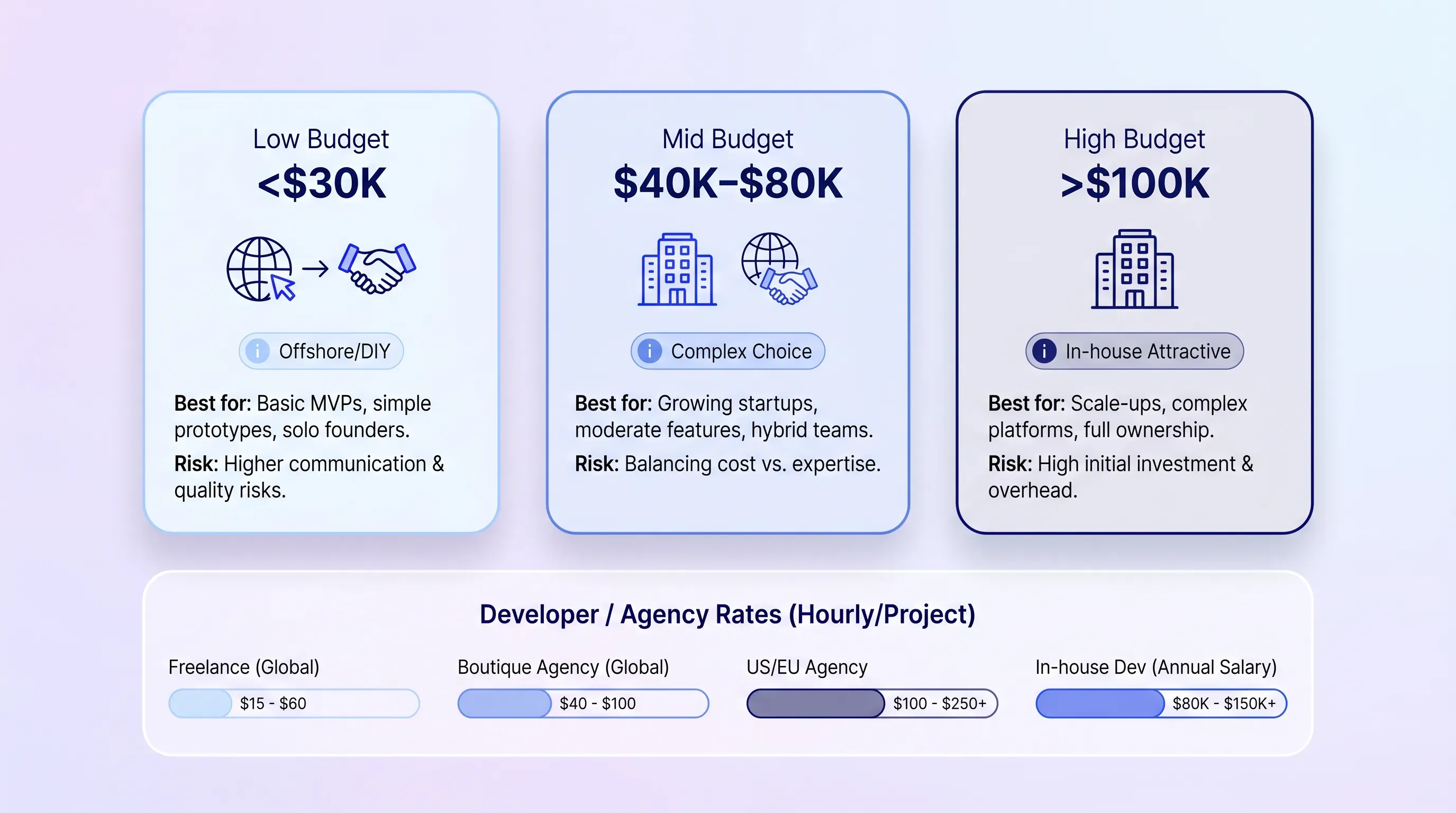
The budget cap is $50K for the year, all-in. That's the contested zone. Below $30K the in house vs outsourcing software development conversation is short, because you're hiring offshore juniors or doing it yourself. Above $100K the in-house calculus changes. The $40K to $80K bracket is where in house vs outsourcing software development decisions get genuinely difficult, because every model technically fits but each produces a different output.

Reference rates throughout:
In house vs outsourcing software development at $50K
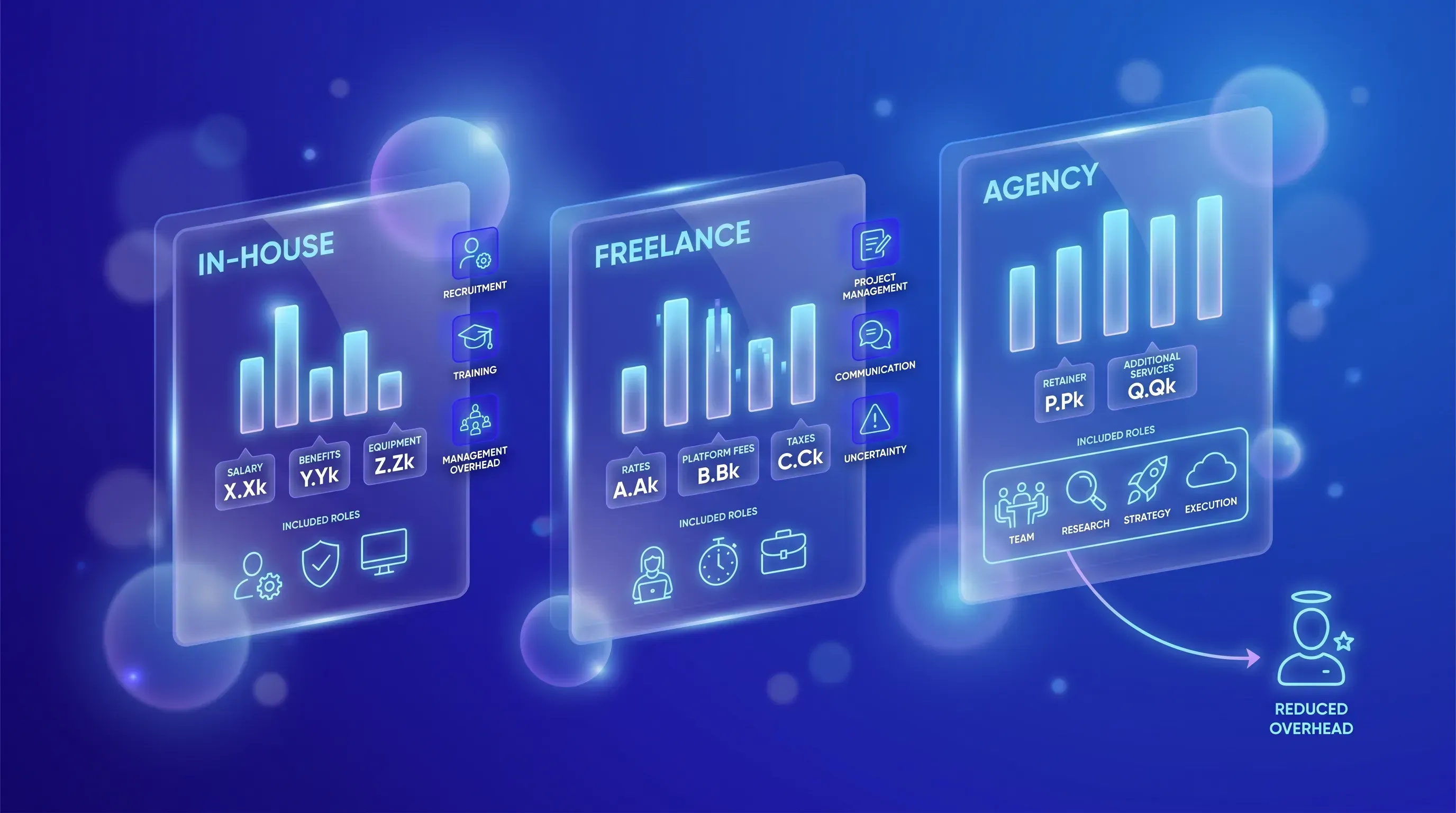
Now the same $50K runs through three pipelines. For each, we'll calculate deliverable hours, what's bundled in, and what risk the founder absorbs personally. The numbers are the argument here, so the prose stays out of the way.
The in-house junior developer
The sticker price of a U.S. junior is the first problem. A base salary of $71,000 already blows past $50K before a single benefit kicks in. So the realistic in house vs outsourcing software development comparison at this budget pushes the founder toward either a junior hire in a low-cost U.S. metro or a Western European junior at €30 per hour.
Let's price the European version, because it's the only one that fits. A Berlin or Lisbon junior on a €40,000 base costs the employer closer to €52,000 once you add the 30 to 40 percent employer overhead the U.S. Bureau of Labor Statistics tracks and European social charges mirror. At today's exchange rate that's around $56,000. You're already over budget, and we haven't bought a laptop.
Here's what the $50K actually covers when stretched:
-
Roughly 9 months of a junior at €40K base instead of 12
-
A MacBook and basic SaaS stack at about $4,700 to $12,000 per year per developer
-
Recruiting cost averaging $4,700 per hire according to SHRM
-
Zero buffer for sick days, holidays, or the ramp-up tax
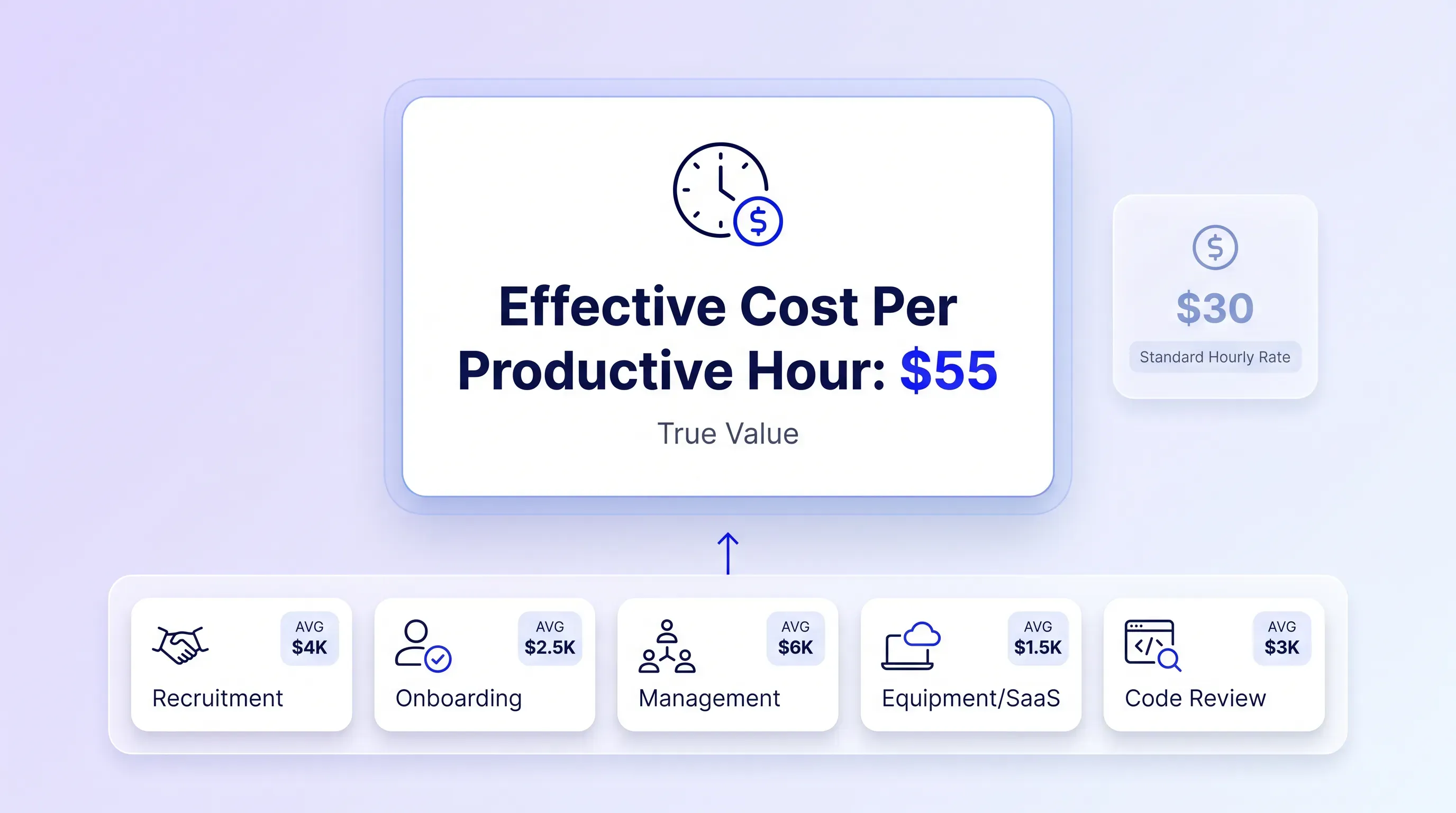
The ramp-up tax is the line item nobody writes down. GitLab's 2024 research found that 44% of organizations say onboarding a new developer takes more than two months. PanDev Metrics puts full productivity at two to four months with an S-shaped curve. For a junior on a fintech codebase, lean toward four. That means of the 1,800 working hours in a year, maybe 900 to 1,000 are net-productive once you subtract ramp, meetings, sick leave, and the founder time absorbed by managing them.
Founder management overhead is the other invisible cost. If you hire dedicated developers in-house, one of you becomes a part-time engineering manager whether you wanted the job or not. Plan on 5 to 8 hours a week of founder time per direct report.
The freelance software developer route
An Upwork contractor looks like the budget hero. At an intermediate rate of $40 an hour, $50K buys 1,250 hours of work. That's more raw hours than the in-house route delivers. The math is seductive until you read the fine print.
First, the platform tax. Upwork's freelancer service fee is a flat 10 percent on most contracts, and clients pay an additional 3 percent payment processing fee. A contractor charging $40 to take home needs to bill closer to $44.50, which trims your effective hours. Then there's the rate band itself. A U.S.-based freelance software developer in the same skill range quotes $60 to $85 per hour, while a Western European freelance software developer lands between $40 and $65. The $40 rate means a part-timer in Eastern Europe or Latin America.
The second issue is availability. Most freelancers on the platform are not full-time on a single client. Vollna's 2024 Upwork analysis found the average one-month project budget sits between $20 and $135, which tells you something about the engagement model. A contractor juggling three clients gives you 20 hours a week of focused attention. That's around 1,000 usable hours per year, with context-switching tax baked in.
The third issue is what happens to the code. When a freelance software developer disappears in month 8 because a better contract appeared, you inherit:
-
A repository whose conventions only the freelancer understood
-
Documentation that ends where the last invoice ended
-
No backup person who can pick up the thread without weeks of reverse-engineering
None of that shows up in the hourly rate.
Hire dedicated developers through an agency
The agency model looks the most expensive on paper. A Central or Eastern European agency rate of $50 per hour buys 1,000 hours of a dedicated developer over the year. That's fewer raw hours than the freelance option and roughly comparable to the in-house net. In the in house vs outsourcing software development comparison, the price difference shows up in what's bundled.
When you hire dedicated developers through an agency, the hourly rate quietly includes a project manager touching the work a few hours a week, QA coverage on the same deliverables, a backup developer who can step in if your primary is sick or quits, and a documented delivery process the agency owns. SCALO in Wroclaw and similar Polish agencies advertise around $40 per hour for this bundle. Romanian and Ukrainian agencies sit in the same band, with Ukrainian senior developers ranging from $35 to $70 per hour direct.
The interesting part is what the agency absorbs that you don't see on the invoice. Recruiting risk, sick day risk, turnover risk, and the cost of a failed hire all live on the agency's balance sheet. SHRM's data places the cost of replacing a developer at 50 to 200 percent of annual salary. When you hire dedicated developers through an agency, that risk transfers off your books.
Pricing is also similar across the Atlantic in the in house vs outsourcing software development model. A U.S. agency quotes $80 to $120 per hour for the same blended bundle, but U.S. agencies servicing this budget bracket build delivery teams from the same Central European talent pool. The headline rate moves while the unit economics stay the same.
What month 7 actually looks like
Upfront math is the easy part. The real test of in house vs outsourcing software development is what happens when something breaks midway through the build. Imagine month 7 of our fintech MVP. The team has shipped the KYC flow and the Plaid integration is live in sandbox. Then a design partner asks for a feature pivot, and the lead developer catches mononucleosis for three weeks just as a SOC 2 readiness review lands on the calendar.
The in-house junior path absorbs the disruption directly. The developer is out, so work stops unless one of the founders becomes the de facto engineer or the timeline slips. There's no slack in a one-person team. If the pivot also requires a skill the junior doesn't have, say a deeper Postgres performance audit, you're hiring a contractor on top of the salary you're already paying.
The freelance path looks similar but worse on continuity. A sick freelance software developer simply stops invoicing. The contract offers no SLA or replacement obligation. If they decide a different client is more interesting during the three-week absence, the contract quietly ends and you have to find another freelance software developer from cold start. That's a 4 to 6 week recruiting and ramp cycle on a project that can't afford it.
When you hire dedicated developers through an agency, month 7 looks different. The agency swaps in a backup developer who has been shadowing the project, while the project manager handles the scope-change conversation with the founders and the QA layer catches the regressions the pivot introduces. The cost shows up as a slight productivity dip instead of a project freeze. That's the part you pay the higher hourly rate for, and you don't see the value until it's tested.
Who owns the code and the knowledge
For a fintech, code ownership is an audit question. A SOC 2 auditor will ask who has commit access and how secrets are managed, with documentation location folded into the same review. The answer differs sharply across the three in house vs outsourcing software development models.
The in-house junior gives you the cleanest ownership story. The repository sits in your GitHub organization, and the developer signs an IP assignment as part of the employment contract while institutional knowledge accumulates inside the company. The risk is concentration. If the junior leaves at month 11 without documentation discipline, the knowledge leaves with them. Devsu's analysis cites SHRM data showing organizations lose an average of 42 percent of project-specific knowledge when turnover exceeds 20 percent per year.
The freelance route is the murkiest. IP assignment exists in the Upwork Terms of Service, but enforcement across jurisdictions is its own headache. A freelance software developer who uses a personal GitHub and personal laptop can also keep a personal Postgres instance for testing, which creates a documentation trail that lives outside your perimeter. Knowledge transfer at the end of the engagement is whatever the freelancer chooses to write down.
When you hire dedicated developers through an agency, the contract specifies IP transfer on payment and repository hosting in your environment; a documentation deliverable is part of the standard process. The agency has a commercial reason to make handoff clean, because their reputation depends on it. For a fintech building toward an eventual acquisition or Series A diligence, this matters more than the hourly rate.
The hidden line items nobody quotes
Every model in the in house vs outsourcing software development comparison has costs that don't appear in the initial quote. Surfacing them changes the effective hourly rate by 20 to 40 percent.
For the in-house junior, the hidden stack includes recruiting time (founder hours plus the $4,129 average cost per hire), onboarding ramp at 2 to 4 months of reduced output, management overhead at roughly 6 hours of founder time per week, equipment and SaaS at $4,700 to $12,000 per year, and the unbudgeted code review that one founder ends up doing on nights and weekends. Add those up and the effective cost per productive hour climbs from the headline $30 or so to around $55.

For the freelance software developer, the hidden costs are coordination and risk. Expect 3 to 5 hours of founder time per week on async management, scope clarification, and re-explaining context the freelance software developer forgot between sessions. Add the platform fee and the documentation gap, then account for the eventual transition cost when the engagement ends. Effective cost per productive hour rises from $40 to roughly $52.
When you hire dedicated developers through an agency, the hidden line items are smaller because most are pre-bundled. Founder time drops to 1 to 2 hours per week of standups and roadmap calls. QA and code review live inside the agency. The trade-off is less direct control and a slightly slower iteration loop on tiny changes. Effective cost per productive hour stays close to the headline $50, which is why this model wins quietly at the $40K to $80K band.
The decision matrix
The right in house vs outsourcing software development answer depends on founder technical literacy and project stage, with budget band setting the constraint. Mapping them to models clarifies the choice.
-
Technical solo founder, pre-seed, under $40K: do it yourself and supplement with a freelance software developer for narrow specialist work. An in-house hire at this budget burns cash faster than it ships code.
-
Non-technical founder, MVP stage, $40K to $80K: hire dedicated developers through an agency. You need the project management layer because you can't supply it yourself, and the documentation discipline matters for the fundraise that follows.
-
Mixed founding team, post-MVP, $80K to $150K: a hybrid model with one in-house mid-level developer and agency surge capacity outperforms either pure approach.
-
Funded team, post product-market fit, $200K plus: build in-house with selective agency augmentation for specialist work like SRE or ML.
The $40K to $80K bracket is where in house vs outsourcing software development math surprises founders. The in-house route looks affordable on the spreadsheet but underdelivers on net hours. The freelance route looks abundant but fragments under real-world pressure. The agency route looks expensive per hour and turns out to be the cheapest per shipped feature.
Running your own numbers
The scenario above is one set of variables. Yours will differ. Before committing to any in house vs outsourcing software development model, work through the same calculation with your own inputs. A short checklist to start:
-
What's the all-in cost of a junior in your target city after 30 to 40 percent employer overhead?
-
How many net productive hours does that buy after ramp, meetings, and management overhead?
-
What's the realistic weekly availability of the freelance software developer you'd hire, and what's the platform fee on top?
-
If you hire dedicated developers through an agency, what's bundled into the hourly rate, and what costs are still on you?
-
What does month 7 look like under each model when scope shifts or someone gets sick?
If your numbers land in the contested middle band and the in house vs outsourcing software development question still feels unresolved, the dedicated developer model is worth a closer look. Pollume builds and runs dedicated engineering teams from Eastern Europe for founders in exactly this budget bracket, with project management and QA already priced in alongside backup coverage. If you want to pressure-test your own math against a real quote, reach out for a scoping call and we'll walk through the line items with you.