Futuristic digital workspace infographic with holographic workflow panel, human figures collaborating with glowing AI icons, deep blue background.

AI Business Automation Fails at the Workflow, Not the Model

This article reframes AI business automation as a three-layer maturity model and shows you which workflow to rebuild first. You'll get concrete before-and-after examples for support and sales workflows, then a content approval example plus an audit checklist to diagnose exactly where your automation is stuck.

Content authorNikita SivtsovPublished onReading time10 min read

Why AI business automation stalls

You bought the tools. You wired up the APIs. And your AI business automation still isn't paying for itself, or worse, your team quietly stopped trusting it. You already know the use cases. What you can't figure out is why the payoff never showed up.

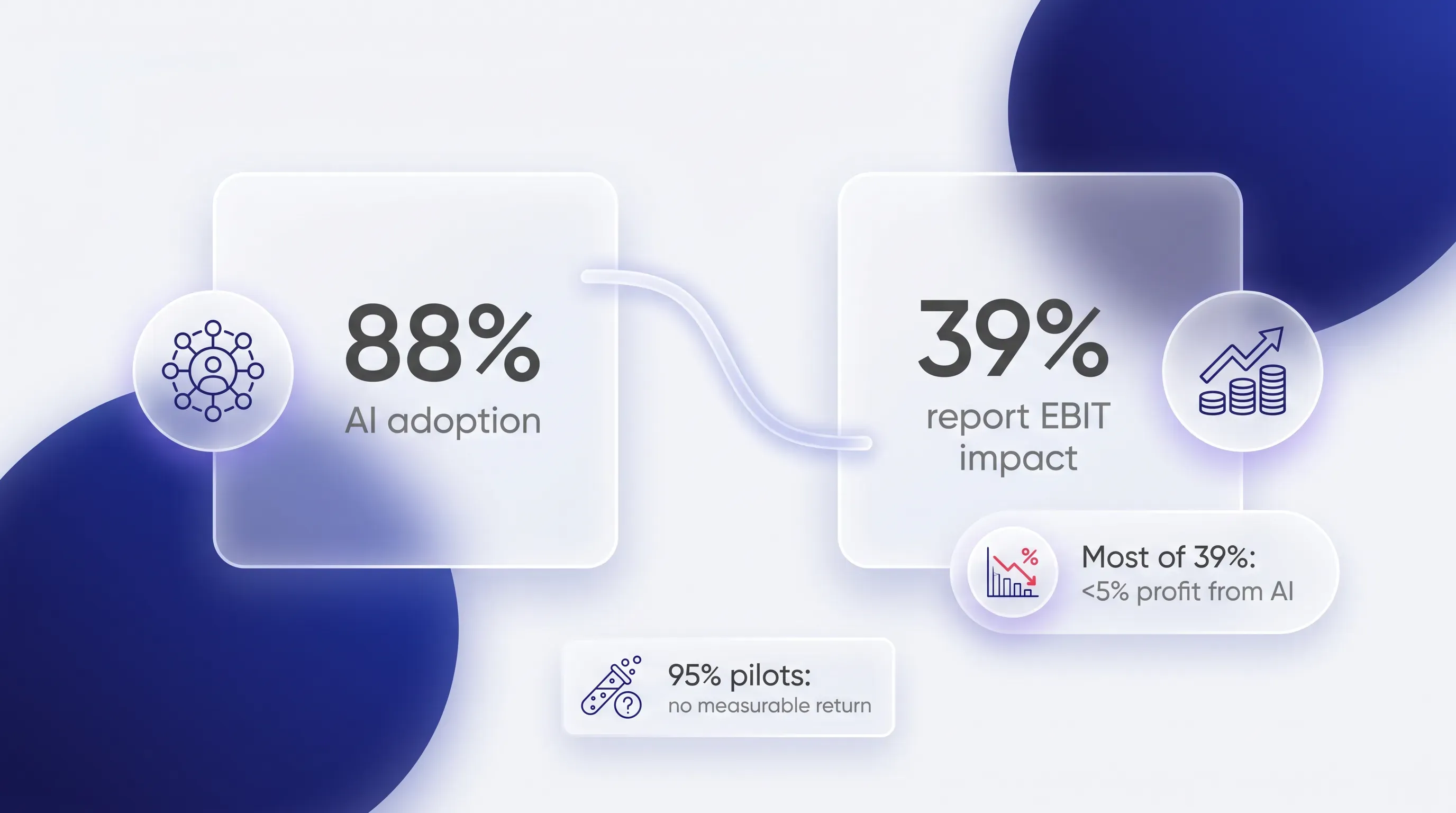
Here's the number that frames the whole problem. McKinsey's 2025 State of AI survey found that 88% of organizations now use AI in at least one business function. But only 39% report any EBIT impact at the enterprise level, and most of those say it accounts for less than 5% of profit. MIT's NANDA initiative put it more bluntly. Their 2025 report found that about 95% of pilots deliver no measurable return.

A glassmorphic infographic featuring two frosted-glass cards showing AI adoption and EBIT impact statistics, with soft ambient lighting.

That gap isn't a tooling problem. Every team at your size has the same models and the same Copilot. The gap opens because nobody redesigned the work around what AI business automation is actually good and bad at. You dropped a capable model into a process that still assumes a human sits at every step, and then you wondered why nothing downstream moved.

The three layers of automation maturity

AI business automation matures across three layers, and skipping one is where projects break. Most teams jump straight from the first layer to the third. They automate a single task, then expect the system to start making decisions on its own, as if handling one isolated action taught it to run an entire process.

This is the lens to carry through the rest of the piece. When your automation stalls, it's almost never because the model is weak. It's because you asked a layer-one setup to do layer-three work and left out the connective tissue in between.

Task automation

The first layer automates a single, isolated action. Drafting a reply. Tagging an incoming email by topic. Pulling the line items off an invoice so nobody retypes them. Each of these is one discrete thing the model does well, and this is where almost every team starts.

It feels like progress because you can watch the AI do the work in front of you. But in AI business automation, task automation alone rarely moves a business metric, because everything around that task stays manual. The invoice gets read, then a person still opens the accounting system and carries the entry through approval. You sped up one step in a chain that's still moving at human speed everywhere else.

AI workflow automation

The middle layer is AI workflow automation, and it's the one most teams skip. This layer connects those isolated tasks into an end-to-end AI workflow automation sequence. It adds system integration so outputs land back in your core tools. It also adds business rules that decide what happens next and a deliberate human checkpoint at the point where judgment matters.

Real return on investment lives here, which is why bypassing it is the most common way projects stall. AI outputs need a validation step and a path back into the systems your team actually works in, or they sit uselessly to the side. A tagged email that never triggers the next action is just a tidier inbox. AI workflow automation is what turns a clever task into a process that finishes on its own and shows up in a metric you care about.

Think of the middle layer as three jobs done together:

  • Integration, so the AI output flows into your core system instead of a separate tab

  • Business rules, so the sequence knows what to do with a high-confidence result versus an ambiguous one

The third job is the human checkpoint, placed where a wrong answer would cost you the most. Get that placement right and the whole workflow holds. Get it wrong and you're back to a stalled pilot.

Decision automation

The top layer lets the system make and act on judgment calls with little or no human review. This is the layer teams rush toward, because it's the one that sounds like the future. And it's where AI business automation does the most damage when the workflow underneath it isn't solid yet.

Attempt decision automation before the middle layer proves reliable and you get confident wrong decisions at speed. The model acts immediately: lead disqualification and outbound messages happen a thousand times before anyone notices the pattern is off. This layer is earned. It only makes sense once a workflow has run long enough to prove it holds up, and the danger of skipping ahead is clearest when you look at real workflows.

Where teams skip the middle layer

So let's look at three you'll recognize. In each one, the model itself works fine. What breaks is the placement of the human, and the recurring lesson is the same across all three: pull the human out too early and you lose output quality along with the internal trust that keeps people using the system at all.

Here's the pattern in each workflow, side by side:

WorkflowBroken "before"Corrected "after"
Support ticketsAI auto-resolves or misroutes with no reviewAI classifies and drafts, human approves edge cases
Lead qualificationAI scores and discards leads unseenAI ranks and enriches, rep confirms before disqualifying
Content approvalAI drafts publish without reviewAI drafts, human owns final approval and voice

Support ticket routing

In the broken version, the AI reads an incoming ticket and either resolves it outright or routes it, with nobody checking either call. That's fine until it confidently tells a customer something false. Air Canada learned the cost of this the hard way. In Moffatt v. Air Canada, the British Columbia tribunal held the airline liable after its chatbot gave a grieving customer wrong information about bereavement fares. "It should be obvious to Air Canada that it is responsible for all the information on its website," wrote tribunal member Christopher Rivers. "It makes no difference whether the information comes from a static page or a chatbot."

The fix moves the checkpoint to one exact spot. AI still classifies every ticket and drafts every reply, so you keep the speed. But edge cases, which are anything the model isn't confident about, route to a person before the answer reaches the customer. That single checkpoint is what stops confidently wrong responses from going out under your name. Support is a strong first workflow to rebuild because volume is high and mistakes surface fast, so you learn quickly whether the redesign holds.

Sales lead qualification

The broken version has AI score every inbound lead and silently discard the low scorers. Nobody sees what got thrown away. The problem isn't the ranking, which the model does well. AI-driven scoring can lift conversion sharply, with one analysis reporting 75% higher conversion rates against traditional methods. The problem is the silent false negative, the real buyer the model misread and deleted before a human ever knew they existed.

So the checkpoint moves to the disqualification step. Let the AI rank and enrich leads all day. But a rep confirms before any lead gets marked dead. That protects revenue from the mistakes you'd otherwise never see, and it's a good candidate for early, measurable return, because you can compare conversion on AI-prioritized leads against your old rules and watch the difference in the pipeline.

Content approval pipelines

Here the broken version publishes AI-generated content with no human between draft and live. The speed is real. So is the exposure. Gartner's research on commerce AI found that up to 30% of recommendations contained hallucinations, fabricated statements that read as plausible right up until a customer or a journalist catches one. Google lost $100 billion in market value in a single day after its Bard demo published a factual error.

The corrected AI business automation pipeline keeps the AI as the drafter and puts a human on final approval and brand voice. That checkpoint sits between draft and publish, which is where reputational damage is cheapest to prevent and where you still keep almost all the speed gain. The judgment got relocated to the one point where a wrong output does lasting harm, and the same principle applies across all three cases.

Audit which layer you're stuck at

Run this against your own setup right now. Answer each with a plain yes or no.

  1. Do your automated tasks connect end to end, or does a person manually carry the output from one step to the next?

  2. Is there a human checkpoint anywhere in the flow, and if so, does it sit at the point where a wrong answer costs the most?

  3. Do AI outputs flow back into your core systems, like your CRM or helpdesk, or do they land in a separate tab nobody acts on?

  4. Does anyone on the team actually trust the results enough to stop double-checking them?

Most teams running this discover they're stuck between the first two layers. The tasks work in isolation, but the outputs never make it back into the tools people live in, and the checkpoint sits in the wrong place when it exists at all. That is an unfinished AI implementation, and that distinction lets you fix the right thing instead of buying another tool.

Moving from pilot to rollout

Once you know your starting layer, treat the path to a wider rollout of your AI implementation as a sequence. A resource-constrained team doesn't have a data science department to absorb a failed big-bang launch, so the whole point of a first pilot is to prove the workflow redesign works before you scale it.

Start with a single workflow that has high volume and visible errors, which is why support routing is the right first pick. Then, before you change anything, record your baseline. Current resolution time or current conversion, depending on whatever the workflow's real metric is. Skip this and your AI implementation has no way to prove it worked, because you'll have nothing to compare against.

Then define what a meaningful result looks like ahead of time, so your return is provable. Here's the sequence for one pilot:

  1. Pick one high-volume workflow where errors show up fast

  2. Record baseline metrics before you touch the process

  3. Rebuild it as a connected flow with the human checkpoint in the right spot

  4. Define the number that proves it worked, then run it long enough to trust the result

Expect the early gains to be modest. That's normal, and it's fine. A pilot that reliably shaves handling time and holds team trust is worth far more than a flashy launch that breaks the first week. The purchased-and-partnered approach also helps here, since MIT found bought solutions succeed about 67% of the time against roughly a third for internal builds. Prove the redesign on one workflow, then a clean AI implementation on the second one goes faster because you already know where the checkpoint belongs.

Relocate judgment, don't remove it

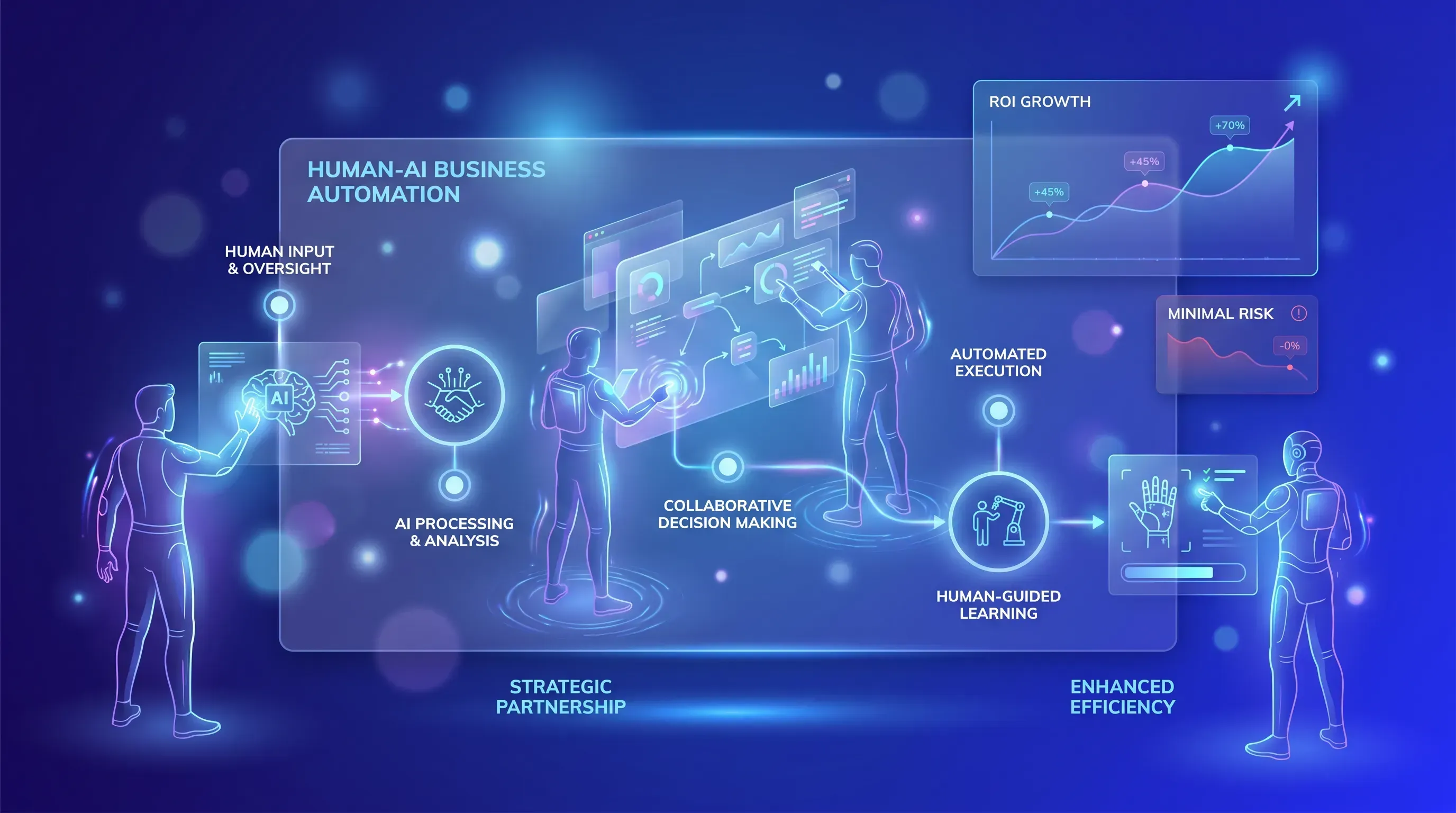
Successful AI business automation moves human judgment to the highest-leverage point in the process. The middle layer is where that move happens, and skipping it is what breaks both trust and return. That's the whole argument in one line: the checkpoint lets you move fast and avoid confident mistakes. If you're stuck between task automation and a real workflow, Pollume helps early-stage startups build AI business automation with the human checkpoints in the right place, so your automation holds instead of quietly breaking.
A workflow is ready when it has repeatable inputs, a measurable outcome, and visible failure points. Choose work with enough volume to compare before and after results, such as ticket queues or inbound lead review. Avoid starting with rare exceptions because they won't produce reliable data for a pilot.

Track the metric tied to the workflow’s business purpose, such as first response time for support or qualified-opportunity rate for sales. Record it before the pilot, then compare it after the workflow runs under normal conditions. Add a quality metric, such as rework rate, so speed doesn’t hide errors.

AI shouldn't approve customer-facing work until the workflow has proved accurate over a defined review period. Customer replies and published content carry brand risk. Keep a human checkpoint before the external action, then reduce review only after error rates stay within your agreed limit.

Task automation fails when the AI output doesn't trigger the next step. A model can tag a ticket or draft a reply, but the result loses value if a person still copies it into another system. AI business automation needs connected systems and rules that move work forward after the model finishes.

Place the checkpoint where a wrong decision costs the most. In Pollume’s approach, that means review before a customer message is sent or before content goes live. The checkpoint should catch risk without forcing people to review low-risk outputs, because blanket review turns automation back into manual work.

Book a call

Book a time that works best for you

You Might Also Like

Discover more insights and articles

A futuristic digital workspace with three holographic panels labeled ChatGPT, Claude, and Gemini, showcasing glowing icons and charts, as a business team eva…

Speed vs accuracy in your product: ChatGPT vs Claude vs Gemini

This article scores ChatGPT vs Claude vs Gemini against six real business tasks your team runs every week, then breaks down the seat and API costs most comparisons skip. You will finish able to map your top use cases to a concrete tool instead of trusting a demo.

A diverse group of professionals collaborates in a futuristic digital workspace with holographic panels and glowing charts, set in cool ambient lighting.

Founders' AI Cost Reduction Audit: Where to Start

This article shows early-stage founders and small agency owners where AI quietly adds cost before it removes any, then hands over a five-point audit and a simple decision framework to turn those leaks into real savings you can measure.

A futuristic digital workspace with founders and executives collaborating around a holographic 'build vs buy' decision matrix.

Build vs Buy AI: The Decision Framework Founders and CTOs Actually Use

Most build vs buy AI decisions get made in a room where half the people are arguing from instinct and half from vendor pitch decks. This guide gives you two concrete tools to cut through that noise: a five-dimension scoring matrix and a readiness audit. The next time this lands on your agenda, you walk in with a framework instead of an opinion.

A futuristic digital workspace with a founder, lawyer, and developer interacting with a holographic contract panel and glowing icons.

Software Development Contract: The MSA, SOW, and Why Most Founders Sign Them in the Wrong Order

In this article, we break down the software development contract paperwork a first-time founder gets handed before hiring a development team, and why it is almost never a single document. You will learn what each piece does and the order to handle them in before any code gets written.