Why AI often costs more first
The pitch was clean. Drop an AI tool into a workflow and watch the busywork disappear; the payroll and invoice stack should get lighter. You wired ChatGPT into a process or handed a task to an agent, and for a week or two it felt like the future had arrived. Then the invoice landed, and it was bigger than the month before.
Here is the part nobody puts on the pricing page. For a team spending a few hundred to a few thousand dollars a month, using AI for cutting costs in business almost always adds cost before it removes any. Usage-based billing charges you per token, so a workflow that runs thousands of times a month scales with volume in a way a flat subscription never did. The rework is invisible until you count the hours. And the tool sprawl creeps up one $30 seat at a time until you are paying for four AI features you barely touch.
None of this means AI cost reduction can't save you money. It means the savings arrive when you find the exact spots where money leaks and close them one at a time. That's what the rest of this piece is about, so let's start by dismantling the promise that got you here.
The AI cost reduction myth
The marketing says AI cost reduction cuts costs on contact. The data says the opposite happens first. A 2025 survey from SaaS benchmarking firm Benchmarkit and cost governance platform Mavvrik found that 85% of organizations misestimate AI costs by more than 10%, and nearly a quarter miss by 50% or more. The estimates are almost always too low. A separate survey of 500 finance leaders commissioned by DoiT found that 79% of enterprises overspent on AI in the past year.
Those are big companies with finance teams whose whole job is forecasting. If they blow past their numbers this badly, the pattern is structural. The subscription or API price you see on the pricing page is half the true cost once you add the human time to fix the output and the weeks you spend learning what the tool is good for.
Here's where the vendor story and the operator reality split. A founder adds an AI writing step to save on a copywriter. The tokens cost forty dollars a month, which looks like a bargain. But every draft needs a senior person to rewrite the opening and clean up the claim and tone before it ships. Now you're paying for the tokens and the person who cleans up after them. Emory University marketing professor David Schweidel ran an experiment where AI drafting plus a human editor cut content costs by 91 percent. That gap between his result and the founder's is the whole game. Cost-effective AI is a deliberate outcome you engineer.
The hidden cost audit
Here are five specific places small teams lose money on AI, each paired with an AI cost reduction fix that turns the leak into a saving. Most founders will recognize themselves in at least two or three, and that's normal. The fixes run from easiest to hardest, so you can start at the top and get a quick win before you tackle the harder ones.
Read each one against your own last invoice. The goal is to find the one or two leaks that cost you the most right now, because that's where cutting costs in business gets fast and measurable.
Defaulting to the priciest model
The most common and expensive mistake is routing every request to a frontier model when a cheaper tier clears the bar. The price gap between tiers is enormous. GPT-4o runs $2.50 per million input tokens, while GPT-4o Mini costs $0.15 per million, which is 94% cheaper for the same input. Older frontier models were worse. GPT-4 cost roughly 60 times more per input token than GPT-3.5.
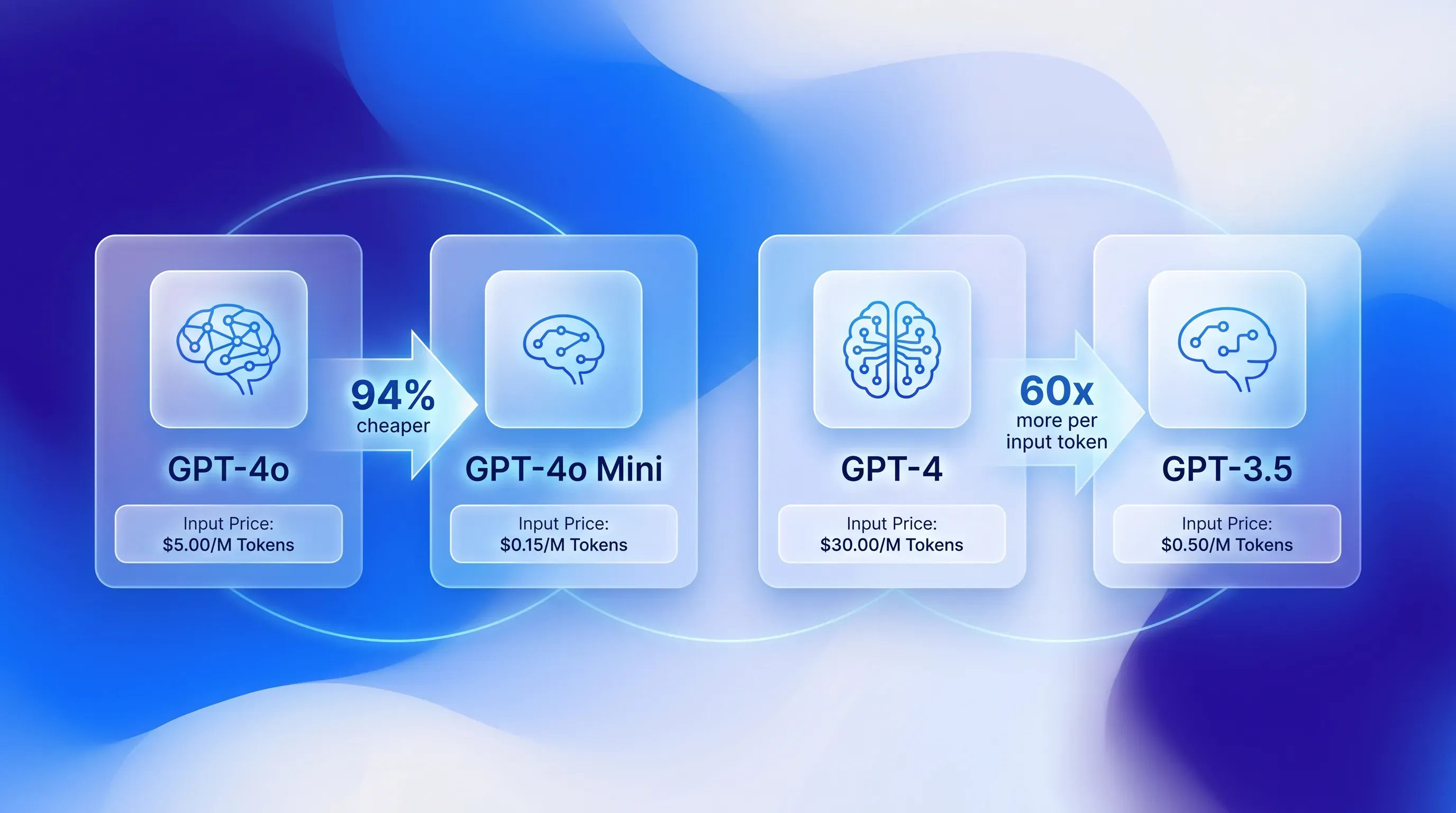
And most real work doesn't need the top model. A study of the n8n automation ecosystem found that information extraction alone accounts for 18.34% of live workflows. Classification and summarization add to a large share of live workflows. These are exactly the tasks a budget model handles fine.
The fix is plain. Match the model to the task, and before you default to the expensive tier, test whether a cheaper one passes on your own real examples. Enable prompt caching first for AI cost reduction, since OpenAI's automatic caching cuts input costs by up to 90% on cached tokens with no code changes. This is the single highest-leverage move for cost-effective AI, and it doesn't touch the quality your customers see.
Sloppy prompts burning credits
Vague and bloated prompts from trial and error quietly inflate your bill. Context is billed by the token, so every word you stuff into a prompt carries a price. Pad a system prompt with instructions the model doesn't need, run it ten thousand times a month, and you've built a recurring cost you never see itemized.
The waste hides in long context windows. When you paste an entire document into a prompt to answer one small question, you pay for the whole thing on every call. An independent evaluation of long-horizon agent tasks found that caching a stable system prompt alone delivered AI cost reduction, with cost savings between 41% and 80% across four major models, which tells you how much of a typical prompt is repeated dead weight.
Tighten and template the prompts that run at volume. Trim the context down to what the model actually needs to do the job, and reuse a cached system prompt so the static part stops costing you full price on every run. For this, you need to read your own prompts and cut the words that aren't doing work.
Unmonitored agent loops
Autonomous or multi-step agents can fall into retry loops and run up spend while nobody's watching. A single runaway job can wreck a small monthly budget overnight. One solo developer reported a Cursor agent falling into a loop and burning $135 of credits in a week before they noticed. A larger case saw four LangChain agents ping-pong requests between each other for 11 days and run up a $47,000 bill before the billing dashboard surfaced a number big enough to stop it.
Worse, provider spending caps fail as hard limits. One consultant in Australia woke up to an $18,000 GCP bill after a leaked key blew past a $1,400 cap that was supposed to be firm. Without basic visibility, you're guessing where the money went.
Set hard spend caps and usage alerts at the account level as your emergency brake. Cap the number of steps a single agent can take so a loop can't run forever. Then check a simple daily or weekly burn number, because the point is to catch a runaway at hour one.
Low-quality output and rework
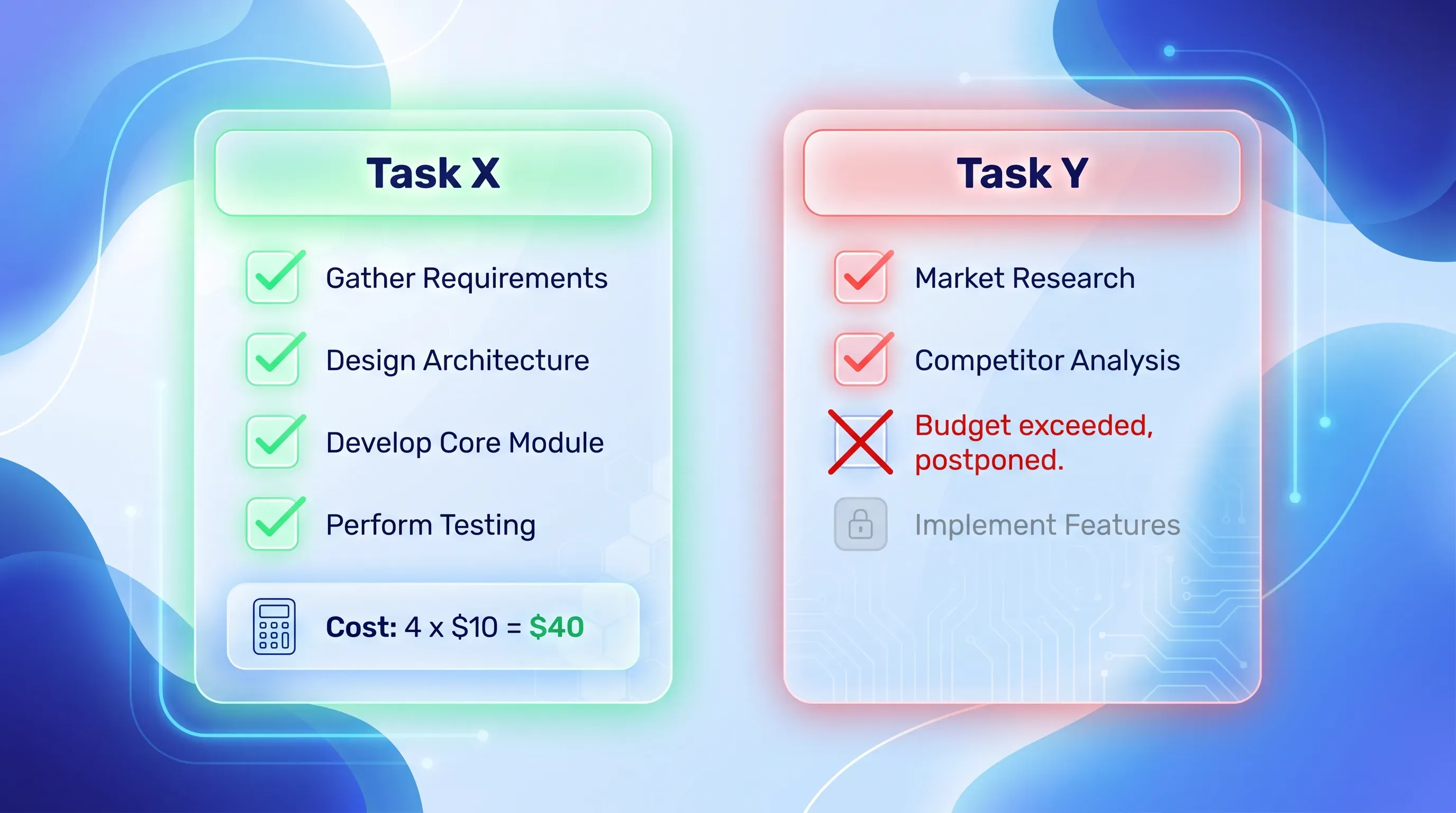
When AI output needs heavy human editing, AI cost reduction savings evaporate. You pay for the tokens and for the person who fixes the work, which is one of the most underestimated hidden costs on this list. And it means the tool was pointed at the wrong task.
The rework math is unforgiving. A 16-month content study found a skilled editor can bring an AI draft up to standard in about 90 minutes for a 1,500-word article, versus four to six hours to write it fresh. That's a real saving. But push AI onto high-stakes client work and the picture flips, because a senior person ends up rewriting the whole thing, and now the draft cost you money and time.
Measure your rework rate honestly. If a rough draft genuinely saves an hour, keep AI on the task. If correction eats the entire gain, pull it off. That single honest measurement is how you keep cost-effective AI from turning into an expensive way to generate first drafts nobody can use.
Paying for bloated SaaS features
Small teams overpay for per-seat SaaS products with AI features bolted on. The average small business under 200 employees now runs 42 different SaaS applications and overspends 25 to 30 percent on tools it barely uses. Stack a $30-per-seat AI add-on across a few of those, and the recurring creep adds up faster than any single invoice suggests.
The structural problem is that seat-based pricing assumes value scales with headcount, which is wrong for cost-effective AI. According to ICONIQ Capital's January 2026 report, 58% of companies still pay for AI on seat-based subscriptions. For a repeated high-volume task, a thin internal tool built directly on an API can cost a fraction of the rented feature, since the OpenAI API bills at $5 per million tokens instead of a flat fee per user.
Audit which AI SaaS features you actually use each month. For the tasks you run at volume, price out a simple in-house script or workflow against the subscription. You're not going to build custom models, and you don't need to. Wiring a basic tool onto an API is within reach, and that's where cutting costs in business quietly happens.
Measuring savings honestly
The honest test is simple arithmetic: net benefit divided by total cost. The trap is the word total. Most founders count the subscription and the tokens and stop there, which is exactly how you convince yourself an expensive experiment is paying off. Total cost has to include the hidden items from the audit: the rework hours and the learning time required to figure the tool out.
Watch out for vibe-based AI cost reduction accounting, where adoption gets mistaken for savings. Your team using AI every day feels like progress, but activity isn't a number you can defend. The MIT report The GenAI Divide found that 95% of pilots delivered no measurable profit-and-loss impact, mostly because teams felt productive without ever proving it. A Gartner survey of 506 CIOs told the same story, with 72% of organizations breaking even or losing money on AI.
Pick one or two concrete metrics you can stand behind:
-
Hours saved, valued at a real hourly rate. If AI saves eight hours a week and your time is worth $60, that's $480 of benefit to weigh against total cost.
-
A reduced external spend line, like a freelance or agency invoice that shrank because AI now handles the first draft.
When Klarna's AI assistant took over tier-one support, the company reported it was doing the work of 700 full-time agents and cut $4 million from customer service costs, a concrete example of cutting costs in business. You need one number tied to hours or dollars that you'd be comfortable showing an investor.
A framework for cost-effective AI
Before you commit money to any specific AI investment, run it through four questions. This AI cost reduction filter keeps you from adopting AI everywhere at once and hoping the savings show up later.
- Is the task repetitive and high volume? AI pays off on work you do thousands of times.

-
Does the cheapest capable model clear the bar on your real examples? Test down before you default up.
-
Can you use the output with minimal rework? If a senior person rewrites it anyway, the math breaks.
-
Can you cap and monitor the spend? If you can't see the burn, you can't defend the investment.
If a task fails any of these, it's not a good first pilot. If it passes all four, you've found one. The MIT research is blunt on why this matters, since purchased or narrowly-scoped tools succeeded twice as often as sprawling internal builds. Validate one pilot with real numbers before you expand. The goal is cutting costs in business.
Where to start this week
Pick the single biggest leak from the audit and fix it as this week's pilot. For most small teams that's model-tier defaulting, so switch one high-volume workflow to a cheaper model and turn on prompt caching before you test whether the output still clears the bar. Then measure the before and after honestly with hours or dollars rather than a feeling. AI cost reduction genuinely reduces costs for a small team, but only when you choose it deliberately and prove it with real numbers. That's the whole promise of AI cost reduction, and it starts with one leak this week.