A futuristic digital workspace with a founder, lawyer, and developer interacting with a holographic contract panel and glowing icons.

Software Development Contract: The MSA, SOW, and Why Most Founders Sign Them in the Wrong Order

In this article, we break down the software development contract paperwork a first-time founder gets handed before hiring a development team, and why it is almost never a single document. You will learn what each piece does and the order to handle them in before any code gets written.

Content authorNikita SivtsovPublished onReading time14 min read

The paperwork founders sign too fast

You found a development agency you like, and your software development contract lands in your inbox as a PDF you are eager to sign so the build can start. So you skim it for the price and the start date, then put your name at the bottom. That moment feels like progress. It is also where a lot of first-time founders quietly hand away the things they most needed to protect.

Here is the part nobody explains. What you think of as one software development contract is two or three separate documents that do different jobs and clip together. One sets the legal ground rules. Another defines the actual work. Sign the wrong combination and you can end up paying for code you don't own, or with no written scope to hold the agency to when the timeline slips.

No legal background needed for what follows. By the end you will know what each document does and the order to handle them in.

The three documents and how they connect

Think of hiring a development team like building a house with a contractor. You need a general agreement about how you two will work together over time, and you need a specific plan for the actual house with materials and a price. Software contracts split along the same line. One document holds the long-term legal terms. The other describes the project in front of you.

Say you are building a mobile app. The legal terms about ownership of finished code and how either side can walk away belong in one place. The list of features and the price belong somewhere else. Blending the two into one informal software development contract is the root mistake, because the moment something changes you won't know which rules apply.

These documents go by standard names, and the structure is well established. Aline's contract guide puts the split simply: one document "defines the overall business relationship," while the other "is a project-specific document that covers tasks, deadlines, and deliverables." Let's translate each one.

The master service agreement (MSA)

The master service agreement (MSA) is the umbrella document. It holds the long-term legal terms that apply no matter what you build, and you negotiate it once at the start of the relationship. According to Sirion's contract library, an MSA covers liability and risk allocation, along with how either party can end the relationship.

Notice what is missing from that list: features. The master service agreement rarely says a word about your app's login screen or your checkout flow. It is mostly legal language, and that is the point. It is the rulebook for how you and the agency behave toward each other.

The value of the umbrella is that it stays fixed while projects come and go. Build your mobile app this year, then a web dashboard next year with the same agency, and the MSA covers both without renegotiation. Juro's contract guide describes it as the document that makes "it easier to negotiate contracts later down the line," because the heavy legal terms are already settled. You agree on the rules once, and reuse them.

The statement of work

The statement of work, often shortened to SOW, is where the real project lives. It spells out what is being built and what it costs. If the master service agreement is the rulebook, the SOW is the actual game plan. PandaDoc's breakdown uses scope, deliverables, timeline, and pricing as its shorthand for the SOW's core contents.

This is where most disputes are won or lost. When the agency says a feature was "out of scope" and you swear it wasn't, the SOW is the document you both reach for. A vague SOW is how a project drifts. A precise one is how you prove what "done" means.

One umbrella can hold many statements of work over time. Each new project gets its own SOW that attaches to the same master service agreement, like this:

Add image

  • One master service agreement (MSA) signed at the start of the relationship

  • A first SOW for your mobile app build

  • A second SOW months later for a feature expansion

  • A third SOW the next year for a separate web project

Don't dismiss the SOW as a planning sheet. The SOW is a binding software development contract. The deliverables and dates written into it are enforceable, which is exactly why founders who treat it casually get burned.

How they reference each other

The two documents become one enforceable set of software development contract terms through a single line of linking language. A statement of work will say something like "this SOW is governed by the MSA dated [date]." That sentence pulls all the legal terms from the umbrella down into the project document, so you don't repeat them every time.

Picture the structure as a stack. The master service agreement sits on top as the parent, and every SOW hangs underneath it as a child that inherits the legal terms above. If the two ever conflict, the parent wins. Juro notes that an MSA "will overrule a Statement of Work if the two documents include conflicting information," because the MSA is understood as the controlling contract.

This linking is what lets you move fast without losing protection. Once the umbrella is signed, you can approve a new SOW for a new project in days, because the legal terms are already locked in above it. The heavy negotiation happens once. The project details get added on top.

What goes wrong when founders skip a step

The software development contract structure protects you only when it is intact. Pull out one piece, or mash everything into one document, and the protections each part was built to provide quietly disappear. These failures rarely announce themselves at signing. They surface months later, when money is gone or a deadline has passed and you reach for a document that isn't there.

Scope problems are the common thread. A study cited by Harvest found that over 50% of software projects experience scope creep, and the same research links cost overruns of up to four times the original budget to it. The documents below exist to keep that from happening to you. Here is how it goes wrong when they break down.

Signing an agreement with no SOW

You sign the umbrella agreement, and work begins on a verbal understanding of what the app should do. No statement of work ever gets written. For a while it feels efficient. Then invoices arrive, and you search for the software development contract document that defines what they owe you because the build looks nothing like what you pictured.

There isn't one. The umbrella covers liability and confidentiality, but it never described your project, so there is no agreed definition of done. The agency keeps billing against hours, and you have almost no leverage to say the work is incomplete, because "complete" was never written down anywhere.

This is the trap of the legal umbrella alone. It protects the relationship in the abstract while protecting almost nothing about the actual product. Sirion's guidance is blunt that the SOW is what "defines the execution details for a particular engagement," and without one you are paying for a project that exists only in conversation.

Treating all three as one

This founder assumes the one software development contract they signed covers everything, and never notices that legal terms and project details got crammed together into a single informal agreement. It reads fine on day one. The problem shows up the first time something needs to change.

You want to add a new feature halfway through the build. In a properly separated structure, that is a new or amended SOW with its own price and deadline, governed by the same umbrella. In the blended document, there is no change process at all, because the document was never designed to handle one. So the change becomes an argument instead of a procedure.

Each document has a job. Collapsing them removes the protections each was built to give:

  1. The umbrella's job is to settle legal terms once and keep them stable across projects.

  2. The SOW's job is to define one project precisely and give you a yardstick for "done."

  3. The link between them is what lets you change project details without reopening the legal terms.
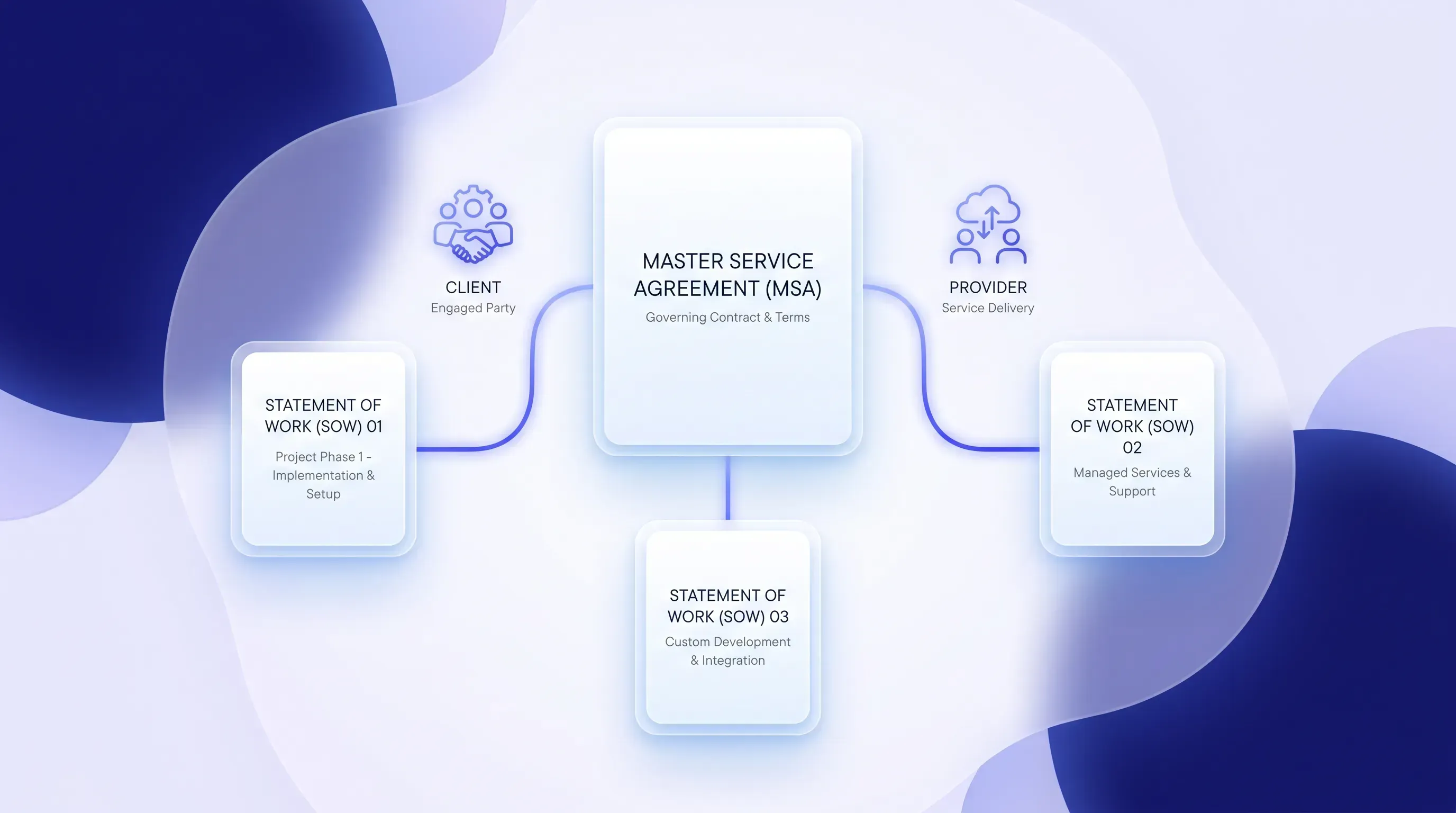
Diagram showing an MSA as the parent contract linking a client and provider, with three Statements of Work attached for different project phases.

Mash all of that into one file and you lose the yardstick and the clean process for change. Poor requirements gathering is the leading cause of software project failure in 39.03% of cases, and a blended document is poor requirements gathering by design.

Paying before scope is locked

The agency asks for a deposit or a first milestone payment to "get started," and you send it before the statement of work is finalized and signed. It feels like good faith. It is the moment you give away the most leverage you will ever hold.

Before money moves, you have the agency's full attention and every reason for them to define scope tightly. After the deposit clears, that pressure flips to you. Now a deliverable you assumed was included gets reclassified as extra, and you are negotiating from behind because you already paid.

Money should follow a locked scope, never lead it. Tie every payment to a defined milestone written into the signed SOW, so each transfer buys a specific, agreed result. The deposit is your strongest card. Don't play it before the scope is on paper.


The intellectual property clause you cannot skip

Here is the part that catches almost every first-time founder off guard: paying for code does not automatically mean you own it.

Think about it this way. When you hire a photographer for your company event, you pay for the shoot but the photographer still owns the photos by default. You only get full rights if the contract explicitly says so. Your software development contract works exactly the same way.

Under default copyright rules, the person who writes the code owns it. Not you. The developer. So if you build your entire product with an outside agency and your software development agreement never addresses ownership, you could end up with an app you paid $80k for and no legal right to the underlying code. That means no selling the company, no bringing development in-house, no anything without going back to the agency.

The fix is a clause in your contract that transfers ownership to you. But here is where founders get tripped up a second time: slapping "work made for hire" into the document is not enough on its own. As Apex Law explains, for independent contractors the doctrine does not apply automatically and the work belongs to the creator unless a written agreement says otherwise. That phrase only works for certain types of work, and custom software is not reliably on that list.

A solid IP clause in your software development contract does both things at once:

  • It calls the work "made for hire" to cover what the law allows

  • It also adds an explicit assignment, language where the developer "hereby assigns" all rights to you, as a direct transfer just in case the first label does not hold

ContractKen's drafting guide calls this the belt-and-suspenders approach, so ownership transfers even if the work-for-hire designation fails. If one fails, the other catches it.

One more thing worth asking about before you sign: open source. Your developers will almost certainly use third-party libraries, and each one carries its own license terms. FOSSA warns that ignoring these can lead to disputes that put your ability to sell the product at risk. A good software development contract requires the agency to disclose what open source they used and confirm it does not conflict with you owning and monetizing the result.

Which document to negotiate first

The order matters as much as the documents themselves. Settle the broad legal terms, then lock the project specifics before any payment moves. Each step depends on the one before it, which is why doing them out of order is how founders lose leverage.

Start with the umbrella. The master service agreement (MSA) holds the liability and ownership terms that will govern everything, so negotiate it before any single project is on the table. With the legal ground settled, move to the SOW and pin down exactly what gets built and what it costs. Only after both are signed should the first payment move, tied to a milestone in the SOW.

Before a line of code gets written, demand these in writing:

  1. Defined deliverables and milestones: specific enough that "done" is not a matter of opinion. Vague language like "build a mobile app" is not a scope - every feature should be described precisely enough that both sides would tell the same story about the finished product.

  2. A clear intellectual property clause with both work-made-for-hire language and a present-tense assignment of rights to you: "work made for hire" alone is not enough. The software development agreement needs a separate assignment where the developer "hereby assigns" all rights to you as a backup if the first label fails.

  3. A written change process: so a new feature becomes an amended statement of work with its own price and deadline, not an argument or a verbal promise that quietly inflates the invoice.

  4. Milestone-based payment: where each transfer is tied to an agreed, completed result. No milestone in the SOW, no payment.

  5. Open source disclosure: the software development contract must require the agency to list every third-party library used and confirm the licenses are compatible with you owning and selling the product commercially.

  6. Termination terms for both sides: what happens if you need to walk away mid-project - who owns the work completed so far, what you owe, and how long the notice period is.

  7. Subcontracting restrictions: some agencies hand work to subcontractors you have never vetted. The contract should require written approval before any third party touches your codebase.

  8. Confidentiality that covers your concept, not just your data: the NDA or confidentiality clause in the software development contract should cover your business logic and product idea, not only credentials or personal data.

  9. Dispute resolution process: how disagreements get handled before they become lawsuits - a defined escalation path saves both sides time and money if something goes wrong.

  10. A lawyer reviews the actual language before you sign: this list tells you what to look for. A lawyer tells you whether what you are looking at actually delivers it.

Get those four locked and the structure is working for you. The project is measurable, and your money follows results instead of leading them.

Before you sign anything

Your real goal is to build your product without getting trapped, and the software development contract paperwork is the thing standing between you and that. Remember that the paperwork is a connected system: the legal umbrella and the project SOW joined by linking language. Understanding the order protects your money and your ownership.

So slow down. Read what you are handed and refuse to start work until the structure answers the questions this piece prepared you for. Now that you know what you are looking at, bring in a lawyer to review the actual language before you sign your software development contract.

Ask a lawyer to review ownership, payment, termination, liability, and dispute terms before signing. They should confirm the MSA and SOW don't conflict and that assignment language transfers code, designs, and documentation. Give the lawyer current drafts plus emails that describe scope, since those messages can reveal missing terms.

Acceptance criteria should state how each deliverable will be tested and approved. Use observable conditions, such as a login flow that lets registered users reset passwords by email. The SOW should also name who approves the work, the review period, and what happens when defects are found.

Yes, if the discovery phase has its own signed SOW. A discovery SOW should define outputs, such as wireframes or technical specifications, and say whether the agency can use them in a later build. Keep payments tied to those outputs, then sign a separate build SOW when scope is clear.

Bug fixes and warranty terms should appear in the SOW or a linked support addendum. The document should define what counts as a defect, how long fixes are covered after acceptance, and the response time for reported issues. This stops ordinary defects from being treated as paid change requests.

You should get source code access as milestones are completed, not only at final delivery. The software development contract can require repository access, credentials transfer, and build instructions at each approved milestone. The client should also receive documentation needed to run the product without the original agency.

Book a call

Book a time that works best for you

You Might Also Like

Discover more insights and articles

A futuristic digital workspace with founders and executives collaborating around a holographic 'build vs buy' decision matrix.

Build vs Buy AI: The Decision Framework Founders and CTOs Actually Use

Most build vs buy AI decisions get made in a room where half the people are arguing from instinct and half from vendor pitch decks. This guide gives you two concrete tools to cut through that noise: a five-dimension scoring matrix and a readiness audit. The next time this lands on your agenda, you walk in with a framework instead of an opinion.

Outsourcing vendor comparison dashboard

How to Evaluate Software Outsourcing Eastern Europe Vendors in 2026

In this article, we explore changes in IT vendor selection in 2026 and detail a rigorous framework to evaluate technical maturity, operational resilience, and cultural alignment.

Futuristic digital workspace with three glowing holographic panels for In-House, Freelance, and Agency, set against a deep blue gradient.

What $50K Actually Buys You: In-House vs Outsourcing Software Development

This article takes a fixed $50,000 software development budget and frames the in house vs outsourcing software development question by tracing exactly what it buys across three hiring models. We'll run the math on a fintech MVP scenario, then close with a decision matrix that pairs founder profile and project stage with the model that actually fits.

Futuristic digital workspace with a glowing decision matrix, highlighted outcomes, and a founder silhouette gesturing towards it.

Why Most Founders Outsource Software Development Wrong (And How to Fix It)

This article unpacks the specific mistakes founders make when they outsource software development, and gives you a 2x2 matrix and a pre-contract checklist you can actually use this week. It's written from the founder seat.