Introduction
When developers build minimum viable products and integrate machine learning, they require strict financial discipline. Historically, engineers built early-stage software with predictable technology expenses. Today, these professionals lose this financial predictability when they add complex foundation models. Even though token prices continue to drop, developers still burn through early-stage budgets quickly because hidden integration friction and unexpected data preparation requirements drain resources. Many teams assume they can treat machine learning as simple plug-and-play features, and this assumption is precisely what drives AI-related technical debt in early-stage products. These teams face severe consequences because of this assumption. According to Pertama Partners, 80.3% of AI projects fail to deliver intended business value. When teams misunderstand the underlying infrastructure expenses, they exhaust their financial resources before they validate any core assumptions or gather real-world data. Teams prevent these failures and scale efficiently when they understand the true artificial intelligence cost structure.
Paradox of Token Price Drops and Artificial Intelligence Cost Increases
This artificial intelligence cost structure creates a confusing economic paradox for developers. Developers expect cheaper development cycles because raw inference prices drop exponentially every quarter. However, these teams still face total enterprise spending that increases by 55.8% across the industry. Development teams require prudence when they budget for new projects in this contradictory financial environment. Companies allocate resources properly when they anticipate hidden infrastructure demands, which is why scoping AI integration before committing to a budget matters more than most teams expect. Consequently, teams exhaust their budgets before they launch a functional product.
Companies allocate resources properly when they anticipate hidden infrastructure demands. Organizations exhaust their budgets prematurely if they ignore complex integration requirements. According to CIO.com, 85% of organizations misestimate AI costs by more than 10% because they fail to account for the supporting architecture. Foundation models represent only a small fraction of the total expense. Development teams invest heavily in the surrounding ecosystem. These teams build secure pipelines, scale server capacity, and maintain constant system monitoring. These requirements turn seemingly cheap application programming interface calls into significant financial liabilities. Teams manage budgets better when they understand this economic reality.
Hidden Development Expenses
This economic reality forces developers to maintain strict financial discipline because hidden development expenses quickly consume 30% to 50% of the initial budget. Teams often assume that model training and inference represent the bulk of their spending. This assumption proves false when teams analyze the actual resource allocation. Engineering leads exercise vigilance to identify the peripheral tasks that drain the budget across every layer of the development stack. These leaders scrutinize the development process and find three major categories of unexpected spending. According to Elsner, data work consumes 40% to 60% of project budgets rather than actual model development. Teams waste money when they fail to plan for the extensive pipeline preparation that machine learning functionality requires. Even platforms that offer nonprofit content generation tools require heavy backend setup to function properly. Engineering teams monitor specific integration areas to control these hidden expenses:
Data Preparation Overheads
Data preparation requirements create the first hidden expense, and developers drain resources when they clean and label datasets before they even touch the machine learning models. Teams underestimate the sheer volume of manual labor required to format raw information into usable training sets. This intensive preparation phase inflates the overall ai pricing structure of the project. Engineers require several weeks to remove duplicate records, correct formatting errors, and annotate data points. This tedious work demands constant watchfulness to maintain data quality. Data scientists produce algorithms with inaccurate outputs if they train models on flawed datasets. According to TechTarget, data infrastructure costs consume $60 of every $100 spent on machine learning initiatives. Companies cannot bypass this financial burden because pristine data serves as the foundation for any functional product.
Legacy System Friction
Even when companies prepare this pristine data, outdated transactional architecture creates significant engineering delays when developers connect it with modern machine learning models. Older databases often lack the necessary APIs to communicate with modern foundation models. Developers build custom middleware to bridge the gap between legacy infrastructure and new software tools. This integration process disrupts standard cost expectations because the required system modifications demand specialized engineering talent. Teams require foresight to budget for these inevitable architectural conflicts. According to TechTarget, legacy system upgrade costs averaged $2.9 million in 2023 for enterprise projects. Smaller companies face similar financial challenges when they force modern algorithms to interact with obsolete database structures. Teams experience budget overruns when they ignore legacy system friction during the integration phase.
AI Cost Calculator and Compliance
During this integration phase, unchecked shadow deployments and regulatory violations expose organizations to financial risks. Employees often bypass official IT channels to use unauthorized machine learning tools. This shadow usage creates security vulnerabilities and violates strict data privacy laws. Teams prioritize the safeguarding of customer information when they build new products. Engineering leads track resource consumption and identify unauthorized deployments across the organization when they implement an ai cost calculator. According to Vectra AI, shadow artificial intelligence adds $670,000 to average data breach expenses. Organizations face penalties from regulatory agencies if they fail to monitor their compliance overhead. A centralized cost calculator enforces strict visibility over all active software tools and prevents these breach expenses.
Financial Threat of Application Programming Interface Sprawl
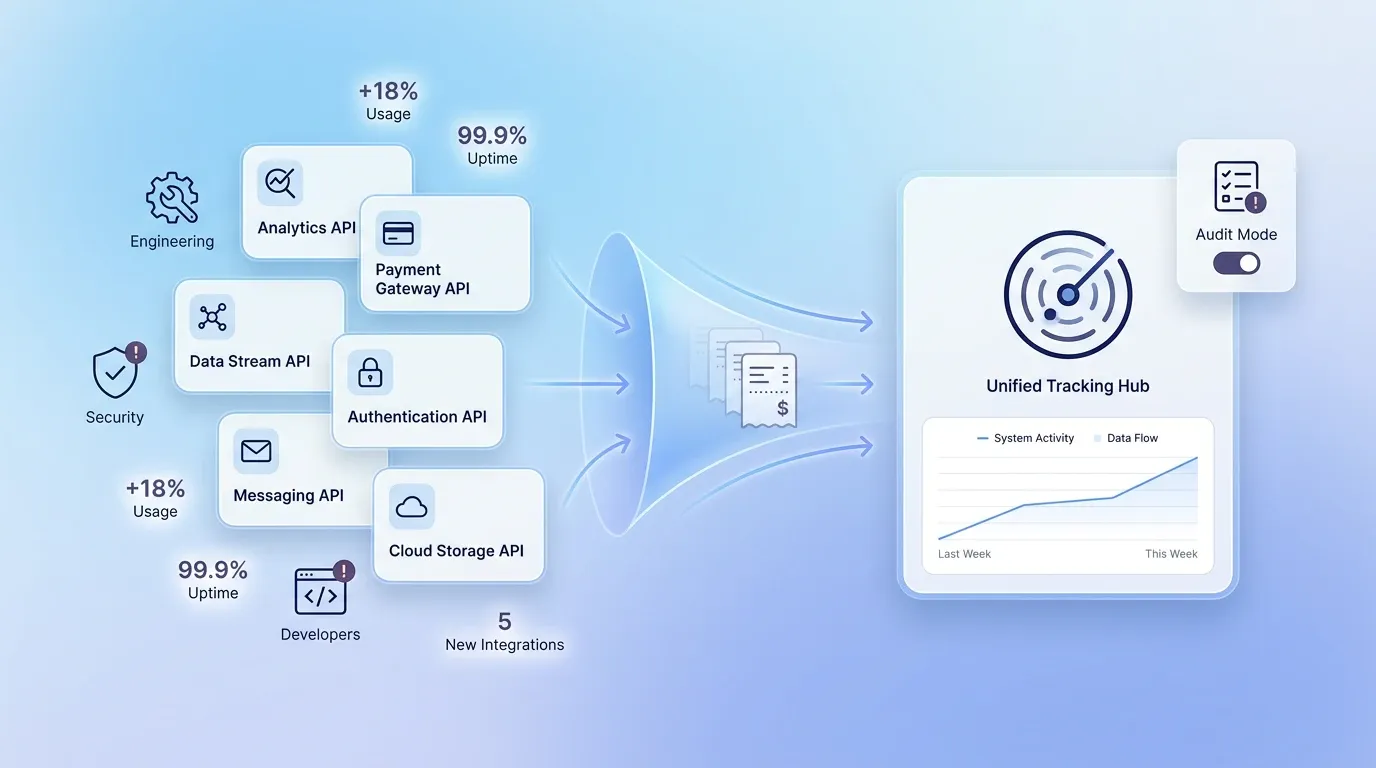
When these active software tools proliferate across an organization, fragmented services create a significant financial burden. Modern products rarely rely on a single foundation model. Companies typically integrate OpenAI for text generation, ElevenLabs for voice synthesis, and Runway for video creation. This fragmented architecture makes it nearly impossible to track the total artificial intelligence cost. Engineering teams face difficulties when they reconcile billing statements from dozens of different vendors. According to Xenoss, 44% of engineering teams spend between $25,000 and $100,000 monthly on their data stack. This unmonitored spending happens because developers implement tools without proper circumspection.
Vectra AI reports that security teams find 665 distinct generative applications across typical enterprises. Even when teams use affordable content creation tools, their decentralized usage drains the budget. Department leads apply strictness when they approve new vendor integrations. These leaders use centralized tracking systems to consolidate billing and monitor usage metrics. Development teams follow a specific cost management process to eliminate service sprawl:
-
Audit all active vendor subscriptions across the engineering department.
-
Terminate redundant services that offer overlapping functionality.
-
Consolidate necessary operations into a single billing dashboard.
Open-Source Infrastructure Against Cloud Services
After teams consolidate necessary operations into a single billing dashboard, organizations face a difficult choice between building internal open-source models and buying external cloud services. Software developers often assume that free software reduces development expenses. According to the Linux Foundation, open models cost 15.66% of closed models on average. But this specific ai pricing only covers the raw software access. Companies must buy dedicated hardware and hire specialized engineers to run these free algorithms. Top engineering talent demands high salaries to manage complex models. If developers choose the open-source path, then they carry the burden of system preservation. Custom servers drain budgets faster than managed subscriptions.
System administrators need time to manage computing capacity. Even when customers do not use the product, the internal servers must stay online to process potential requests. According to GMI Cloud, idle machine learning infrastructure burns between $500 and $23,000 monthly with zero traffic. The total artificial intelligence cost increases rapidly because developers must maintain these active hosting environments. Companies avoid these large server bills when they use external cloud providers. Developers can rely on external content creation software instead of building custom hardware networks from scratch. Organizations save funds when they outsource server management, and this allows them to measure output metrics accurately.
Unit Economics Before Operation Expansion
Companies achieve financial stability when they use these output metrics to measure the monetary value of each processed transaction. Development teams evaluate how much money a single prediction or generated document costs the company, and teams building an early-stage product need this number before they scale anything. These unit economics demand financial prudence. If companies attract thousands of users before calculating these metrics, they risk negative profit margins. Hugo Huang serves as the Canonical public cloud director, and he warns that vectorization token expenses reach tens of thousands monthly for early-stage projects. Companies face financial deficits if the cost to serve a customer exceeds the revenue that customer generates. Organizations must map out the total artificial intelligence cost for every single user interaction.
Development teams monitor usage metrics during the testing phase. They build controlled environments to observe how actual users interact with the system. An integrated ai cost calculator tracks these interactions and reveals the precise expense of each feature. Teams can deploy machine learning marketing tools to small focus groups and measure the computing expenses tied to specific user tasks. Engineers modify the application logic and test alternative models until the unit economics become profitable. Companies can expand their operations securely without unexpected infrastructure bills once the profit margin turns positive.
Conclusion
In summary, teams achieve a positive profit margin and control their development budgets successfully when they abandon the plug-and-play assumption and adopt a lean, process-driven integration approach. An early-stage product exists to validate core assumptions and gather real-world data rather than achieve technical perfection from day one. Teams ensure the project survives the initial testing phase when they prevent unexpected infrastructure expenses. In the future, teams will rely on structured cost management frameworks to scale their products without exhausting financial resources. Reviewing the search engine marketing guide helps teams refine promotional strategies and optimize the artificial intelligence cost accurately.