Diagnose before choosing
The rebuild vs refactor question starts as a verdict. After a year of slow releases and work in a codebase that feels hostile, someone senior declares that the only fix is to start over. The decision is made before anyone has measured what is actually broken.
Age and ugly code are symptoms. None of them tells you where the damage sits or how deep it goes. A twelve-year-old system with a clean core and one rotten module needs a different answer than a five-year-old system whose data model can no longer represent the products you want to sell.
Treat this as a diagnosis before a treatment. Before you commit a budget, you need to know how unhealthy the system is and where the damage concentrates. You also need to know how much disruption your organization can absorb. If your team is already arguing about the remedy without agreeing on those three facts, that's the sign you need a second set of eyes on the assessment first.
Define rebuild vs refactor
Software refactoring improves the code you already have while keeping the system's external behavior intact. The team continues to ship. Users see the same product. The architecture stays in place while each deployment delivers a smaller and safer change. You pay down technical debt that reaches 20 to 40 percent of a technology estate's value, according to McKinsey's 2020 survey of 50 CIOs at billion-dollar firms.
Rebuilding means creating a replacement on a new foundation, then moving operations to it through a cutover that includes users and data. You get a higher ceiling because you're no longer bound by the old structure. You also concentrate cost and execution risk near the end of the program, when value arrives.
That's the central rebuild vs refactor tradeoff. Refactoring spreads investment and produces early increments, but it can leave a low architectural ceiling in place. Rebuilding raises that ceiling and pushes most of the payoff and most of the danger to the far side of a migration. If this tradeoff already feels like the crux of your roadmap debate, a structured legacy assessment is the fastest way to settle it with evidence.
Score the codebase
In a room with engineering and product at the table alongside finance and operations, opinions lose to evidence. Score each criterion below on a low-to-high scale, and require a documented artifact for every rating. No artifact, no score.
| Criterion | What to inspect | Low score signal | High score signal |
|---|
| Architecture and code quality | Module coupling, complexity metrics, dependency maps | Clear boundaries, low coupling | Tangled dependencies, no seams |
| Stack support | Vendor support policies, end-of-life dates | Current, supported versions | Unsupported runtimes or languages |
| Test coverage | Coverage reports, observability, CI logs | Reliable tests and tracing | No safety net for change |
| Business criticality and uptime | Incident history, revenue dependency | Tolerant of short outages | Zero-downtime, revenue-critical |
| Integration and dependency density | Interface inventory, third-party contracts | Few, well-documented integrations | Dense, undocumented coupling |
| Team knowledge concentration | Ownership records, commit history | Knowledge spread across the team | One person holds the system |
| Change-request pressure | Release lead time, backlog growth | Roadmap fits current design | Every change fights the structure |
| Time to first value | Delivery estimates per route | Value ships within weeks | Value waits on a full replacement |
| Long-term maintenance cost | Maintenance spend trend, support premiums | Flat or declining cost | Cost rising every quarter |
Read the pattern behind the total. In a rebuild vs refactor assessment, a single average hides the thing that should drive the decision. Legacy maintenance already consumes 60 to 80 percent of enterprise IT budgets across portfolios, so a rising maintenance trend beside an unsupported stack outweighs three healthy indicators elsewhere. Grab a copy of this scoring table and run it with your stakeholders before anyone drafts a budget.
Map scores to treatment
There's no universal number that flips the rebuild vs refactor decision. What you're looking for is the difference between repairable implementation debt and a foundational constraint. Implementation debt is messy code inside a sound structure. A foundational constraint is a limit baked into the architecture or data model that no amount of cleanup removes.
Business tolerance bends the result further. Two systems can score identically, and the one that cannot survive a hard cutover still lands on a different route. Uneven or ambiguous scores are a reason to investigate your system boundaries more closely.
Software refactoring indicators
Choose software refactoring when the core architecture holds and the stack is supported. Tests or observability must also let you change things safely. The current system still fits the roadmap, and you need it to keep running while you improve it.
This route suits organizations that need continuous uptime and value delivered early, with spend distributed across releases rather than concentrated in one program. Smaller, frequent releases also reduce blast radius, which is why elite teams keep lead time under one day in Google's DORA research.
But be honest about what software refactoring cannot do. It lowers local complexity and eases maintenance friction within the existing architectural ceiling. If a documented review of your codebase would help separate what's repairable from what's structural, that's a natural place to bring in outside eyes.
Rebuild indicators
Point toward a rebuild when unsupported technology or systemic coupling creates a hard architectural limit. Unsafe data structures can impose the same limit when they block the products and integrations the business needs, along with its scale and security work. The constraint is in the foundation, so the foundation has to change.
A rebuild only earns its place if the business can fund parallel delivery and recover undocumented behavior. It must also validate parity against the old system while it manages migration and cutover risk. Knowledge loss is the quiet killer here. With the average COBOL developer at 55 and 10 percent of that workforce retiring each year, the people who understand the old behavior are already gone.
The rebuild vs refactor call tips toward rebuild only when preserving the foundation is itself the larger long-term liability. If you're weighing that liability as part of legacy software modernization and want a parity plan before you commit, a staged legacy assessment can map it out first.
Mixed signals
Most real assessments come back mixed. You find healthy modules sitting next to deeply constrained ones, or a strong technical case for a rebuild alongside a business that cannot tolerate a hard cutover. That combination is a signal.
Mixed results argue for boundary-by-boundary decisions instead of one treatment for the whole application. Find a capability that's painful and separable, then replace it in stages. Let that first replacement test your diagnosis before you scale the approach. If your scores came back uneven, talk to someone who has mapped these boundaries before deciding where to cut.
Compare money and risk
In a rebuild vs refactor analysis, the two routes put money and risk in different places on the timeline.
| Factor | Refactor | Rebuild |
|---|
| Engineering spend | Distributed across releases | Concentrated in one program |
| Duplicate environments | Usually none | Parallel run required |
| Migration and retraining | Incremental, low | Large, front-loaded near cutover |
| Ongoing maintenance | Improves gradually | Old and new both maintained during overlap |
| Operational disruption | Low, rollback per release | Concentrated at cutover |
| Time to first delivered value | Weeks | Delayed until replacement ships |
| Exposure at cutover | Minimal | Highest single point of risk |
Software refactoring distributes cost and lets you roll back through smaller releases. Rebuilding carries parallel-run costs and stacks most of the value and most of the danger near the end. The failure record backs this up: a 2025 Standish Group report found 67 percent of large-scale replacement projects blow their budget by more than half, and 28 percent get cancelled outright.
Weigh opportunity cost on both sides. Preserve a constrained foundation too long and you keep paying interest on it, since McKinsey found 10 to 20 percent of new-product budgets get diverted to servicing debt. Pause the roadmap for a full rebuild and you stop shipping features while a competitor keeps moving. If you want this matrix filled in with the actual numbers for your legacy software modernization effort, that's exactly what a legacy audit produces.
Show the wrong choices
The two rebuild vs refactor cases below are composites. Each one traces back to evidence a triage would have surfaced. Keep your attention on decision quality and business interruption rather than the technical drama. Duplicated spend and delayed roadmap value belong in that assessment.
Refactoring a broken foundation
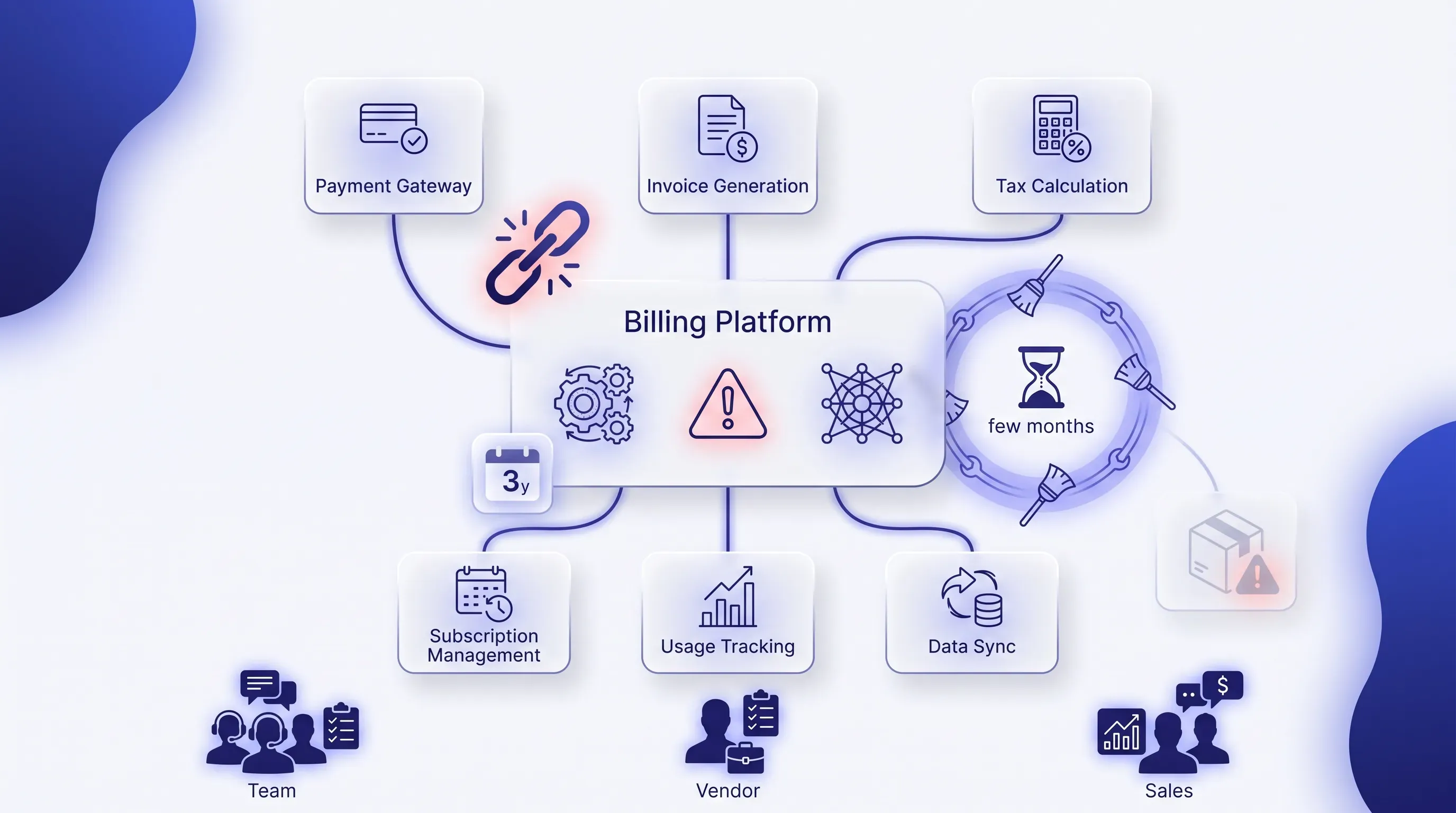
A business-critical billing platform kept its team busy for three years cleaning up modules. Each sprint tidied another corner, and each cleanup bought a few months of relief. Meanwhile, the runtime had passed its vendor's end-of-life date, and the dense dependencies made one change ripple through six services. The data model also couldn't represent the pricing the sales team kept promising.

Maintenance cost climbed every quarter and change lead time stretched from days to weeks. The team was refactoring a foundation that needed replacing, and the scores would have said so. An unsupported stack and a rising maintenance trend form exactly the pattern that supports a planned rebuild or a staged replacement when the architecture cannot absorb change-request pressure. If your team keeps buying temporary relief during legacy software modernization, an evidence-based audit will tell you whether you're repairing or just delaying.
Rebuilding repairable software
A product team approved a full rewrite because the existing code was unpleasant and thinly documented. The architecture was actually viable, and the real pain sat in a handful of isolated hotspots. But nobody ran a diagnosis, so the mess got mistaken for a foundation problem.
Then came the parity work. Forgotten edge cases surfaced during migration, and every integration had to be rebuilt. The hard cutover pushed value out by more than a year. This is the exact trap Joel Spolsky named after Netscape's 1998 rewrite, which he called the "single worst strategic mistake" a software company can make and which cost the company three years. Targeted refactoring would have shipped improvements incrementally, and the embedded business knowledge would have stayed intact.
A few audit questions can challenge a recommendation built on frustration or optimism:
-
What documented evidence says the architecture, not the code, is the problem?
-
Which specific products or integrations does the current foundation actually block?
-
Who understands the undocumented behavior, and are they still here?
-
Can the business absorb a hard cutover, and what happens if it slips a year?
If a proposed rebuild can't answer those, bring in a second opinion before the budget is signed.
Use a hybrid path
When choosing rebuild vs refactor for the full system creates risk you don't need to take, the strangler fig pattern gives you a middle route. Named by Martin Fowler in 2004 after the fig that grows around a host tree until it replaces it, the pattern is now the default recommendation for legacy software modernization of mission-critical systems.
The sequence is straightforward. Pick one painful module and build its replacement behind a stable interface with feature flags. Then route a growing share of traffic to the new component while you monitor it. Keep rollback ready. When the new piece proves itself, retire the old one and move to the next.
This keeps the current system running and lets you keep delivering features while you replace structural constraints one boundary at a time. It's the approach that avoids the "big bang" cutover behind TSB Bank's GBP 330 million loss and the customer lockout that followed its 2018 migration. Incremental legacy software modernization with validation at every step is the pattern that consistently survives.
The strangler fig isn't always the right tool. It struggles when dependencies can't be separated or a shared data store makes partial migration unsafe. It also struggles if the transition overhead of running two systems exceeds the value of the module you're replacing. If you're not sure a capability is separable enough for this route, that's a good question to work through with someone who has run the pattern before.
Turn diagnosis into delivery
The artifact you carry out of this rebuild vs refactor process is a decision record with documented scores and their supporting evidence. It captures the explicit business constraints and a chosen route for each system boundary. It also sets review points where the recommendation can change as you learn more. The assessment comes before any architecture commitment or budget. It also precedes any cutover promise.
Pollume conducts that legacy assessment and folds the resulting rebuild vs refactor decision, or a hybrid strangler route, into a staged delivery plan for each boundary. Book a legacy assessment call with our team to turn your diagnosis into a delivery plan.